The Leibholz brothers
Schubin in Posen, then Berlin, then Auschwitz and Chełmno
Four men of this surname appear in the German Federal Archives' Memorial Book. Three of them were brothers. The fourth was not, and proving that is one of the two corrections this page makes to the family's own tree.
The entries, as the Bundesarchiv has them
Bundesarchiv, Gedenkbuch — Opfer der Verfolgung der Juden unter der nationalsozialistischen Gewaltherrschaft in Deutschland 1933–1945, online edition, read 14 September 2026. Each entry is cited by its stable identifier.
| Name | Born | Birthplace | Living in | Deported | Died | Entry |
|---|---|---|---|---|---|---|
| Jacob Leibholz | 08.08.1884 | Schubin (poln. Szubin)/Posen | Berlin (Schöneberg) | from Berlin 26.02.1943 → Auschwitz, Konzentrations- und Vernichtungslager | not documented | en1100957 |
| Samuel Leibholz | 28.06.1877 | Schubin (poln. Szubin)/Posen | Berlin (Kreuzberg) | → Auschwitz, Konzentrations- und Vernichtungslager | 10.04.1943 — Auschwitz, Vernichtungslager | en909753 |
| Oskar Leibholz | 13.05.1887 | Schubin (poln. Szubin)/Posen | Berlin (Wilmersdorf) | from Berlin 17.03.1943 → Theresienstadt, Ghetto; 16.10.1944 → Auschwitz, Konzentrations- und Vernichtungslager | 16.10.1944 — Auschwitz, Vernichtungslager | en1100894 |
| Georg Leibholz | 07.06.1884 | Hammerstein/Schlochau/Westpreußen | Berlin (Mitte) | from Berlin 01.11.1941 → Litzmannstadt (Lodz), Ghetto; 13.05.1942 → Kulmhof (Chelmno), Vernichtungslager | not documented — Kulmhof (Chelmno), Vernichtungslager | en1100801 |
Why Jacob lasted until February 1943, in one line of a form Documented · 20 September 2026
The 1939 census supplementary card recorded the ancestry of all four of a person’s grandparents. Auguste Leibholz née Luwinski’s card reads “Race”: NNNN — four times nicht-jüdisch. The German state classified Kurt’s mother as not Jewish, on its own form, in 1939. Her basis of persecution is given as collective: the term for someone taken as part of a household rather than for their own recorded ancestry.
That is a Mischehe, a mixed marriage, and it is the ordinary explanation for the thing that has always looked strange about this family — that Jacob, a Jew from Schubin, was still living at Meraner Straße 2 in 1939 and was not seized until 26 February 1943, the day of the Fabrikaktion, when Berlin’s Jews in mixed marriages were finally taken. The category is on the record. The inference from it is not asserted here.
Her card also names her birthplace: Sauerbaum, Kreis Rössel, East Prussia — the same village as Johanna Thimm, Kurt’s great-grandmother, whose surname this archive had already been using as its East Prussian control. The East Prussia page was built on Ermland parish entries; here is the village, from a state document.
Correction one: Jacob did not die in 1945
The family tree records “1945, KZ Auschwitz”. The Memorial Book records his deportation from Berlin to Auschwitz on 26 February 1943, and — carefully — no date of death at all, because the Federal Archives publish one only where it is certain.
He was 58. The 1945 in the tree is a family estimate that hardened into a fact. Correct the year; keep the place. Documented
And the place is now corroborated, 20 September 2026. The Reichssippenamt census card of 17 May 1939 — Bundesarchiv R 1509, through Mapping the Lives — carries Jacob in the family block of his wife’s record as “† before 08.05.1945 in Auschwitz”. The Memorial Book leaves the place blank as well as the date. A second source names it, and it is the place the family always said. The date is still not documented anywhere.
Correction two: Georg was not their brother
The tree makes Georg a fourth son of Sally Leibholz and Friederike Schmul. He cannot be. Jacob was born at Schubin in Posen on 8 August 1884; Georg at Hammerstein in West Prussia on 7 June 1884. Sixty-two days apart, one mother. Both dates come from the Bundesarchiv, independently of the family, and that arithmetic is the whole of the argument.
A Memorial Book search on the surname returns fifty Leibholz entries, and they cluster in two places: Schubin in Posen, and Hammerstein, Karwen and Bärwalde in West Prussia and Pomerania. Those two clusters are not two families. Sally Leibholz — Jacob’s own father — was born at Hammerstein, and the Schubin marriage register says so in as many words: on 24 December 1874 der Kaufmann Sally Leibholz, geboren zu Hammerstein, wohnhaft zu Hammerstein married Friederica Schmul of Schubin. It is one family in the two towns it lived in — the place it came from, and the place it moved to, with a registrar recording the move as it happened. Corrected 20 September 2026
The distance was doing work in the argument that it cannot do. What rules out brotherhood is the sixty-two days, not the two hundred kilometres — and with the geography gone, a Leibholz born at Hammerstein in 1884 is not a stranger sharing a surname but a relative in the ancestral town. That makes cousin the strong reading rather than a different family, which is what the next panel has said all along.
The marriage entry, read 22 September 2026 Documented
Everything below this panel was argued from a family record and the Gedenkbuch. It is now on a document. Standesamt Schubin, marriage akt nr 9 of 24 December 1874, the ninth and last marriage of that year, gives the groom as der Kaufmann Sally Leibholz, jüdischer Religion, sieben u. zwanzig Jahre alt, geboren zu Hammerstein, wohnhaft zu Hammerstein. Twenty-seven on 24 December 1874 puts his birth between 25 December 1846 and 24 December 1847 — a window that contains the 7 July 1847 this archive has always carried for him, and that no surviving register can confirm, because Koszalin answered on 16 September that the Hammerstein books are gone. The marriage entry did what the destroyed birth register would have done. The bride is Friederica Schmul, born and living at Schubin. So the move east is not an inference: it happens at this wedding.
And the entry reaches a generation higher than anything else this archive holds. Sally is Sohn des Kaufmann Jacob Leibholz und der H—— geb. Pollnow — Kurt’s great-great-grandparents, neither of whom existed here in any form before that evening. Her given name is an initial because that is all the page yields; the panel below says how it was tested and what it cost to find out. The grandson born at Schubin ten years later was named Jacob for him. The maiden name was the least certain thing on the page — Kurrent, where P, T and Z confuse — so it was tested against a list of German-Jewish surnames. In the Bundesarchiv Gedenkbuch, POLLNOW returns eight people; TOLLNOW, ZOLLNOW and SOLLNOW return none, with Leibholz at 50 and a nonsense string at zero as controls. Of the four ways that capital could be read, only one is a name anybody bore. That is not proof, but it is no longer a guess.
Archiwum Państwowe w Bydgoszczy, USC Szubin Miasto, sygn. 141, akt małżeństwa nr 9/1874, scan 10, on genealogiawarchiwach.pl. Found because Bydgoszcz answered a letter by pointing at a portal where the registers had been published since 2015.
And the same entry names the bride’s parents, which nobody here had read Documented
The portal’s index for that one scan lists six people, and this archive took four of them. Sally Leibholz, Jacob Leibholz, Philipine Pollnow, Friederica Schmul, Juda Schmul, Jette Machot.
JUDA SCHMUL and JETTE MACHOT are Friederica’s father and mother, and neither name has ever been held here. A Prussian marriage entry names the parents of both parties — something this archive has said about other people’s marriage records repeatedly, and did not apply to the one in its own hands. She was about twenty in November 1874, so born around 1854: her parents are a couple at Szubin in the 1850s, and MACHOT is a surname this archive has never searched anywhere.
And the index said PHILIPINE Pollnow, where this archive had published Wilhelmine. Those are not the same name, and neither a volunteer indexer nor this archive is authoritative over the other. The entry was re-read at the image the same day with both names held in view. Both are wrong — see the panel below.
Bydgoszcz answered all three questions, and the smallest one paid best 25 September 2026
One page, three paragraphs, over the signature of the Director Karolina Kawczyńska, case officer dr Małgorzata Urbanowska-Chyła.
The Jewish registers of Szubin survive — and only for 1820 to 1847. “Archiwum Państwowe w Bydgoszczy … przechowuje Akta metrykalne żydowskiej gminy wyznaniowej w Szubinie jedynie z lat 1820-1847.” That span is exactly wrong for the woman it was asked about: Friederica Schmul was born about 1852 and is not in them. It is exactly right for somebody else. Abraham Schmul was born at Szubin in 1846 — inside the span by a single year — and his birth entry would name his parents in a registrar’s hand instead of a volunteer’s transcription. That is the document that decides whether he is her brother.
The death indexes survive for 1874–1878 and 1894–1924, and for nothing else. The word is wyłącznie — exclusively — so 1879 to 1893 is a stated gap, not an omission. They attached the 1894–1908 volume, which is the one read above.
And then the paragraph nobody asked for
The 22 September letter ended with a small favour: the printed form at akt nr 9/1874 reads Tochter der…, and this archive could not read the words after it. She read them.
… interesujący Pana zapis może dotyczyć zawodu ojca panny młodej. Niestety jest trudno czytelny, być może jest to Gastwirt w starszej pisowni przez th: Gastwirth Juda i Jutta z domu Machol Schmul jego żona. — Archiwum Państwowe w Bydgoszczy, IU.631.434.2026
Friederica’s father has an occupation: he kept an inn. Gastwirth, the older spelling of Gastwirt with a th, which is why it looks wrong to a modern eye. This archive had bracketed the same word as [Gastwirth] from the image earlier the same day, before the letter was opened — two readers on one word, one of them professional and holding the original.
But she reads the mother differently from everyone else. She gives Jutta, née Machol. The portal’s volunteer index gives Jette Machot. Abraham Schmul’s indexed card gives Jette née Muschll. Three readings of one woman, and Machol against Machot is one terminal letter in a Kurrent hand — exactly the class of confusion that took a week to settle over Pollnow. She is not automatically right: she calls the line trudno czytelny and hedges the occupation with być może. She is, however, the only one of the three with the book in front of her. The name stays as published and is flagged.
And a mistake, which is this archive’s. The reply arrived on 25 September as two e-mails: a covering note with this letter attached, and a separate folder share carrying the index. The folder was opened and the attachment was not, and a letter then went back asking whether a death index survives for 1874–1893 — when this page already said 1874–1878 does and 1879–1893 does not. That is the third time in a week this archive has read the new artefact and not the context around it; twice before it was an e-mail body ignored because a PDF was opened, and here it is the PDF ignored because a folder was shinier. The rule does not care which half is which.
Bydgoszcz sent the index this archive had published as non-existent 25 September 2026
A letter went to the Archiwum Państwowe w Bydgoszczy on 22 September asking about the pre-1874 Jewish community books of Szubin. The answer came back with something nobody asked for. Sandra Dończyk shared a folder; inside it, uploaded by the case officer Małgorzata Urbanowska-Chyła, was a 103-scan volume:
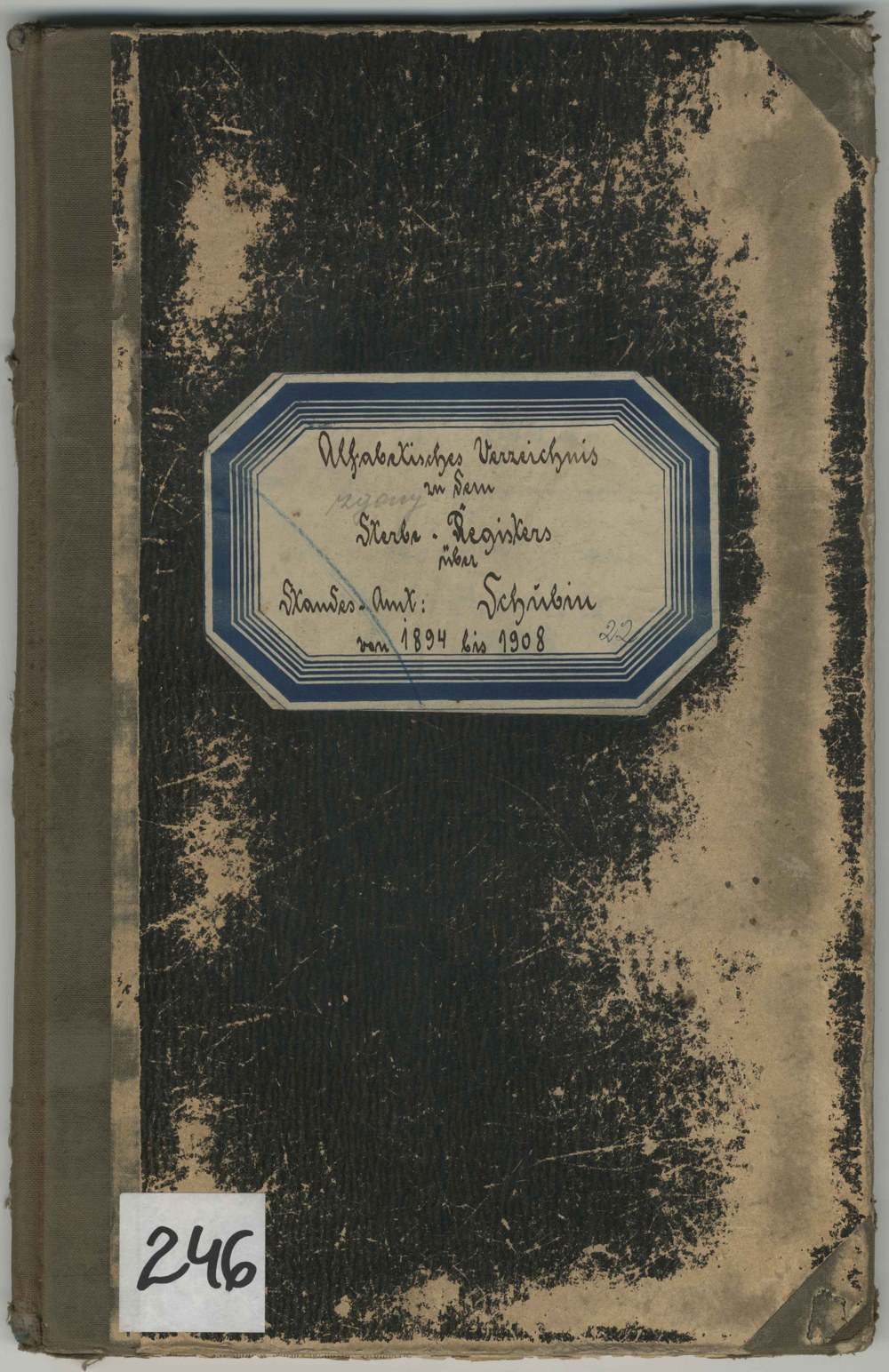
This archive had published that it does not exist. The reasoning was careful and it is worth repeating because it was sound: filtering the portal to skorowidze zgonów returns zero, while the identical query on akta zgonów returns 190 units — so the zero is a real absence and not a broken filter. From that, the file concluded that “deaths at Szubin have no name index and must be paged”, and row 264 costed Sally Leibholz’s death at 190 blind volumes and recommended trying Berlin first.
A catalogue is not an archive. The zero was a fact about a website, and it was turned into a fact about a building.
The portal shows what has been digitised. The archive holds what it holds, and the only instrument that reads the difference is a letter to an archivist. With this volume the Szubin question is four pages, not 190 units.
And the four pages say no
The book is not alphabetical in the way the word suggests: within each letter the entries run by year — a heading 1895., that year’s deaths under that letter numbered from one, then 1896., and so on. You cannot skim it for a surname. You read the whole letter, which is the slot method arriving as a physical object.
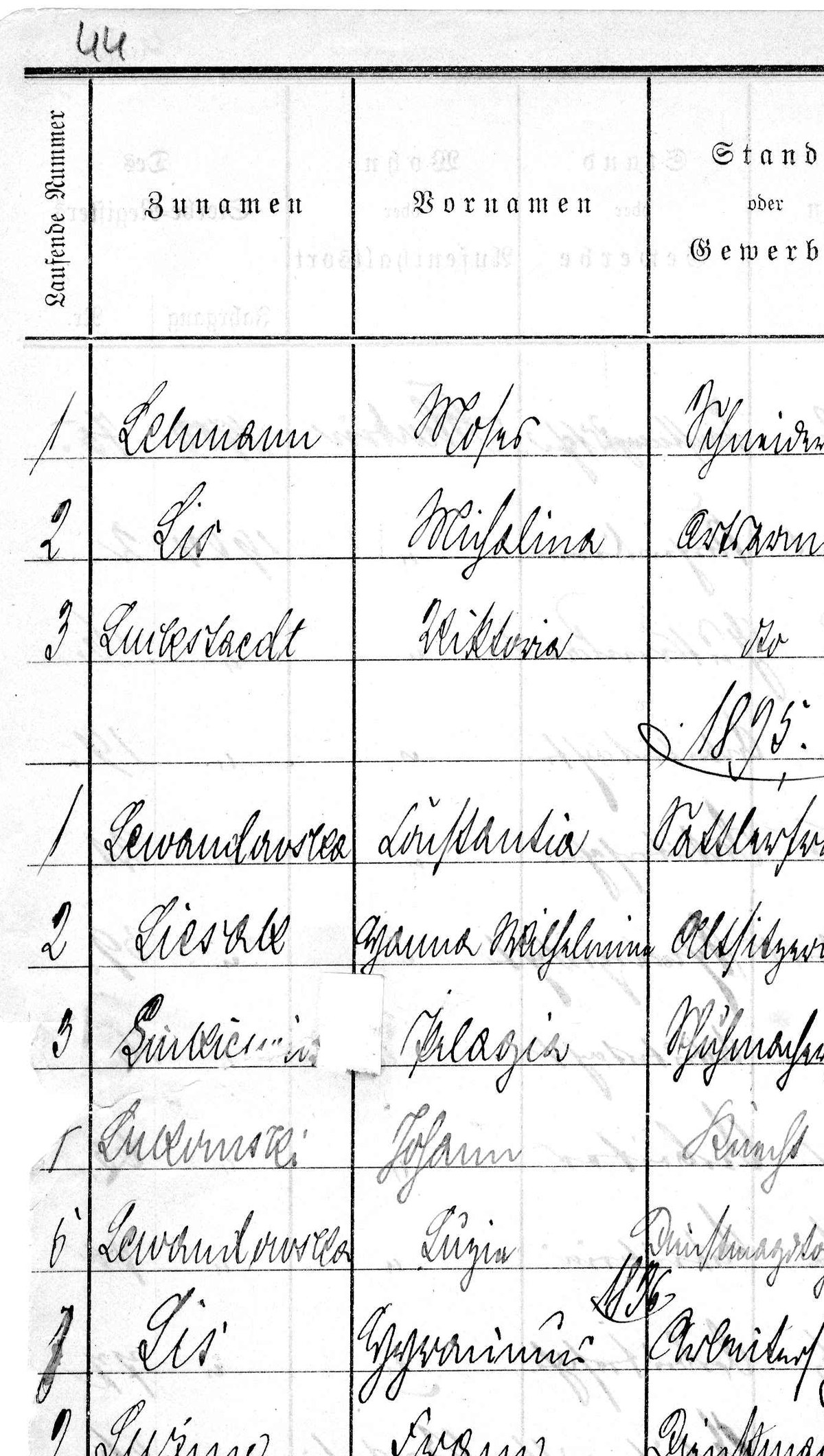
Lehmann, Lis, Luckstaedt, Lewandowska, Liesske, Lurkiewicz, Luckowski, Lesner, Luczny, Leonski, Lawnicki, Lauge, Lawrenz, Lesniewski, Lukowska, Lüttke, Luchowska, Lichy, Ludes, Lukomski, Loewe, Langer, Loeffler, Lölke, Leu, Lahren, Leiser, Lorusch, Łowiński, Loferski, Lange. There is no Leibholz in it.
And the slot carries its own control, which is worth more than the negative. The very first entry is Lehmann, Moses, and 1909 opens with Leiser, Adolf; elsewhere in the volume sit Samuel, Silberberg, Salzbrunn and Schobelt. A Jewish death at Schubin after 1874 went into the civil register like anyone else’s, and this index lists them. So the missing Leibholz is missing because he is not there, not because the book would have passed him over.
What this does not cover, stated before anyone asks. The volume begins in 1894. Sally Leibholz was alive at Schubin in August 1884, registering his son’s birth in person, and was born in 1847 — so a death between 1884 and 1893 is entirely outside this book, and for a man who would have been only 46 in 1894 that is arguably the likelier window. It is also one registry office of three: Szubin also had Wieś I and Wieś II, and this volume says nothing about either. Row 264 is narrowed, not closed. The next letter should ask whether an equivalent index survives for 1874–1893.
The bride’s family was read in the same sitting. The S and Sch slots run scans 80 to 88 and hold no Schmul — so Juda Schmul, Jette Machot and Friederica herself did not die at Szubin town between 1894 and 1911 either. The nearest thing is Schimmel, Julius, Altsitzer, 1895, checked at magnification because a reduced image made it look like the name.
Berlin was tried first, as the row asked, and it is empty New, 11 October 2026
Row 264’s instruction was “try Berlin first”: Kurt was born there in 1912, the household is at Chodowieckistraße in 1913, Jacob married there in 1924 — so if Sally followed his sons to Berlin, his death is a Berlin death and the directory would place him. There is no Sally Leibholz in any Berlin directory from 1903 to 1920.
Eighteen years of the Leibholz run, in volumes that print full forenames rather than initials: Adolf, Albert, Arthur, Cäsar, Curt, Else, Felix, Franz, Georg, Ida, Julie, Julius, Leo, Louis, Max, Nathan, Oscar, Paul, Siegfried, Th., William. Not one Sally and not one Salomon. The 1916 run was read at the page image and agrees with its text layer entry for entry, which is what licenses the other six years.
Stated narrowly, because that is all it is worth. A man who is not a householder is not in a directory. Sally was 56 in 1903 and 73 in 1920, and a man of that age living with a son, in an institution or as a lodger would not be printed. This is not proof that he never came to Berlin. It is the only cheap instrument for placing him there, run across eighteen years, returning nothing — so the row’s preference for Berlin over Szubin no longer has anything behind it, and a death at Schubin before his sons left remains the simplest explanation of every negative this archive holds.
And the instrument had a hole in it that nobody had noticed for three weeks. The ZLB record this archive has queried throughout, PI 34115495, is the Berliner Adreßbuch for 1903 to 1943 and nothing earlier — 1902 and before return zero pages and zero Schmidt, so it is the record and not the surname. The earlier volumes are a different record, PI 34115512, 1873 to 1896, now tested year by year with controls. And 1897 to 1902 are digitised under neither: a six-year hole, and any Berlin directory question inside it is unanswerable at ZLB. A note in this archive had said “1799 to 1970” since September. The pre-1900 volumes also print forename initials only — “A., Beamter”, “O., Lederhändler” — and a single letter is the worst-OCR’d thing on a Fraktur page, so they cannot be asked a forename question at all.
Three things came off the 1916 page on the way. Samuel’s hat business is “S., Hüte, SW 19, Jerusalemer Str. 5. 6” in 1916 — seventeen years earlier than this archive’s first record of it. William owned Kurfürstendamm 169 and 170, the E. being Eigentümer, where the archive held only 169. And there is a second Leibholz household in Chodowieckistraße — “Else, geb. Kabelitz, Lageristin, NO 55, Chodowieckistr. 8” — twenty-three doors from Georg at number 31. Nothing joins them but a surname and a street.
The name read against the clerk’s own hand — and both published readings fall 27 September 2026
Wilhelmine or Philipine was never going to be settled by preferring a source. It was settled by asking what this registrar’s letters look like when you already know what he meant, and there were two answers sitting on his own page.
![A line of Kurrent handwriting from the 1874 Schubin marriage register, reading: -holz und der [name] geb. Pollnow](/pollnow-1874-marriage.jpg)
His P is a single round bowl. The disputed capital has no bowl at all — it is two steep straight diagonals. A capital cannot be both in one hand on one line, so Philipine is out, and it is out on the strongest control there is.
| The clerk’s certain letters | The disputed capital |
|---|---|
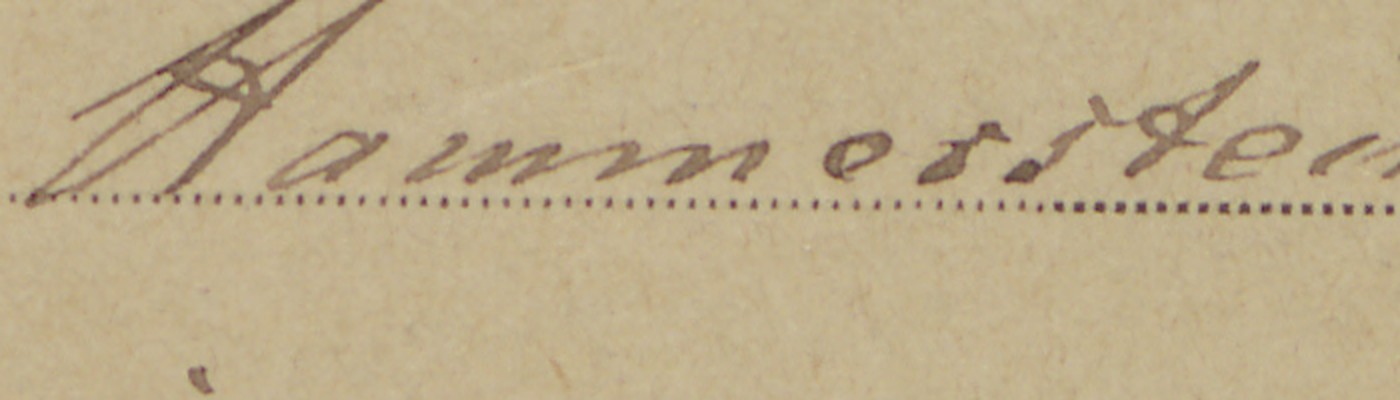 H, from Hammerstein — written twice on this page as the groom’s birthplace and residence, so the reading is certain. | 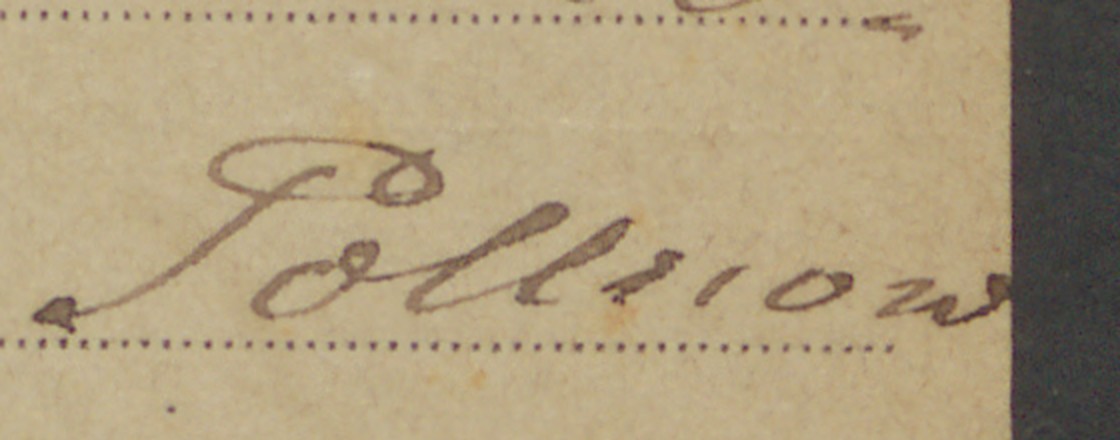 P, from Pollnow — four words along the same line as the name in question. |
The H has three features: a long flat lead-in along the baseline, two steep parallel diagonals, and a low crossbar joining them. The disputed capital has all three. It is his H. So the name is neither Wilhelmine nor Philipine, and what this archive can publish is an initial:
Sohn des Kaufmann Jacob Leibholz und der H—— geb. Pollnow
The rest of the word is x-height minims at the limit of the scan. Henriette is the name that would occur to anyone reading a Jewish Prussian register of 1874, and that is exactly why it is not being written down. The layer is unreadable; that is the finding.
And the W control has since been found, one page away. When this was first written the weakness was stated plainly: Kurrent W and H are genuinely alike, both built from two tall strokes, and there was no W anywhere in this clerk’s hand on either page of the spread — so W was excluded on the positive match to his H rather than on a W exemplar. The exemplar was on the previous scan. Akt nr 8 of the same volume, in the same hand, marries Heinrich Gustav Julius Wengatz, and the archive already knew that: it is the near-miss the reader landed on while hunting for this entry.
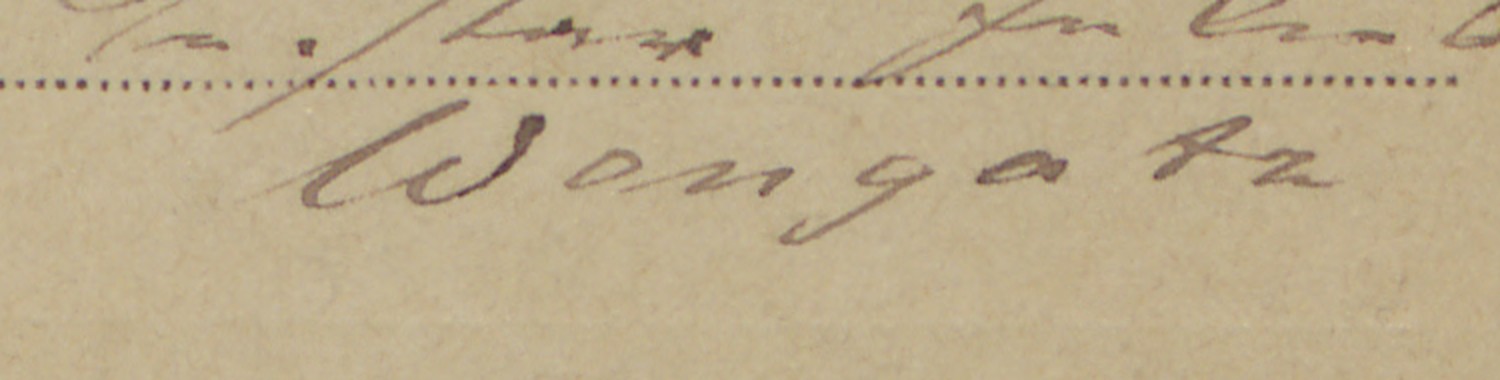
His W is two rounded, looping arches. It has no straight strokes and no crossbar. The disputed capital is two steep straight diagonals joined low down. They are not the same letter and they are not close. The reading no longer rests on an absence — it is the positive H match and a genuine W to fail against, and the name is not Wilhelmine.
And the reasoning that got this wrong is worth naming. An earlier pass this same week read the word as Philipine and justified it by saying a W “has no ascender loop”. That is false, and worse, it was a claim about the alphabet in general when an exemplar was sitting four words away. The rule earned here: when the question is which letter this is, do not reason about letterforms — find the same clerk writing the letter somewhere you already know the answer.
Re-read at the image through the portal’s Loris IIIF endpoint, which serves arbitrary regions at up to twice native resolution; the viewer’s own canvas is tainted and cannot be copied, the tile server can. Native page 3991 × 5870. Nothing downloaded from the viewer, nothing purchased, no account created.
And the same re-read moved the wedding by a month Corrected 27 September 2026
This archive published 24 November 1874 on 22 September and wrote that it was “the date the family record has always given, now standing on the register itself”. It does not stand on the register. The entry opens Schubin am 24 vier und zwanzigsten December tausend acht hundert siebenzig und vier. The day is written twice, as a numeral and spelled out, and both give the 24th. The month is written once, and it is December: a single large looped capital D, where this same clerk’s N — like his H and M on this page — is built from two tall strokes.
Everything around it agrees with December, and never agreed with November. Prussian civil registration began on 1 October 1874, so this volume covers three months and holds nine marriages; akt nr 9 is the last wedding of the year, and late December is where the last wedding of the year belongs. The archive was already holding the contradiction. Its own note on the near-miss records that akt nr 7 is dated 24 November 1874 — “the right date and the wrong people”. Two entries cannot both be the 24 November it was hunting.
Which is how the wrong date got published. The reader went to the document already knowing the answer, was shown a genuine 24 November on the way in, and then read the right entry with the date already confirmed in mind. A document was used to certify a date the reader brought to it. The family record remains the only source for 24 November, and it is now contradicted by the register it was supposed to have been confirmed by.
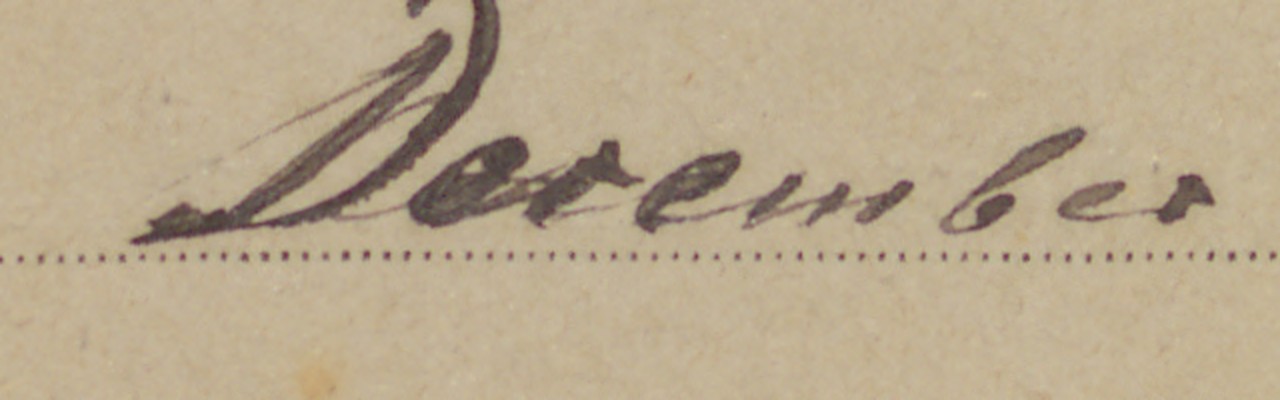
That is a second, independent control on the month, and it puts the whole volume in order. Akt nr 7 is 24 November, akt nr 8 is December, akt nr 9 is 24 December — nine marriages running from the day the registry office opened to the end of the year, in sequence. The November reading had akt nr 7 and akt nr 9 sharing a date with akt nr 8 stranded between them.
What survives: sieben u. zwanzig Jahre alt is confirmed at the image. Twenty-seven on 24 December 1874 puts Sally’s birth between 25 December 1846 and 24 December 1847, and the family’s 7 July 1847 sits inside that window — so the month change does not disturb his birth year, and the marriage entry still does the work the destroyed Hammerstein register cannot.
A candidate brother for Friederica Inferred
The only other Schmul scan indexed at Szubin gives a person: ABRAHAM SCHMUL, born Szubin 1846, died Koronowo 1904, father Juliusz, mother Jette née Muschll.
Born in the same small town eight years before Friederica, in exactly her generation — and his mother is a Jette, which is the forename the 1874 index gives Friederica’s mother. Muschll and Machot are close enough in a Kurrent hand to be one name read twice. Against it: his father is Juliusz and hers is Juda — different names, though both are the kind an indexer renders freely, since Juda, Judas, Julius and Juliusz sit on one another in these registers.
What would settle it is his birth entry of 1846 and hers of about 1854, in a registrar’s hand rather than an indexer’s. Both predate Prussian civil registration, which began on 1 October 1874 — so they are Jewish congregational registers, and they are the very books the outstanding letter to Bydgoszcz asks about. If he is her brother, the family did not stay put: Koronowo is forty kilometres north.
A likelier reading Inferred
Sally Leibholz was himself born at Hammerstein — now documented, see the panel above — on 7 July 1847, and married at Szubin on 24 December 1874. So the family had people in both towns. The cleanest explanation is that Georg belonged to the Hammerstein branch Sally came from — a nephew or a cousin of Jacob's, not a brother. That keeps every documented date intact and only moves one line on the chart.
Status of Georg in this archive: Disputed — right surname, right family, wrong generation, pending a Schubin or Hammerstein register.
The question has been put to the two archives that can answer it 15 September 2026
Both towns are now in Poland, and both civil registries began in 1874 — so a birth entry from 1884 names both parents outright, which is precisely what settles whether Georg was Jacob's brother or his cousin.
| Archive | Asked about |
|---|---|
| Archiwum Państwowe w Bydgoszczy | Standesamt Schubin 1884 — the birth of Jacob Leibholz, 8 August 1884 |
| Archiwum Państwowe w Koszalinie | Standesamt Hammerstein 1884 — the birth of Georg Leibholz, 7 June 1884 — and any Jewish community register for Sally Leibholz, born there 7 July 1847 |
Written in Polish, each with an English summary, and each told what the other has been asked. Both set out the arithmetic plainly: two children of one mother cannot be born two months apart in two provinces. If both entries survive, the parents' names decide it in a single line.
A note on method, since it nearly cost a bounce. The Polish state archives do not use the
ap.gov.pl domain that most references give — the live one is
archiwa.gov.pl. Checked before sending, as everything now is.
Three documents from Berlin, and a letter worth more than two of them
On 29 September 2026 the Landesarchiv Berlin answered this archive’s enquiry. Arabella Oberle, im Auftrag, sent three scans, summarised each before this archive had read it, explained in detail what she could not do and why, taught the method for doing it without her — and wrote at the foot: “Diese Antwort ist für Sie kostenlos.” This answer is free of charge.
The scans are reproduced in full below, each with a line-by-line transcription of the German and an English translation beside it, so that nobody has to take this archive’s word for what the pages say.
The marriage, 5 January 1924 — the entry itself, nine days after the index found it
On 20 September this archive found the marriage in an index — two lines in a Namensverzeichnis, giving a number and two religions. This is the register. Standesamt Schöneberg II, Heiratsregister 1924, Nr. 6, P Rep. 161 Nr. 171 — and note that the index this archive had been citing is Nr. 271, a different volume. Index and register were never the same shelfmark.
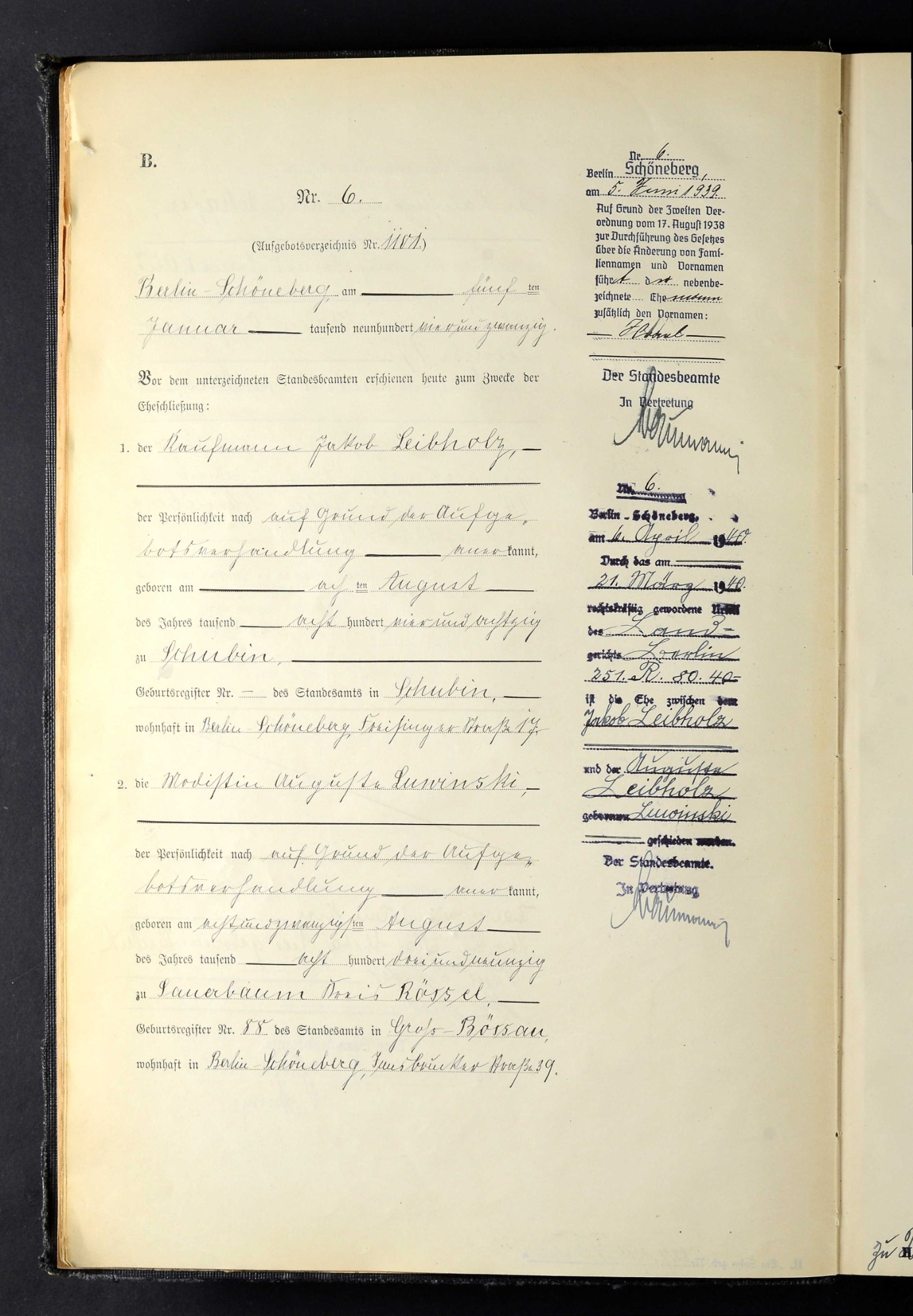
What the entry says
Nr. 6. (Aufgebotsverzeichnis Nr. 11[..])
Berlin-Schöneberg am fünften Januar tausend neunhundert vier und zwanzig.
Vor dem unterzeichneten Standesbeamten erschienen heute zum Zwecke der Eheschließung:
1. der Kaufmann Jakob Leibholz, der Persönlichkeit nach auf Grund der Aufgebotsverhandlung anerkannt, geboren am achten August des Jahres tausend acht hundert vier und achtzig zu Schubin, Geburtsregister Nr. — des Standesamts in Schubin, wohnhaft in Berlin-Schöneberg, Freisinger Straße 19
2. die Modistin Auguste Luwinski, der Persönlichkeit nach auf Grund der Aufgebotsverhandlung anerkannt, geboren am acht und zwanzigsten August des Jahres tausend acht hundert drei und neunzig zu Sauerbaum Kreis Rössel, Geburtsregister Nr. 88 des Standesamts in Groß-Bössau, wohnhaft in Berlin-Schöneberg, Innsbrucker Straße 39.
In English
No. 6. (Banns register no. 11[..])
Berlin-Schöneberg, on the fifth of January one thousand nine hundred and twenty-four.
Before the undersigned registrar there appeared today for the purpose of marriage:
1. the merchant Jakob Leibholz, his identity accepted on the strength of the banns proceedings, born on the eighth of August in the year one thousand eight hundred and eighty-four at Schubin, birth register no. — of the registry office at Schubin, resident at Berlin-Schöneberg, Freisinger Straße 19
2. the milliner Auguste Luwinski, her identity accepted on the strength of the banns proceedings, born on the twenty-eighth of August in the year one thousand eight hundred and ninety-three at Sauerbaum, district of Rössel, birth register no. 88 of the registry office at Groß-Bössau, resident at Berlin-Schöneberg, Innsbrucker Straße 39.
The single most useful line on the page 29 September
Geburtsregister Nr. 88 des Standesamts in Groß-Bössau. This archive has swept the Ermland for Luwinskis for weeks with nothing to go on but a village name. Auguste’s birth entry now has a number and an office. A German birth entry names the parents — so Joachim Luwinski and Johanna née Thimm, two of the four names this archive has never seen on a document, sit in a register it did not previously know to ask for.
A house number the clerk settled himself Method
The groom’s house number is a single glyph and it was not obvious — 14, 17 and 19 were all live. It is settled by the same clerk’s own hand on his own page. His 4, in “46 Jahre alt” for the first witness, is angular, open-topped, and sits on the baseline with no descender. His 9, in “Innsbrucker Straße 39” three lines below, has a closed round bowl and a descender. The disputed glyph has the bowl and the descender. It is a 9.
Not reasoned from the alphabet. Matched against the same man writing the same figure where the answer was already known — which is the rule this archive adopted after getting a capital letter wrong on the 1874 Schubin entry, and the first time it has been applied to a numeral.
And the three Schöneberg addresses now in hand — Freisinger Straße for him, Innsbrucker Straße for her, Meraner Straße for the household in the 1939 census — are all in the Bayerisches Viertel. They were living a few streets apart in the same corner of Schöneberg fifteen years before the census put them under one roof in it.
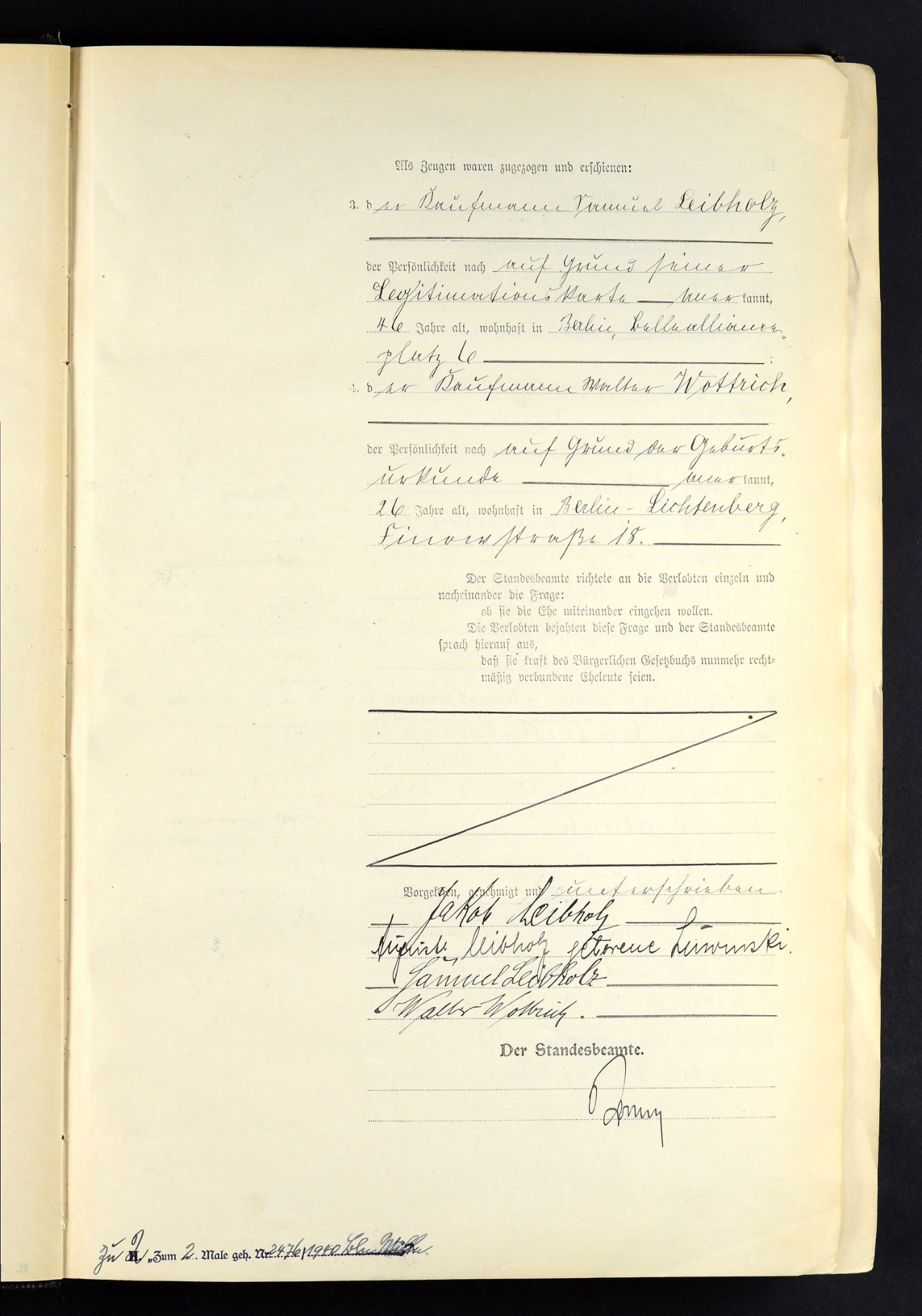
What the second sheet says
Als Zeugen waren zugezogen und erschienen:
3. der Kaufmann Samuel Leibholz, der Persönlichkeit nach auf Grund seiner Legitimationskarte anerkannt, 46 Jahre alt, wohnhaft in Berlin, Belleallianceplatz 6;
4. der Kaufmann Walter Wottrich, der Persönlichkeit nach auf Grund der Geburtsurkunde anerkannt, 26 Jahre alt, wohnhaft in Berlin-Lichtenberg, Simonstraße 18.
Der Standesbeamte richtete an die Verlobten einzeln und nacheinander die Frage: ob sie die Ehe miteinander eingehen wollen. Die Verlobten bejahten diese Frage und der Standesbeamte sprach hierauf aus, daß sie kraft des Bürgerlichen Gesetzbuchs nunmehr rechtmäßig verbundene Eheleute seien.
Vorgelesen, genehmigt und unterschrieben: Jakob Leibholz · Auguste Leibholz geborene Luwinski · Samuel Leibholz · Walter Wottrich
Zu 1. „Zum 2. Male geh. Nr. 2476/1940 [office blotted]
In English
Called and appearing as witnesses:
3. the merchant Samuel Leibholz, his identity accepted on the strength of his identity card, 46 years old, resident at Berlin, Belle-Alliance-Platz 6;
4. the merchant Walter Wottrich, his identity accepted on the strength of his birth certificate, 26 years old, resident at Berlin-Lichtenberg, Simonstraße 18.
The registrar put to the betrothed, individually and one after the other, the question whether they wished to enter into marriage with one another. The betrothed answered this question in the affirmative, and the registrar thereupon pronounced that they were now, by force of the Civil Code, lawfully joined as husband and wife.
Read aloud, approved and signed: Jakob Leibholz · Auguste Leibholz née Luwinski · Samuel Leibholz · Walter Wottrich
Note to party 1: “married for the 2nd time, no. 2476/1940” [office blotted]
The first document that puts Samuel beside Jacob 29 September
This archive has followed Samuel Leibholz for weeks through directories and telephone books — the wholesale hat business, the move from SW19 to SW68, the forename replaced by the imposed one in the 1940 volume — and has always called him Jacob’s brother on the strength of a shared surname and a shared Schubin. Here he is, standing at Jacob’s wedding.
Forty-six in January 1924 puts his birth in 1877 or 1878, which is what this archive already carried. A witness need not be a brother, and this does not prove that he was one. It is the first time the two men appear on one piece of paper. Belle-Alliance-Platz 6 — today Mehringplatz, in Kreuzberg — is also five years earlier than any address the archive held for him.
Walter Wottrich, twenty-six, of Berlin-Lichtenberg, is a name entirely new here. He was identified by his birth certificate rather than by an identity card, which is what a young man without papers of standing would have produced.
The margins, added fifteen and sixteen years later
Berlin-Schöneberg, am 5. Juni 1939
Auf Grund der Zweiten Verordnung vom 17. August 1938 zur Durchführung des Gesetzes über die Änderung von Familiennamen und Vornamen führt der nebenbezeichnete Ehemann zusätzlich den Vornamen: Israel
Berlin-Schöneberg, am 4. April 1940
Durch das am 21. März 1940 rechtskräftig gewordene Urteil des Landgerichts Berlin 251. R. 80. 40 ist die Ehe zwischen dem Jakob Leibholz und der Auguste Leibholz geborene Luwinski geschieden worden.
Berlin-Schöneberg, 5 June 1939
Pursuant to the Second Decree of 17 August 1938 for the implementation of the Act on the alteration of family names and given names, the husband named alongside additionally bears the forename: Israel
Berlin-Schöneberg, 4 April 1940
By the judgment of the Regional Court of Berlin, 251. R. 80. 40, which became final on 21 March 1940, the marriage between Jakob Leibholz and Auguste Leibholz née Luwinski has been dissolved by divorce.
The first is the law reaching back fifteen years into a closed register to add a name to a man’s wedding. The second ends the marriage.
A question this archive refused to guess, and the answer it refused to invent Documented
The 1940 Berliner Adressbuch carries “Leibholz Auguste, Witwe, Schöneberg, Badensche Str 9” — a widow, three years before Jacob was deported. This archive set out three possibilities and picked none of them: an error in the directory, a different Auguste Leibholz, or something that happened to the marriage before 1940 that it did not know about.
The third is now documented. The marriage ended by judgment on 21 March 1940, and Jacob lived until 1943. The two statements no longer contradict each other.
And it is still not solved, which is a different sentence. A divorced woman is not a widow: Witwe remains wrong on its own terms. The 1940 volume was compiled from returns gathered before the decree became final, so “she was divorced, hence the directory said widow” does not work either. What has gone is the contradiction that made the identification impossible. What has not gone is the word.
Two consequences that do follow. Auguste died at Kraichtal in 1975 as Auguste Fricke, and that marriage has never been found; it now has a floor, and cannot be earlier than 21 March 1940. And the foot of the second sheet says Jakob himself married a second time in 1940, entry no. 2476 of that year.
Two predictions this archive made in advance, and it got one wrong Tested
On 20 September, with only the index in hand, this archive wrote down what the entry would contain. The first prediction is simply wrong. It said the entry would name both sets of parents — Joachim Luwinski and Johanna née Thimm, Sally Leibholz and Friederike née Schmul, “four names this archive believes it knows and has never seen confirmed on one document”.
It names no parents at all. The Prussian marriage entry of the 1920s cites each party’s birth register instead of naming their parents. The four names are still unconfirmed on one document.
That is the second time in one day that a row here was planned around a field which the form revision in question does not have — the other was a British passenger list, in a different century and a different country’s record system. A form is not a record series, and what a document contains is a question to be checked before a row is built on it.
The second prediction produced a negative, which is also an answer. The same note said that if Kurt Luwinski — born 11 May 1912, and twelve years old at this wedding — had been legitimised by his mother’s marriage, the note would be in the margin of this entry. There is no such note. The margin carries the name decree and the divorce and nothing else. Kurt was not legitimised by this marriage, which is consistent with everything else about him: he carried Luwinski out of Germany in 1933 and to his death in Johannesburg in 1968.
Gertrud, 27 February 1943, a quarter to nine in the morning
Gertrud Leibholz née Leibke was the wife of Oskar, Jacob’s brother. This archive knew her from the other end: the AJDC card for Oskar gives his last address as Berlin W 50, Marburgerstr. 13 and names “Ehefrau: (Sa) Gertrud geb. Leibke 13.7.94 Berlin”. The register matches it to the house number and to the day.
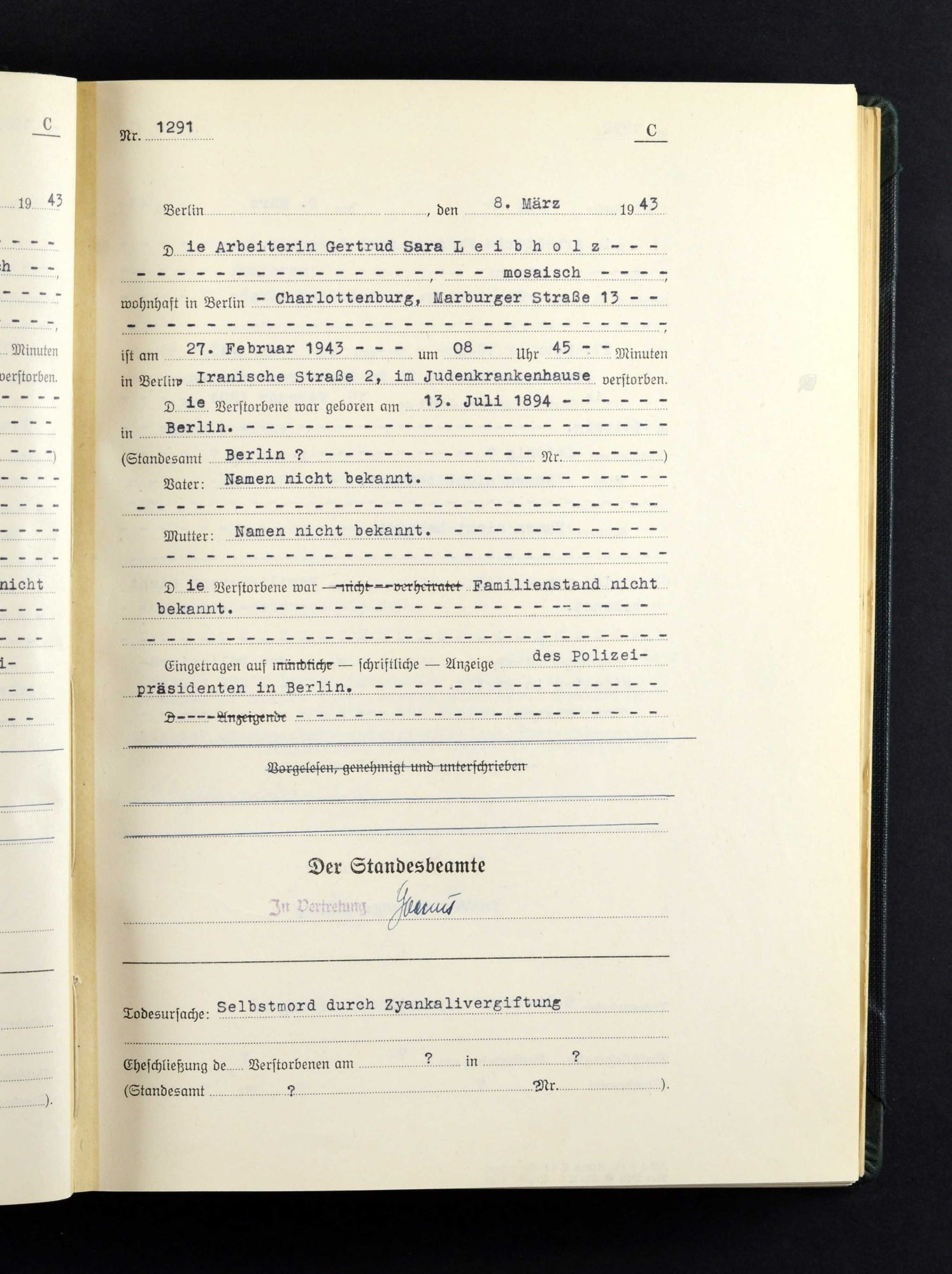
What the entry says
Nr. 1291. Berlin, den 8. März 1943
Die Arbeiterin Gertrud Sara Leibholz, mosaisch, wohnhaft in Berlin-Charlottenburg, Marburger Straße 13,
ist am 27. Februar 1943 um 08 Uhr 45 Minuten in Berlin, Iranische Straße 2, im Judenkrankenhause, verstorben.
Die Verstorbene war geboren am 13. Juli 1894 in Berlin. (Standesamt Berlin ? Nr. —)
Vater: Namen nicht bekannt.
Mutter: Namen nicht bekannt.
Die Verstorbene war [nicht verheiratet — struck out] Familienstand nicht bekannt.
Eingetragen auf [mündliche — struck out] schriftliche Anzeige des Polizeipräsidenten in Berlin.
Der Standesbeamte, In Vertretung [signature]
Todesursache: Selbstmord durch Zyankalivergiftung
Eheschließung der Verstorbenen am ? in ? (Standesamt ? Nr. ?)
In English
No. 1291. Berlin, 8 March 1943
The woman labourer Gertrud Sara Leibholz, of the Jewish faith, resident at Berlin-Charlottenburg, Marburger Straße 13,
died on 27 February 1943 at 08 hours 45 minutes in Berlin, Iranische Straße 2, in the Jewish Hospital.
The deceased was born on 13 July 1894 in Berlin. (Registry office Berlin ? No. —)
Father: name not known.
Mother: name not known.
The deceased was [not married — struck out] marital status not known.
Entered upon the [oral — struck out] written notification of the President of Police in Berlin.
The Registrar, by deputy [signature]
Cause of death: suicide by cyanide poisoning
Marriage of the deceased on ? at ? (Registry office ? No. ?)
The blanks are the document Documented
Father: name not known. Mother: name not known. The words nicht verheiratet are struck out and replaced with marital status not known. The marriage line at the foot has a question mark in every field. The state that had registered her as a Jew, renamed her and put her to labour recorded that it did not know whether she was married. She was: to Oskar, who was alive in Berlin that morning and was deported eighteen days later.
“Sara” is not a name she was given. It is the compulsory forename imposed on Jewish women by the Second Decree of 17 August 1938 — the same law that put Israel in the margin of her brother-in-law’s marriage entry, scanned in the same email. “Arbeiterin” is not a trade she chose: a Jewish woman of forty-eight described as a labourer in Berlin in February 1943 was in forced labour. Both words are the state’s.
The archivist notes that police involvement is unremarkable for an unnatural death, and that is right. The consequence stands anyway: the death was reported by the police president because there was no one left to report it.
The date, stated as context and not as cause Read carefully
27 February 1943 is the Fabrikaktion — the day the Gestapo seized Jewish forced labourers from their workplaces across Berlin. She was a labourer, and she died at a quarter to nine that morning.
The register says what she did. It does not say why, and nor will this archive. The coincidence of day is written down because it is a fact about the date, and because leaving it out would be its own kind of claim.
The week around it: 26 February, Jacob deported from Berlin. 27 February, 08:45, Gertrud dies. 8 March, the death registered. 17 March, Oskar deported to Theresienstadt on the fourth great transport of the elderly. 1944, Oskar dies there.
One small correction the entry makes: the Gedenkbuch gives her residence as Wilmersdorf and the register says Charlottenburg. Both are right about different years — the census of 17 May 1939 has Oskar and Gertrud at Waghäuseler Straße 9/10, which is Wilmersdorf. A move, not a contradiction.
What the letter gave that the scans did not Next
The Sammelakte exists, and the 1923 banns papers are in it. “In der zum Heiratsregister angelegten Sammelakte befinden sich keine Unterlagen zur Ehescheidung, es sind nur die Aufgebotsunterlagen aus dem Jahre 1923 vorhanden.”
A German banns file of 1923 normally contains the birth certificates of both parties — and a birth certificate names the parents. The four names the marriage entry failed to give may be sitting in a box in Berlin. It is not digitised, so there is no scan; copies can be ordered for a fee.
That is a purchase, and it is David’s to make. Drafted, not ordered. And a clean negative to save anyone the trouble: the Sammelakte holds no divorce papers. The judgment is Landgericht Berlin 251. R. 80. 40 and it lives, if it lives, in a court series.
She asked for the one thing this archive has had for nine days Our failure, not hers
“Leider reichen die von Ihnen gemachten Angaben nicht aus.” The 1912 birth registers are not digitised, and to search the analogue registers the Landesarchiv needs a full name, a date, and the responsible Standesamt — “die bloße Angabe Berlin reicht nicht”. The letter she was answering, sent on 14 September, gave her a name, a date and the word Berlin.
This archive established the office on 20 September, and the entry number with it. Standesamt Berlin VIII, Geburtsregister 1912, Nr. 963 — LUWINSKI · KURT MYSZISLAUS · 963, from the May block of the L section of the name index, P Rep. 523 Nr. 1395. Schöneberg was excluded by reading its whole 1912 L section; Chodowieckistraße 32 put the household in Prenzlauer Berg; and the Berliner Adressbuch’s own street index, whose first column is headed Standesamt, gives houses 23–32 as office 8.
A reply supplying exactly that has been sitting in a drafts folder since 20 September. It was written, it names the register and the number and the finding-aid page it came from, and it was never sent. An attempt to send it directly was refused by this session’s permission mode — which was the right outcome, and this archive did not work around it. What went wrong is that nobody was told it was waiting.
So the gap in her answer is not a gap in the record and it is not a gap in her work. An archivist spent an unpaid morning explaining how to find something this archive already knew, because the sentence that would have saved her was nine days old and unsent. The instruction she gave is still worth having — the indexes are digitised even where the registers are not, and her system cannot display umlauts, so an office whose name carries one must be searched on the stem alone. Both facts are recorded for the next person. Neither should have been necessary.
What the dates do when you lay them side by side
Georg went first: Berlin to the Łódź ghetto on 1 November 1941, then to Chełmno on 13 May 1942. His daughter Elli, born in Berlin on 7 November 1915 and working as a secretary, is recorded in the family's tree as dying “after 13 May 1942” — which is his transport date exactly. She went with him.
Then the Berlin round-up. Jacob was deported on 26 February 1943, the day before the Fabrikaktion. Gertrud Leibke, born in Berlin on 13 July 1894, died in the city itself on 27 February 1943 — the day of it. Six weeks later, on 10 April 1943, Samuel was dead at Auschwitz.
Oskar lasted longest. Berlin to Theresienstadt on 17 March 1943, and Theresienstadt to Auschwitz on 16 October 1944, where the Memorial Book gives that same day as the date of his death.
The addresses, and two corrections
Mapping the Lives (Tracing the Past e.V.), built on the census of 17 May 1939, read 14 September 2026. Every district it gives matches the Gedenkbuch independently — and it adds the street.
| Who | Born | Died | Address |
|---|---|---|---|
| Jacob Leibholz | 08.08.1884 | before 08.05.1945 | Meraner Str. 2, Schöneberg |
| Auguste Leibholz née Luwinski | 28.08.1893 | — | Meraner Str. 2, Schöneberg |
| Siegfried Leibholz | 05.08.1925 | — | Meraner Str. 2, Schöneberg |
| Samuel Leibholz | 28.06.1877 | 10.04.1943 | Kommandantenstr. 29, Kreuzberg |
| Oskar Leibholz | 13.05.1887 | 16.10.1944 | Waghäuseler Str. 9/10, Wilmersdorf |
| Gertrud Leibholz née Leibke | 13.07.1894 | 27.02.1943 | Waghäuseler Str. 9/10, Wilmersdorf |
| Georg Leibholz | 07.06.1884 | 13.05.1942 | Michaelkirchstr. 26, Mitte |
| Lydia Leibholz née Perl | 16.01.1885 | 13.05.1942 | Michaelkirchstr. 26, Mitte |
Gertrud was Oskar's wife, not Georg's Settled
The family tree attaches Gertrud Leibke to Georg, and duplicates her onto Oskar. The census settles it: Gertrud and Oskar share an address — Waghäuseler Str. 9/10, Wilmersdorf, which is exactly the district the Bundesarchiv gives for Oskar. Georg was in Mitte, with someone else.
Jacob was not taken from the family flat Documented
The table above puts Jacob, Auguste and Siegfried together at Meraner Straße 2 on census night, 17 May 1939. On 20 September 2026 the Arolsen Archives served the transport list itself, and it gives a different street.
Wave 44 — 30th Osttransport to CC Auschwitz, 26 February 1943, page 153, line 1039: “Leibholz · Jakob Israel · 8.8.84 · Schubin · Beruf ohne · verh. ja · Alter 58 · arbeitsfähig ja · Wohnung Treuchtlingerstr. 4 · Kennkarte A492552 · Kennzeichen 31822”. An index card of the Berlin AJDC office repeats the address and adds one word: “b/Spier” — bei Spier, care of a family called Spier.
The same page of the list carries “49 b/Grindel”, “b/Gottfeld” and “b/Neumann” against other names. He was lodging in somebody else’s flat, as many of the 1,100 on that list were. Between the census and the transport he had been moved out of his own home, and nothing read here says when, or by whom.
One column is worth reading twice. In the 1938 directory he is Jaques, Kaufmann, with a clothing firm at Krausenstraße 59–60. On the list of February 1943 the occupation column says ohne. None.
And the Spiers have names Documented
The 1939 census database was then searched by street and house number rather than by surname. Treuchtlinger Straße 4 held seventeen persecuted people from eleven family names on census night — Brück, Cohn, Eisenberg, Eisenberger, Kaphan, Kochanowska, Löwenheim, Podbielski, Rosenstock, Sundheimer — and Spier.
SPIER, MAX, born 12 April 1864, died 26 March 1941. SPIER, HANS, born 2 December 1894. SPIER, ALICE née WOLLSTEIN, born 3 November 1899. The last two both died before 8 May 1945. The two letters on Jacob’s card are a household with three names in it, and by the time he was lodging there the eldest was already dead.
Eleven surnames at one address in May 1939 is not an ordinary Berlin apartment block. Jacob was moved into a house that was already full, three and a half years before the transport.
And the directory gives the house, floor by floor Documented
Every earlier pass at the Berlin address books read Teil I, householders by name. There is a Teil IV that lists the same people by street, house by house, owner first and tenants under him. The 1939 volume, printed page 1629:
Treuchtlinger Str. (Postamt Berlin W 30) · Rechte Seite
2 geh. z. Barbarossastr. 36a
4 E Eisenberg, G., vw. Handelsgerichtsrat · Bayer, W., Oberstleutn. · Eberhardt, C., Kfm. · Jakob, W., Maurer · Mannowsky, S., vw. Geh. Reg. Rat · Petras, M., kfm. Angest. · Rosenstock, L., kfm. Angest. · Spier, H., Handelsvertr. · — M., Vertret. · Sundheimer, M., Handelsvertr. · Wendorf, R., Abteilungsleit.
The E is Eigentümer. The building belonged to Gertrud Eisenberg née Haake, born 9 June 1879, a commercial court councillor’s widow — and the census has her living in it. Spier, H. is Hans Spier, born 2 December 1894, a commercial agent; the dash line under him is a second Spier, M., who is Max, born 12 April 1864 and dead by March 1941.
That dash is the convention that cost this archive four Leibholz households in a single day last week. Only the first name of a run is spelt out. Read carelessly, Hans Spier lives at Treuchtlinger Straße 4 alone.
The two volumes that had to be found by eye New, 11 October 2026
The panel at the foot of this page, written on 21 September, ends: “The 1942 and 1943 volumes would close it further, and the text layer will not give them up … those two pages have to be found by eye.” They have been. And the 1940 volume with them, which nobody had opened either, so the house now runs unbroken across five years.
| Volume | Owner of Treuchtlinger Straße 2/4 | Read |
|---|---|---|
| 1939 | E Eisenberg, G., vw. Handelsgerichtsrat | 29 September |
| 1940 | E EISENBERG, G. SARA, Ww. T. | 11 October |
| 1941 | E Eisenberg, G. Sara, Ww. T. | 21 September |
| 1942 | E UNGENANNT. | 11 October |
| 1943 | E ungenannt. | 11 October |
A name, then the name the state imposed, then nobody. The 1940 volume is where Sara first appears, which is exactly where it should: the decree of 17 August 1938 took effect on 1 January 1939, so the 1939 volume, compiled from 1938 returns, could not carry it and the next one does.
And then the owner is gone from the page. In 1942 and 1943 the entry reads E ungenannt — owner unnamed — while the houses either side of it on the same page still name theirs. Jacob Leibholz was deported from this address on 26 February 1943, out of a house the directory of that year would not say who owned.
What “ungenannt” means is not proved and this archive is not pretending. It is consistent with a forced sale, with a property under administration, with her death, and with an ordinary editorial gap. What is recorded is the sequence, and that one tenant leaves at the same volume boundary: the man this page reads as Stephan, H. Israel is in 1940 and 1941 and gone from 1942.
A small correction to that name. This page read it Stephan from the 1941 directory; the 1940 and 1941 images read Kephan; and the 1939 census list of this house, eleven surnames at one address, has Kaphan. The census is a typed index and the directory is Fraktur, so Kaphan is the reading to keep. One household, three spellings, and the only one not taken off a Fraktur page is the one that wins.
And the move is now bounded tighter at one end. The 1942 volume was compiled from returns gathered in 1941 and still has no Leibholz in the house; the directory lists householders, not lodgers, so it will never show him there at all. What closes is the other question: why the street page cannot be searched for. The Teil IV heading OCRs as “Tremhtliagrr Str.” in 1942 and “Trerlchtlürger Str.” in 1943, so a query for the street returns every Namenteil mention of a resident and never the page itself — which is precisely what the 21 September panel observed and could not explain. Walking the running heads of Teil IV, which survive the OCR far better than the body, finds the page in five or six reads: order 5933 in 1939, 6069 in 1940, 6106 in 1941, 6181 in 1942 and 6088 in 1943.
Who was still called Leibholz in Berlin afterwards Documented
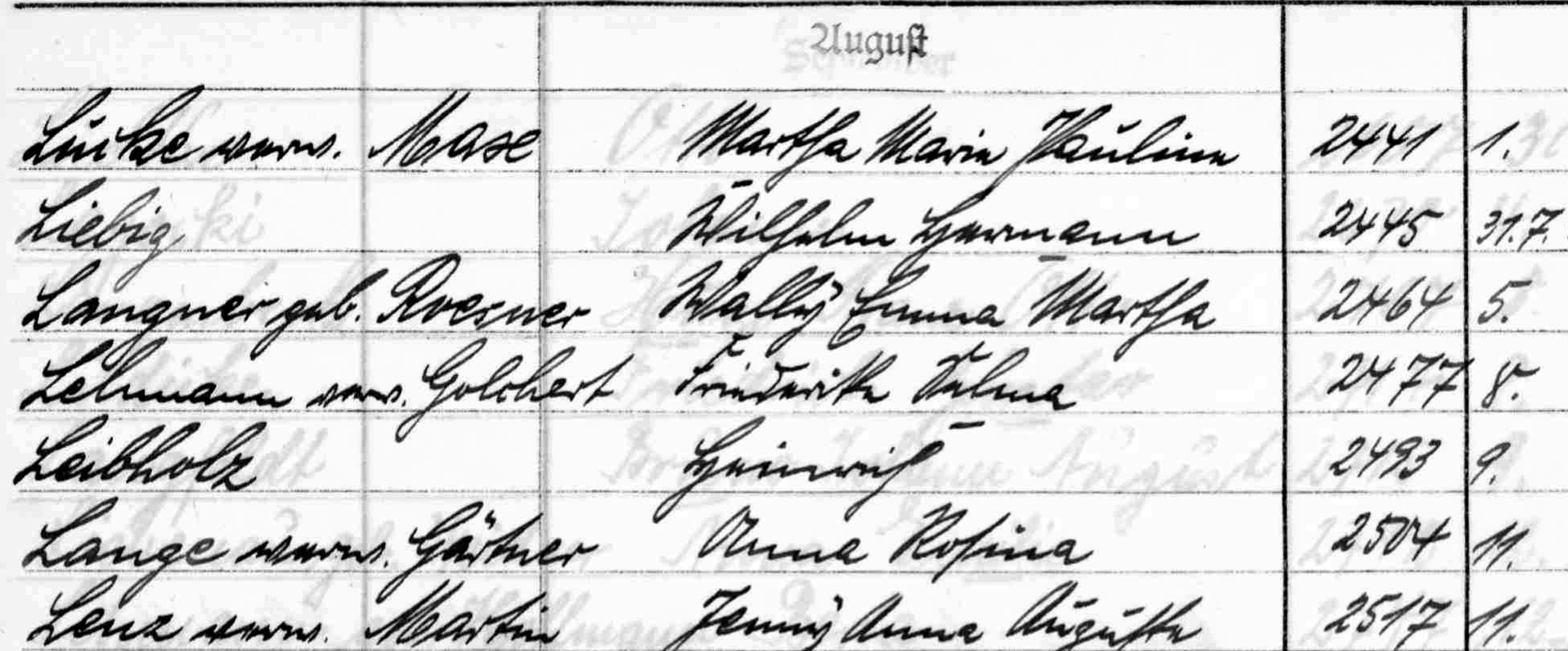
The pre-war volumes track this surname disappearing — seventeen householders in 1938, six in 1942, every name carrying Israel gone. The opposite question had never been asked. The post-war books run to 1980 and are set in Antiqua, so the text layer is clean enough to read: Leibholz returns nineteen pages across seventeen volumes, and six names across thirty years.
These volumes are not searched by name. The OCR prints this surname Leiphotz, Lelpholz, Leipkslz and Leibbolz — five of the eleven readable telephone volumes mangle it, and a search for the correct spelling misses every one, while a common-name control (Schmidt, 133–191 hits a volume) looks healthy throughout. A common-name control cannot clear a rare-name negative. What works is the alphabet: the name falls in a known slot, so the whole slot is printed and read, and an absence is recorded only when a name above it and a name below it are both in hand. Everything below is read that way.
Agnes is the one that closes a loop. “Leibholz Agnes, Rentn., SW 61 Mehringdamm 109” in 1957 and 1959 — and still at Mehringdamm 109 — read at the slot, she is in eight consecutive telephone books, 1972–73 to 1979–80, on one number, and the slot is complete and empty in 1980–81. Twenty-three years at one address, 1957 to 1979–80. Two of those eight volumes print her Leihholz and Leibheiz. Heinrich Leibholz is this archive’s control case, the man who proved that vanishing from the directory after 1942 does not mean death, because he died on 9 August 1948 — Sterberegister Kreuzberg 1948 Nr. 2493, found in the index on 8 October 2026 and read at the image. He lived in Neukölln and died in Kreuzberg: Neukölln’s own 1948 index was read page by page the same day and is correctly empty, because a death registers where it happens and not where the dead person lived. The whole Kreuzberg L block for that year, pages 170 to 185, holds no other Leibholz. The census gives his wife as Agnes née Kerger, born 10 March 1889 at Mallmitz, Kreis Sprottau, Silesia — today Małomice in Poland, so she had no home region left to return to after 1945. And Sophie Leibholz, writing from Shanghai in 1946, named him with “wife Agnes” and asked where he was. He had survived, he died two years later, and his widow lived on at Mehringdamm for another quarter-century. His death is also why the family is in that borough at all — Agnes is in Neukölln on census night 1939 and at Mehringdamm 109 by 1957, with nothing in between, and Kreuzberg 1948 fills the gap. Where she herself died is not known. All twelve West Berlin boroughs have now been read for the surname, 1967 to 1994, and she is in none of them; the year coverage was checked borough by borough and only Neukölln 1993–94 is missing, where she would have been 104. She died after 1994, or outside Berlin, and nothing here says which.
And the two readings are now narrower, because the East was read too 11 October 2026
The sentence above — after 1994, or outside Berlin — rested entirely on the twelve West Berlin boroughs. Two things were done on 11 October and neither changes the conclusion; both tighten what it is a conclusion about.
First, a gap inside her own window, found by counting the sweeps instead of trusting them. This archive had said since 8 October that all twelve boroughs were swept. They were — but not all from the same year, and nobody had laid the twelve coverages side by side. Spandau I began at 1983. She leaves the telephone book in 1980–81. The three volumes covering 1980, 1981 and 1982 had never been read. They have been: all three legible — 1.861, 1.725 and 1.691 control names a page against this archive’s blind threshold of 0.15 — so these are real negatives and not silences. No Kerger, not once, in any of the three.
Second, East Berlin, which had only ever been an argument. The East was left out on the reasoning that a West Berliner in a 1979 telephone book did not move to the DDR — and that reasoning is right, but it has a date on it: until 9 November 1989 a West Berlin pensioner could not relocate east at all. So the window is bounded by the Wall rather than by choice, and it is 1990 to 1994. Forty-seven volumes, a gigabyte, eleven registry offices — Friedrichshain, Hellersdorf, Hohenschönhausen, Köpenick, Lichtenberg, Marzahn, Mitte, Pankow, Prenzlauer Berg, Treptow and Weißensee — searched for the family’s spellings and for KERGER, which is the first time her maiden name has been put to any East Berlin office.
Thirty-three of the forty-seven are legible and hold nothing of the name. The other fourteen are blind and are recorded as unread, not as negatives — and the blindness is not random: every single 1990 volume is blind, in all eleven offices, the first year after reunification unreadable across the whole of East Berlin, plus Prenzlauer Berg 1991–93 entire.
One Kerger came out, and she is not Agnes. Köpenick 1992, “Kerger, Karoline Henriette Lucie” — three forenames, none of them Agnes, and no married name, where Agnes was born 10 March 1889 and married a Leibholz. Her register number is not cleanly separable in the text layer and is not guessed here. It is written down so that the maiden name is not searched again by somebody who assumes it was never tried.
So the two readings stand and the ground under them is firmer. She died outside Berlin, or she died after 1994 and is behind the thirty-year closure — she would have been 105 when the readable record stops. What is no longer available as a third answer is that she died quietly in a borough nobody had looked at.
The others: Ella, a Krankenschwester at Dominicusstraße 43 and then Willmanndamm 3, 1957 to 1970 — and a nurse of that name is in the 1938 directory in the same district — and a candidate death: Tiergarten 1974 Nr. 1160, “Leibholz geb. Baesler, Ella Josephine Martha”, 22 June 1974, four years after she leaves the directory, in the borough beside her own, whose registers were read out for 1970–1994 and are empty. Charlotte at Hasenheide 61–62, 1957 to 1967, and a candidate death: Tempelhof 1982 Nr. 161, “Leibholz geb. Schötzow, Charlotte Herta Marie”, 14 January 1982. Gerhard, Dr., Dipl.-Volkswirt, in Steglitz — not the constitutional lawyer of the same name, who died at Göttingen. Felix at Wiesbadener Straße 57, and Hilde at the same flat six years later, with a candidate death in her own borough — Wilmersdorf 1983 Nr. 304, “Leibholz, Hilde Henriette”, 7 February 1983, about two years after she last appears. The slot read puts Hilde in nine consecutive volumes, 1972–73 to 1980–81, which makes her the last Leibholz in the post-war Berlin books.



Erna of Streitstraße 39 in Spandau is not one of them. She is a LEIPHOLZ, and the alphabet around her is what settles it: that line sits between Leipert and Leipner, where Leipholz belongs and Leibholz cannot, and the 1975–76 through 1979–80 volumes print the P plainly, on one number throughout. She and Hilde are in the same 1980–81 book, three places apart in the alphabet and under different spellings of what the directory itself called one name.
Not one is documented as belonging to the Schubin family, and that is the point. The survivors of this surname in Berlin are the other Leibholz families. Kurt’s people were in Johannesburg, in Potsdam, and in a grave at Auschwitz. — And one absence was looked for on purpose: Frida Leibbholz née Spree, Samuel’s widow, is in none of the forty volumes.
The eighth spelling, and what it has produced Documented
On 20 September the Berliner Adressbuch was found to print its own cross-reference — “Leipholz, s. a. Leibholz”, and in the 1940 volume the other way round. The compiler of the city these people lived in treated the two names as one for at least twenty-seven years. Every bounded negative this archive had recorded was one spelling short of complete. This is what the eighth spelling has produced since.
Friedrich Leipholz is the fullest life of them. An Angestellter at Berliner Straße 5a in Tegel in 1957 and 1959; a Pensionär at Schwabstraße 4 in Reinickendorf from 1961, with the same neighbours in the street section seven years apart; and in the telephone book at that flat in 1970–71, 1972–73 and 1973–74. He is absent from the 1974–75 volume and every one after it, on a slot that is complete and empty. A man who retires between 1959 and 1961 was born around 1895, which puts him in Jacob Leibholz’s generation.
And his own borough has now been read out. All twenty-one years of Reinickendorf’s death-register indexes, 1974 to 1994, bracketed on both sides of both spellings: his death is not registered there. So he moved and died elsewhere, or he died after 1994 at nearly a hundred, or he simply gave up the telephone. Heinrich Leibholz — who left the Berlin directory in 1942 and did not die until 1948 — forbids the easy reading. Leaving a telephone book is not dying.
The twenty-one years turned up exactly one Leipholz, and she is new: Marie, dying in the borough Friedrich lived in.

The text layer rendered her death date @507 and was not legible enough to date her at all. At the image it is the fifth of November — which is why a layer that cannot be read is said to be unreadable rather than rounded into a fact.
And the image carries a column the text layer never showed at all: she is “ev.” — evangelisch, Protestant. That column reads mosaisch for the Jewish woman in the Spandau 1982 index, and mosaisch for Leinkram Gertrud three lines above Marie on her own page, so the distinction is being made on that very sheet. A Protestant Leipholz belongs with the Masurian Leipholz family of Pianki and Arys, whom this archive already holds and already calls certainly not the same people — not with Jacob Leibholz of Schubin. It is one word and it proves nothing. For once it points away from this family rather than toward it, which is worth as much.
The rest of the cohort: Klara, a Putzmacherin — a milliner — at Dieffenbachstraße 58 in 1957 and 1959, the same street and house number where a Paul Leipholz, Schlosser was listed in 1924. Erna at Streitstraße 39 in Spandau, in six consecutive telephone books on one number, 1975–76 to 1980–81 — and not the Erna Frida Else Leipholz who died at Schöneberg on 13 January 1975, because a woman who died in January 1975 is not listed on her own line for the next six years. They are two different women of the same name. And Elisabeth Weiler née Leipholz, born 1891 at Neustettin in Pomerania, who is in the Bundesarchiv’s residents’ list and not in the Gedenkbuch, and now it is clear why: she got out, to Palestine. Not one of them is joined to Jacob Leibholz of Schubin by any document held here. The directory’s own cross-reference is why they are worth holding, and it is not a pedigree.
And a tenth, found 11 October in a borough nobody had finished reading. “Herfert verh. Leipholz · Else Hedwig · 24.11. · 3483 · ev. · verh.” — Standesamt Spandau I, Sterberegister 1980 Nr. 3483, died 24 November 1980, read at the page image. Born Herfert, married a Leipholz, and the column says still married — so there was a living Mr Leipholz in Spandau that year, in the same borough and the same window as the Erna Leipholz this archive already had at Streitstraße 39 across six consecutive telephone books. Nothing joins them but that, and nothing joins either to Schubin.
She is also the reason a sentence elsewhere on this site is narrower than it looks. She is filed under H, with the family’s spelling only as the second element of her line, and that office did not cross-index her under L — while the same office did cross-index its 1982 Leibholz woman under both L and S. The four blind Kreuzberg years were read by L block, so a woman who married into this surname and whom the registrar did not cross-index would not be in the band that was read. Those negatives say what they say and no more.
Klara is found, and the surname has a ninth spelling New, 11 October 2026
Klara of Dieffenbachstraße was last printed in the 1959 directory, and her borough was read forward from there. Kreuzberg 1963 to 1994 is empty of the name, 1959 was read at the image and empty, and she is in the first blind year after her last entry.
Leipsholz geb. Diedring · Johanne Klara · 4. · – · 316
Namensverzeichnis zum Sterberegister, Standesamt Kreuzberg 1960, P Rep. 510 Nr. 679, page 123, under the Februar heading. Died 4 February 1960, no confession stated. Read at the page image at five times magnification.
LEIPSHOLZ, with an s — a ninth spelling, in a registrar’s own hand and not a machine’s. No index and no search engine would have matched it; the band was read by eye.
A strong candidate and not a claim. The forename is Klara, the borough is Kreuzberg, and she died in the first blind year after her last directory entry. Against it: the spelling differs by a letter, and geb. Diedring is a maiden name this archive has never held. Kreuzberg 1960 Nr. 316 gives her last address; if it reads Dieffenbachstraße 58 the question closes and the household’s run closes with it, 1924 to 1960. That is a certificate order.

And the office is now closed, 1938 to 1994. Forty-five volumes scanned by text layer — seventeen legible and twenty-eight blind, the text layer of this series beginning at 1963, which was measured and contradicted a prediction made here that all forty-five would be blind — plus 1980–1994 read in September and the four blind years that mattered, 1959 to 1962, read page by page at the image. 1961 and 1962 prove nothing about Klara, who was already dead when 1961 opened; they were read so the sentence is about fifty-seven years rather than forty-nine. In fifty-seven years the office yields exactly two of our people: Heinrich Leibholz in 1948 and Johanne Klara Leipsholz in 1960. Every other year is a measured silence rather than an unmeasured one, and a blind volume was never allowed to count as one — every volume scored its own eyesight against six common surnames first.
Samuel had a wife, and she was not Jewish either Documented
The same search, run on Kommandantenstraße 29 — Samuel the hat wholesaler’s address — returns two people, on consecutive census cards.
| Who | Born | “Race” | Died | Card |
|---|---|---|---|---|
| Samuel Leibholz | 28.06.1877, Szubin (Schubin) | JJJJ | 10.04.1943, Auschwitz | VZ153419 |
| Frida Leibbholz née Spree | 12.05.1888, Berlin | NNNN | — | VZ153420 |
So both brothers were in mixed marriages. Jacob married Auguste née Luwinski, NNNN, persecuted “collectively”. Samuel married Frida née Spree, NNNN. Two men from Schubin, two non-Jewish German wives — and both men were deported anyway, Jacob on 26 February 1943 and Samuel to Auschwitz, where he died on 10 April. Neither wife has a death date in the database. A Mischehe delayed the two brothers and it did not save them.
Samuel is not in the Arolsen index at all, searched twice, the second time with the consent declaration ticked. He is in the German Federal Archives census set with a card number, a household and a wife. The gap is Arolsen’s, not this family’s. The clerk spelt her surname Leibbholz, with a doubled B.
And Oskar’s own registration card says so too Corroborated
The paragraph above was argued from a shared address in the 1939 census. On 20 September 2026 the Arolsen Archives served Oskar’s Berlin registration card — a Vordruck Nr. 25 B in the series Berlin: Registration Cards from Jewish Residents — and it has two lines on it: “Oskar Israel, verh., 13.5.87, Schubin” and, directly beneath, “Ehefr. geb. Leibke … Gertrud Sara, verh., 13.7.94, Berlin”. Their Kennkarte numbers are consecutive: A 442 462 and A 442 461. Their tracing-case numbers are consecutive too — T/D 52.971 and T/D 52.972. The census gave an address; the card gives a marriage.
Oskar’s two transports, from the two ends Documented
The Memorial Book gives Oskar two dates. Four Arolsen documents now give the paperwork behind them, and it fits together.
The Gestapo list for the “4th Large Transport of the Elderly” of 17 March 1943 names its own transport I/90 and carries, at page 161 line 54, “Leibholz · Oskar Israel · 13.5.87 · Schubin · W.50, Marburgerstr. 13 · 014577”. An index card of the Berlin AJDC office repeats the birthplace as Schubin/Bromberg, the address as Berlin W 50, Marburger Straße 13, and files him as “49/30999 II — 4.gr.Alterstrsp. 17.3.43”.
And in Terezín a Czech clerk filled in a card headed Ústřední kartotéka — transporty: “Leibholz Oskar · 13.5.1887 · Deportace na východ: Číslo Er 606, dne 16.X.1944 · (původní transportní číslo: 11025-I/90)”. The original transport number on the Terezín card is the Berlin transport’s own designation. The two ends of the journey name each other.
What the Terezín card does not say is where he was sent. It says na východ — to the east — and gives a letter, a number and a date. The Memorial Book’s Auschwitz is not written on it, and is not claimed here as read.
He travelled alone, and there is a card that says why Documented
Oskar’s line on the transport list carries no Ehepaar bracket, although the same sheet brackets other couples. Gertrud has a document of her own, and it explains it.
It is a printed card of the Kultusvereinigung Berlin headed
“Zählkarte für auswandernde Personen” — a counting card for
emigrating persons, with the word emigrating struck through in ink. In the
columns: Leibholz geb. Leibke · Gertrud · 13.7.94, Berlin ·
verh. And in the column headed Zielland, country of destination:
“verstorben 27/2.43”. At the foot, the household address
— Marburgerstr. 13 — and the date it was written,
8 March 1943.
She died on 27 February 1943, eighteen days before the transport left. That date was already on this page from the Memorial Book; it is now on a card filled in nine days afterwards by the office that knew her, with her address on it. Oskar went to Theresienstadt a widower of three weeks.
An emigration form with emigrating crossed out and a death written into the box for the country she was going to. The card does not say how she died, and 27 February 1943 in Berlin was the day of the Fabrikaktion. This archive is not writing a cause of death out of a coincidence of dates.
Georg's wife was Lydia née Perl, and they died on the same day Documented
Lydia Leibholz née Perl, born 16 January 1885, lived at Michaelkirchstr. 26 — Georg's address — and died on 13 May 1942, the exact date of Georg's transport from the Łódź ghetto to Chełmno. They went together.
And two Pages of Testimony filed for Georg at Yad Vashem, by two different nieces and years apart, both give his wife's name as Lydia. Neither mentions Gertrud. Three sources, none quoting the other.
The two nieces disagree about where he died — one wrote Riga, the other Auschwitz — and the Bundesarchiv, working from the transport lists, says Łódź and then Chełmno. Two families remembered two different wrong places, which is what happens when nobody is left who saw it. It does not make them unreliable about the rest: they agreed on his wife, his city and his trade.
And Meraner Straße 2 held fourteen of them Inferred, strongly
Searched by street, that one address returns fourteen people in the persecution records, from six unrelated families — the three Leibholzes, three Salingers and a Peyser, two Schlesingers, an Ida Weil, an Anna Puff, and the Schades: Friedrich, Klara, and a boy called Heinz born in July 1933.
Six families crowded into one building, all appearing in the May 1939 census, is the signature of a Judenhaus — a house Jews were moved into after being evicted from their own homes under the tenancy law of 30 April 1939. The borough housing files would prove it; this is the shape of it.
If so, the Leibholzes were not living in their own flat by 1939. They had been concentrated there with five other families — and it is from that building that Jacob was taken on 26 February 1943.
Auguste is in the persecution records herself
She was not Jewish, and she is in the dataset anyway — Auguste Leibholz née Luwinski, Meraner Straße 2, Schöneberg — registered at her Jewish husband's address in the census whose supplementary card asked about grandparents. That is what a Mischehe looked like on paper in May 1939. Note the name: she is recorded as Frau Leibholz, which the family tree does not carry.
And she is on the Meraner Straße list. A German woman in a Mischehe did not have to follow her husband into such a building. Some did. It is the clearest thing this archive has about what she chose — and she got the younger boy out to Sommerfeld in January 1943, the month before his father was taken.
Kurt is absent. A search on Luwinski across the whole database returns two people: Auguste under her married name, and an unrelated man from Königsberg. The gap in the Berlin record is the emigration.
What is still open about Gertrud Open
Which brother she married is now answered. What is not: she died in Berlin on 27 February 1943, the day of the Fabrikaktion, and not in a camp. Yad Vashem categorises her as murdered. A death in Berlin on that particular day has an obvious and terrible range of explanations, and the record does not choose between them. The Berlin death register would.
There is no stone for him Checked
Against the register of all 738 Stolpersteine in Berlin-Schöneberg and the citywide database: none at Meraner Straße, and none for any Leibholz in the district. The Leibholz stones that do exist in Berlin belong to other Leibholz families.
Until today nobody knew the address to put one at. An application is drafted, in German, with the Gedenkbuch entry, the transport, the 1939 household and the two addressees — the Koordinierungsstelle and the Tempelhof-Schöneberg borough office.
The great-grandparents, documented at last
The chart on the front page of this site has said “Sally Leibholz & Friederike Schmul” since the first day — on the family tree’s word and nothing else. It has a source now, and of all the places it could have come from it came from this one.
SAMUEL ISRAEL LEIBHOLZ — born 28 June 1877 at Schubin
Father’s first name: SALI
Mother’s first name: FRIDERICKE
Mother’s maiden name: SCHMUL
Married — spouse Frieda
Died Auschwitz, 10 April 1943Yad Vashem 5415605. Content note: document number 18258/1943. Source: the Auschwitz Death Registers, State Museum Auschwitz-Birkenau.
Both great-grandparents are named on a German death register kept at Auschwitz, against a numbered entry, for a man born at Schubin in 1877. The spellings are Sali and Fridericke — what the clerk wrote. It is the first primary source this archive has ever held for that generation. And it gives Samuel a wife, Frieda, whom nobody here knew about.
A test was built out of it and run. Yad Vashem can be searched on mother’s maiden name. SCHMUL returns people from Berlin to Łódź to Komarów — it is a common name — and exactly one Leibholz. No brother of Jacob and Samuel is recorded anywhere in that database with those parents. That is a limit of the records, not of the family: Jacob’s and Oskar’s entries come from deportation lists, which carry no parents’ fields at all. Only a Page of Testimony or a death register carries parents, and of the four men only Samuel has one — four men, three brothers. It also settles the shape of the Georg question — he will never be included or excluded by a parents’ field, because his records do not have one either. His niece remains the route.
Two people survived to write these names down
A Page of Testimony is not a list. It is a form filled in by a person who knew the dead, and it names that person and what they were to the victim. Eighteen exist under this surname. Two have been opened.
| The page | What it records | Who wrote it |
|---|---|---|
| Elli Struzik née Leibholz YV 13689593 · item 1819733 | Born 7 November 1915 at Berlin — matching this archive’s register to the day. Father: Georg. Mother: Lydia. Mother’s maiden name: PERL. Married to Harry. A secretary. Twenty-six. Deported Berlin to the Łódź ghetto, 1 November 1941, and Łódź to Chełmno, 13 May 1942. | MARGOT COX Cousin |
| Georg Laibholz item 1684365 | Born 1883. Married Lidia née Peretz. Of Berlin. Profession: factory owner. | IRMGARD SHTERN Niece |
These are not Kurt’s relatives on any evidence this archive holds. The position argued above is that Georg is not Jacob’s brother — Jacob born at Schubin in Posen on 8 August 1884, Georg at Hammerstein in West Prussia two months earlier, and two men cannot be brothers on those dates. Margot Cox and Irmgard Shtern belong to Georg’s line.
And that is exactly why they are worth everything. Irmgard Shtern is Georg’s niece, so her parent was Georg’s sibling — and Georg’s parents are the single fact that would settle whether his line touches Sally Leibholz and Friederike Schmul of Schubin at all. A niece is one generation from the answer to the question this page was built to ask.
Three things that were assertions here are now documented: Georg’s wife was Lydia née Perl, and it is on her daughter’s page in a cousin’s hand; Elli’s death is no longer “after 13 May 1942” but 13 May 1942, at Chełmno; and Georg was a factory owner, which nobody here knew.
And three discrepancies are carried rather than resolved. Georg’s birth year is now 1884, 1885 and 1883 — three sources, three years. Lydia’s maiden name is PERL on one page and PERETZ on the other. And his place of death is Auschwitz on this page but Chełmno on the deportation lists. A Page of Testimony is written from memory, years afterwards, by somebody who was not there; the deportation list is the better source and this archive keeps Chełmno.
The transport has a number
This site has carried Jacob’s deportation as a date — 26 February 1943, Berlin to Auschwitz — since the first day. Yad Vashem’s Central Database of Shoah Victims’ Names, searched properly on 17 September 2026, carries a field this archive never had.
Details of Transport: Transport 30 from Berlin, City of Berlin, Germany to Auschwitz Birkenau, Extermination Camp, Poland on 26/02/1943.
Yad Vashem record 13520936, item IDs 11572198 and 4113817. Date of birth 08/08/1884; place of birth Schubin; permanent residence Berlin; citizenship Germany.
Transport 30. Not a date any more — a numbered train, with a list, that other people were also on.
And it comes from a memorial book this archive did not know it was standing on. That record is sourced not to the Bundesarchiv but to the Gedenkbuch Berlins der jüdischen Opfer des Nationalsozialismus — Freie Universität Berlin, Edition Hentrich, Berlin 1995. Berlin’s own memorial book, a different work from the national one cited on every other page here, and the source of the transport number. It has not been consulted directly, and it should be: for Auguste, for Siegfried, and for an address.
Oskar’s record (13449776) gives the two deportations and closes the distance between them: Berlin to Theresienstadt on 17 March 1943; Theresienstadt to Auschwitz on 16 October 1944; and date of death 16 October 1944 — the same day the second transport left.
One discrepancy settles in the Bundesarchiv’s favour. Yad Vashem gives Georg as born in 1884, agreeing with the Gedenkbuch and disagreeing with Arolsen’s 1885. Two against one, and the two are the older and better-sourced. Lydia Leibholz appears on the Łódź ghetto list, which is where this archive already believed Georg’s wife died on the same day he did.
A decoy, written down before it costs somebody a day. The same search returns “KURT LEIBHOLZ, 1927, Berlin, murdered”. That is not our Kurt. Ours is Kurt Luwinski, born 11 May 1912, who left Germany in the 1930s and died in Johannesburg in 1968. A Kurt of the same city, fifteen years younger, murdered, is exactly the kind of near-match this archive has been caught by three times in a fortnight.
A second archive, and it says the same thing
Everything on this page rested on one source: the Bundesarchiv’s Gedenkbuch. On 17 September 2026 the Arolsen Archives were searched for the first time — the international centre on Nazi persecution, thirty million documents naming some seventeen and a half million people. 213 person entries carry the name Leibholz.
| Arolsen index entry | Born | Birthplace | |
|---|---|---|---|
| LEIBHOLZ, JAKOB | 08.08.1884 | SCHUBIN | Exactly the Gedenkbuch, from records with no connection to it. |
| LEIBHOLZ, JACOB | 08.08.1884 | — | The same man again. |
| LEIBHOLZ, Jacques Jaques | 08.08.1884 | — | The same man French-spelled — which means a document made in French hands, a tracing or displaced-persons file rather than a German one. |
| LEIBHOLZ, OSKAR | 13.05.1887 | SCHUBIN | Exactly the Gedenkbuch. Four entries in all. |
| LEIBHOLZ, ISRAEL OSKAR | 13.05.1887 | — | The compulsory name, on this family’s own record. |
| LEIBHOLZ, GEORG ISRAEL | 07.06.1885 | — | The same, for Georg — and a year out from the Gedenkbuch’s 1884. Same day, same month. |
| LEIBHOLZ, Siegfried | 05.08.1925 | — | Kurt’s younger brother, to the day. |
| Tracing case T/D 52.971 | “LEIBHOLZ, OSCAR born 13.05.1887” | Fourteen documents. After the war, somebody asked the International Tracing Service what had become of him. | |
The Israel is the thing to stop at. This site publishes the 1938 decree that forced that name on German Jews. Here are two of these brothers carrying it. The law and the men are no longer on separate pages.
And there is a tracing case, which means somebody came looking. A T/D file is opened because a person asks. Fourteen documents were generated by that asking. Who asked is inside the file, and the likeliest askers are a brother who got out or a widow who did not.
Samuel is the one absence, and it is recorded as unfinished rather than as a negative. A search under his name returns nothing, although both Yad Vashem and the Gedenkbuch have him. Only twenty-five of the 213 entries were read. He may be on a page not yet turned.
The documents were not opened, and that is deliberate. Reading one requires ticking Arolsen’s declaration of consent to the use of sensitive personal data — a statement a named person makes about their own conduct. This archive does not tick it on anybody’s behalf. Everything above is from the index, which asks nothing of anyone.
A surname leaving a city
The Zentral- und Landesbibliothek Berlin has digitised the Berliner Adressbücher — the city directory, one volume a year from 1799 to 1970, six to seven thousand pages each, listing householders by name, trade and street. It is free and full-text. This archive had never opened it until 17 September 2026, although the whole of this family lived in that city. 1,047 pages carry the name Leibholz.
Counting them by year does something a list of four deportations cannot. These are page hits per annual volume, and the volumes are the same size throughout — six to seven and a half thousand pages, every year.
| Volume | Leibholz | Thimm | Hirschfeld | Bergmann |
|---|---|---|---|---|
| 1933 | 24 | 66 | 52 | 784 |
| 1934 | 23 | 53 | 54 | 764 |
| 1935 | 16 | 47 | 55 | 628 |
| 1936 | 22 | 65 | 55 | 691 |
| 1937 | 16 | 72 | 96 | 703 |
| 1938 | 18 | 68 | 91 | 723 |
| 1939 | 15 | 45 | 66 | 556 |
| 1940 | 12 | 75 | 59 | 729 |
| 1941 | 5 | 69 | 63 | 709 |
| 1942 | 6 | 63 | 41 | 720 |
| 1943 | 2 | 75 | 37 | 644 |
Leibholz goes from twenty-four to two. Thimm goes from sixty-six to seventy-five.
Thimm is the control, and it is not an idle one. Johanna Thimm of Sauerbaum is Kurt’s own great-grandmother — East Prussian, and not Jewish. Her surname is as common in the last volume as in the first. So the scanner did not get worse, the Fraktur did not get harder, and the book did not get smaller. Bergmann, a large mixed name, is flat. Hirschfeld, plainly Jewish, declines but far less steeply, and this archive cannot explain that and does not pretend to.
What the count cannot do, which matters more than the count. A page hit is a page and not a person; twenty-four is not twenty-four Leibholzes. The numbers are small, so a single year proves nothing and only the direction across four does. And above all, deportation, emigration and administrative exclusion from directories all look identical in a count — Jews were being struck out of German commercial listings from 1938 quite apart from being taken away. This table shows a name leaving a city. It does not say by which door, and nothing here should be read as though it did.
Still to find
- Whether Jacob has a Stolperstein in Schöneberg. The Leibholz stones located so far — Willmanndamm 6, Danckelmannstraße 44 — belong to other Leibholz families. Danckelmannstraße 44 is now identified: the 1939 census puts Hans Leibholz, born 25 January 1912 at Preußisch Friedland, Kreis Schlochau, his mother Else née Rothenberg, born at Schlochau, and his sister Liselott in that flat — the first Berlin Leibholz household documented as coming from Sally Leibholz’s own district. A district is not a family, and it is not claimed as one.
- The Schubin (Szubin) Jewish registers, for Sally and Friederike's children and the brothers' births.
- The 17 May 1939 census card for Oskar at Berlin-Wilmersdorf, which recorded grandparents.
- Arolsen Archives, for all four, and for Elli and Werner.
- Jacob in the Berlin directory, year by year, at Meraner Straße 2. The volumes are open and the counting works; reading a named line needs the page image, because the Fraktur columns jam exactly as the South African gazettes did. The year he stops appearing is the year the record of his life in that city stops.
- The eighteen Pages of Testimony under this surname. A Page names who submitted it — a living relative writing down a dead one. None has been opened.
- The Gedenkbuch Berlins itself, Edition Hentrich 1995, which is where Transport 30 comes from and which this archive has been quoting at second hand without knowing it.
- The other Berlin Leibholzes — Wilhelm 1890, Else 1889, Ruth 1923, Lieselotte 1923, Walter 1922, Chana 1938, Heinrich 1890, Albert 1886, Max 1877, Hans Israel 1912. Sally and Friederike had more sons than this archive has names for, and a Berlin Leibholz of the right age is where a fifth would show.
- Auguste in the same books — before 1924 under Luwinski, after it under Leibholz, and after the war under Fricke.
Fifty in the memorial book, and only three born at Schubin
The Bundesarchiv Gedenkbuch was opened only to control a search for the eighth spelling of the name. The control returned fifty Leibholz, and the fifty say something the four this archive already held could not.
Three of fifty, and they are ours New, 20 September 2026
Jacob, born 08.08.1884. Samuel, 28.06.1877. Oskar, 13.05.1887. No other Leibholz in the entire memorial book was born at Schubin. This family is not a fragment of a Posen population of the name — it is the only Leibholz household Schubin has in the record of the murdered.
And the other forty-seven cluster somewhere else entirely: Glowitz 6 · Hammerstein 5 · Karwen 5 · Schlochau 3 · Bärwalde 2 · Preußisch Friedland 2 · Tempelburg 2 · Danzig 2, with singles at Rummelsburg, Grabow, Zettin, Dammen, Loosen, Ostrowo, Bischofstein and Gelsenkirchen, and ten born in Berlin itself. Every major cluster is in Pomerania and West Prussia, within about sixty kilometres of Schlochau. The German centre of gravity of this surname is Kreis Schlochau, not Posen.
And Sally Leibholz — Jacob's father, Kurt's grandfather — was born at Hammerstein on 7 July 1847 and married at Szubin in 1874. This archive has held both facts for days without drawing the line between them. The Schubin branch is a Hammerstein family that moved east, out of the surname's heartland rather than into it.
Which thins the reasoning on the register of lines. Georg's lane and the Kreis Schlochau lane have been kept apart from ours because they begin at Hammerstein and ours at Schubin — but so did our own great-great-grandfather. The lanes stay separate, because no document joins them. The reason for expecting them to be separate has gone.
And Georg's wife was born eighteen kilometres from Auguste's village A mechanism, not a proof
The book gives a birthplace this archive did not hold: Lydia Leibholz, born 16 January 1885 at Bischofstein — Lydia née Perl, daughter of Julius and Mina, wife of Georg of the Michaelkirchstraße laundry, deported with him to Łódź and dead with him at Chełmno.
Bischofstein is in the Ermland, about eighteen kilometres from Sauerbaum, where Auguste Luwinski was born and where her mother's people farmed. And Georg Leibholz lived next door to the Luwinskis at Chodowieckistraße in 1913 and 1914.
That proves nothing. Two Ermländer households next door to each other in Prenzlauer Berg is how chain migration works, and Berlin was full of them. But it is the first mechanism this archive has ever had for how a Catholic dressmaker from Kreis Rössel came to marry a Jewish merchant from Posen — through a neighbour who had made the same journey from the same place. The Kreis attribution for Bischofstein in 1885 has not been verified and should be before it is leaned on.
The Weinstraße household was at Yad Vashem all along
This archive had the household from two sources and thought it had exhausted a third. The directories give “Wilhelm, Vertreter, NO18 Weinstr 6” from 1938, then in 1941 “Wilhelm Israel, Bauarbeiter” — a sales representative reduced to a building labourer — and then nothing. The 1939 census gives Wilhelm Leibholz, born 30 December 1887, and Jenny née Rosenberg, born 11 February 1893, both died before 8 May 1945, which is what a census card and an absence can prove and no more.
And the register of lines carried a note saying he was not the Wilhelm Yad Vashem has. That was written off a search for LEIBHOLZ, and it was true of that search.
Both Wilhelms are there. One is filed under LEIPHOLZ New, 21 September 2026
Page of Testimony 5369884: “Leipholz · Willi · Willhelm · Date of Birth 30/12/1887 · Married · Spouse Jenny · Spouse's Maiden Name Rosenberg · Address of Permanent Residence WEINSTR 6.” The birth date, the wife, her maiden name and the street. There is no room for a second reading.
And it says the thing the census could not: place of death, Auschwitz.
Jenny's own page, 1122806, gives her birthplace as Schlochau and her parents as Isidor and Cecillie Rosenberg — two names this archive did not have. Schlochau is the district Sally Leibholz was born in, and the district the Gedenkbuch's fifty cluster in. The Bundesarchiv gives her birthplace as Loosen instead; both are in the same corner of Pomerania, and this archive is not choosing between two sources on no evidence.
And somebody sat down and wrote it out The only document here anyone chose to make
Both pages were filled in by the same man: Khanan Rosenberg Varadi, recorded as Family on Willi's and as Nephew on Jenny's. So a Rosenberg — a child of one of Jenny's brothers or sisters — who survived, and who at some point sat down and set out what had happened to his aunt and his uncle.
Everything else in this archive is a clerk's form, a register line, a transport list, a card index. A Page of Testimony is the only kind of document here that somebody chose to make.
It is not evidence of kinship to this family, and it is not treated as any. Nothing connects Willi Leipholz of Weinstraße 6 to the Schubin Leibholzes but a surname and a city, and the surname is the very thing these two days have shown to be unreliable in both directions. No approach has been made to the submitter or to anyone connected with him, and whether one ever should is not this archive's decision.
And he wrote five, not two New, 11 October 2026
The panel above has sat here for three weeks with a test written into it and never run: Yad Vashem indexes submitters as well as victims, so searching the man who wrote these two pages would give every page he filed. A names search returns three tabs, and the second — Results Regarding Data Submitters — lists every record whose submitter matched. Searching a survivor’s name returns the dead he wrote down.
GEORG ROSENBERG · born Schlochau, 3 December 1888 · father Isidor, mother Cecillie · Kaufmann · of Berlin before and during the war · murdered, aged 54
Page of Testimony 1057746. Submitter: Khanan Rosenberg Varadi. Relationship to victim: Son.
He is Jenny’s brother — four years and two months older, the same two parents, out of the same house at Schlochau. The archive has had Isidor and Cecillie as two forenames with no dates since September. They now have a second child with a day on him.
And a second Page for the same man, by the same son, gives the parents as YITZKHAK and SETZILIA. One couple, written once in German and once in Hebrew by the person who knew them best. That is the thing that would matter if a Jewish community register at Schlochau is ever reached, because it will not be written in German. The two Pages also disagree about how his father died — Auschwitz undated on one, Theresienstadt 1942 on the other — and neither is published here as his death.
A second family came with them. Joseph Ehrlich, born at Reetz in Pomerania, of Wardenburgstraße 11, Berlin, deported to Theresienstadt on 17 March 1943 and dead there on 1 February 1944 — filed by the same man as his grandson. Khanan’s other grandfather is Isidor, so Ehrlich is Georg Rosenberg’s father-in-law, and names the family Georg married into.
And a lesson that applies to every Page of Testimony in this archive. The Ehrlich Page disagrees with the German federal memorial list on his birth day and with three lists on his death year, and the lists win both times. A Page of Testimony is a relationship document, not a date document. Written from memory, often decades later, often in Hebrew and auto-translated back, it is the best evidence there is for who was whose son and the worst for when. What it gives that no list gives is the single word in the relationship field: son, nephew, grandson.
Still not kin to anyone here, on any evidence, and that has not moved. What has moved is that a question which opened with two forenames and no dates now has four named people of Schlochau with dates — and Schlochau is the Kreis Sally Leibholz was born in, which is the only reason the question was ever asked. A sixth result, “Hona Varadi” born 1920 from a Bergen-Belsen women’s survivor list, is a synonym false match and is not him; written down so nobody rules it out twice.
The house he was moved into, and the man he was lodged with
Jacob's deportation line of 26 February 1943 gives his address as “Treuchtlingerstr. 4 b/Spier” — bei Spier, lodging with Spier. The archive read that correctly and could not say who Spier was.
Spier, H., Handelsvertreter New, 21 September 2026
The 1941 directory, street section, printed page 1615: “Rechte Seite · 2. 4 · E Eisenberg, G. Sara, Ww. · Bayer, W., Oberstleutin. · Eberhardt, C., Kfm. · Jakob, W., Maurer · Stephan, H. Israel, Einricht. · Kochanowskea, F., Hausgehilfin · Petras, M., kfm. Angest. · Rosenstock, L., kfm. Angest. · Spier, H., Handelsvertr. · Boß, C. F., Kfm. · Wendorf, R., Abteilungsleit.”
There he is — a commercial agent, in the building two years before Jacob was put into it.
And look at the owner. Eisenberg, G. Sara, Ww. — the widow who owned the house, carrying the name the 1938 decree forced on her. Stephan, H. Israel on the floor below. A Jewish-owned house filling with Jewish tenants in 1940 is what a Judenhaus was, and the directory shows it happening without ever using the word.
And he is not in it yet The move, bounded at both ends
No Leibholz anywhere in that 1941 entry — and the 1941 volume was compiled in the autumn of 1940. So: Meraner Straße 2 on the census of 17 May 1939. Still not at Treuchtlinger in autumn 1940. At Treuchtlinger 4 bei Spier on 26 February 1943. The forced move happened inside that window.
The 1942 and 1943 volumes would close it further, and the text layer will not give them up: a fuzzy search on the street returns only cross-references from neighbouring streets, and a combined search on the owner's and the lodger's names returns nothing in either volume. Those two pages have to be found by eye.
They were, on 11 October 2026 — along with the 1940 volume, which nobody had opened either. Both read E ungenannt: the house Jacob was deported from had a named Jewish owner in the 1941 volume and no owner at all in the 1942 one. The five years of it, above →