What the DNA says
A test the paper record set for itself, and failed
The family tree makes a hard, checkable prediction about Derrick's DNA. The DNA does not meet it — not narrowly, but by the whole of one grandparent.
The finding Inferred, strongly
Kurt Israel Luwinski is very probably not Lynn Derrick Luwinski's biological father. Two independent lines of evidence say so, and the paper record was already hinting at it before any test was taken.
Not documented, and not closed. What would close it is set out at the foot of this page.
The prediction, and the result
If Derrick is Kurt's son, then Kurt's father Jacob Leibholz — a Jewish merchant of Schubin and Schöneberg — must put roughly a quarter Ashkenazi Jewish into Derrick's genome, and Kurt's mother Auguste, of an East Prussian farming family, roughly a quarter Germanic. Neither is optional. This is simply how autosomal inheritance works over two generations.
| From | Expected | Why | Observed |
|---|---|---|---|
| Ashkenazi Jewish | ~25% | from Jacob Leibholz, of Schubin and Berlin-Schöneberg | 0.0% |
| Germanic / Baltic | ~25% | from Auguste Luwinski, of Sauerbaum in East Prussia | 1.4% |
| Portuguese | ~50% | from Ivone de Figueiredo, of Lourenço Marques | 60.6% |
Ashkenazi Jewish is the most sharply resolved population in consumer ancestry testing. A strong founder effect and centuries of endogamy make the signal unmistakable, and a quarter-share is not something an estimate mislays. Zero is not noise. Neither is 1.4% standing in for an East Prussian grandmother.
The full estimate
| Population | Share |
|---|---|
| Portuguese | 60.6% |
| English | 18.5% |
| French | 5.8% |
| Danish | 5.4% |
| Breton | 5.3% |
| Dutch | 1.5% |
| Scottish and Welsh | 1.5% |
| Germanic | 1.4% |
| Ashkenazi Jewish | 0.0% |
Additional genetic groups reported: Southeastern and Eastern England</strong>, <strong>England. Everything but the Portuguese — 39.4% of the whole — is northwest European and leans English.
The match list says it independently
Ethnicity estimates are inferences. A match list is arithmetic on shared segments, and it is harder to argue with. Derrick has 5,464 matches. The ten closest fall into two clean groups and neither of them is German or Jewish.
| Match | Estimated relationship | Shared cM | |
|---|---|---|---|
| A match in the United Kingdom | 2nd cousin | 333.9 | British cluster |
| A match in the United Kingdom | 1st cousin's daughter | 297.5 | British cluster — South Africa in common |
| A match in Australia | 2nd cousin | 292.7 | British cluster — manages a tree of 10,715 |
| A match in the United Kingdom | 2nd cousin's son | 165.9 | British cluster |
| A match in Portugal | 3rd cousin | 133.2 | Portuguese cluster — Portugal in common |
| A match in Portugal | 2nd cousin's daughter | 111.2 | Portuguese cluster — Portugal in common |
| A match in Portugal | 2nd cousin's son | 108.7 | Portuguese cluster — Portugal in common |
| A match, manager in Japan | 2nd cousin's son | 99.1 | |
| A match in the United Kingdom | 2nd cousin's son | 96 | British cluster |
| A match in the United Kingdom | 2nd cousin's son | 92.5 | British cluster |
Match holders are living people and are not named here. Their names are in the private research file.
A person with one Ashkenazi grandparent normally carries thousands of Ashkenazi matches, because that population is heavily over-represented in these databases. Derrick has none at the top of his list. What he has instead is a British cluster — one of whom shares South Africa with him as an ancestral place — and the Portuguese cluster that is his mother, exactly where she should be.
The paper record was already saying it
Ivone married Johannes Antonie Oelofse de Witt on 2 February 1948.
Ivone married Kurt Luwinski on 19 June 1948, entered in the register as Ivone de Witt.
Kurt filed for divorce after June 1948 — within weeks of the wedding, and before the child was born.
None of that was read as meaning anything until the DNA arrived. Read backwards from the DNA it is hard to read as anything else. The year, set out day by day →
What this does not touch
- Ivone stands. Three Portuguese matches at 108–133 cM confirm her line directly.
- The Berlin history stands. Jacob Leibholz was deported to Auschwitz on 26 February 1943. Samuel died there, Oskar died there, Georg died at Chełmno. Kurt escaped. (The year 1933 is the family tree’s and is now in doubt; that he got out is not.) All of it is documented and none of it depends on this question.
- It remains Derrick's family. He was born into it, named for it, and raised in it. This archive keeps descent and inheritance in separate columns rather than collapsing one into the other.
Nor does de Witt obviously fit
The temptation is to move the fatherhood four months earlier and be done. But an Afrikaner Oelofse–van Straaten line should read Dutch, German and French Huguenot. The observed Dutch is 1.5% and Germanic 1.4%, against English 18.5% and a named genetic group of Southeastern and Eastern England. That is an English family, not a Cape one. The question is open, and this archive does not intend to close it by guessing.
The British cluster, worked
Three of the closest matches have now been opened in full. The structure that came out changes this page from a negative finding into a positive one. Match holders are living and are not named here; what follows is the shape, and the family surnames, which are the search terms.
| Match | Shared | Reading | Their surnames | Shared matches |
|---|---|---|---|---|
| A man in the United Kingdom | 333.9 cM | 2nd cousin, 55.9% — MRCA great-grandparents | Harrison · Brown | 124 |
| A woman in the United Kingdom | 297.5 cM | 1st cousin's daughter, 39.7% — MRCA grandparents | Halsey · Parr · Fenton | 103 |
| A woman in Australia | 292.7 cM | 2nd cousin, 68.0% — MRCA great-grandparents | a 10,715-person English tree | 149 |
It is one family, and it is tightly interlocked
Each shared-match table gives a person's relationship to both sides at once, which is what makes the shape readable. Five of these people — the 333.9, 292.6, 165.9, 99.1 and 88.6 cM matches — are first cousins to one another, sharing between 450 and 801 cM. And every one of them is a second cousin to Derrick. That is not a scatter of coincidental matches. It is one English family, and Derrick hangs off it at a fixed distance.
And one match is a generation closer The lead
The 297.5 cM match is not part of that knot — to her, the Harrison line is only a parent's third cousin. She sits nearer to Derrick than any of them:
1st cousin's daughter — 39.7% — most recent common ancestors: Derrick's grandparents.
In plain terms: her grandparent was a sibling of Derrick's biological father. And the detail that turns arithmetic into a place — her father was born in Johannesburg. Her family surnames are Halsey, Parr and Fenton.
What that establishes, and what it doesn't
- The paternal family is English — which the ethnicity estimate said, and the match structure now confirms independently and at close range.
- A branch of it was in Johannesburg, in the right city at the right time.
- The closest match sits at grandparent distance; the five second cousins named above sit one generation further out.
- It closes the Kurt question from the other side. Every one of these pages prints the same line — “do not share any ancestral surnames” — against Derrick's own list of Figueiredo, Leibholz, Luwinski, Schmul, Thimm. Six matches examined closely, three British and three Portuguese, and not one touches Leibholz or Luwinski.
It does not name him. A first-cousin-once-removed relationship fixes a distance, not a person, and two shapes still fit equally: Derrick's father was a Halsey of Johannesburg, brother to that match's grandfather — or he married a Halsey sister, and the name to find is Parr or Fenton. Chromosome triangulation between the two clusters would separate them.
Triangulation: it is one family, not two
The paragraph above left two shapes open — a Halsey father, or a Halsey sister married to someone else. Segment coordinates settle it. The three matches share, respectively, 12, 16 and 12 segments with Derrick; laid over each other they produce this:
Chromosome 2, 181,681,048 – 216,191,586 34.5 Mb
All three matches share that exact stretch with Derrick.
| Pair | Overlapping regions | Total |
|---|---|---|
| The two second cousins, with each other | 9 | 115.0 Mb |
| The closest match × the Australian one | 1 | 45.3 Mb |
| The closest match × the English one | 2 | 38.2 Mb |
The two second cousins overlapping across 115 Mb is just what first cousins look like — they already share 801 cM with each other. The finding is the closest match joining them on the same stretch of chromosome 2. The alternative shape would have put her on a different chromosome from them. She is on the same one.
So Derrick's biological father belongs to one English family, and Halsey is the nearest surname on it — that match's grandparent was his father's sibling. Harrison and Brown sit a generation further out on the same line.
And a recombination you can see
On chromosome 18 one match's segment ends at 55,491,965 and the other's begins at 55,493,868. They abut, 1,903 base pairs apart. Two relatives holding adjacent, non-overlapping stretches of the same ancestral chromosome is the signature of a break in a shared ancestor — the point where one grandparent's chromosome was cut and handed down two different branches. Between them, the two matches reconstruct nearly the whole of Derrick's paternal chromosome 18.
The honest caveat: strict triangulation also requires the three matches to share that segment with each other, which needs their kits compared directly and only they can run that. The pairwise totals make it very likely. The conclusion does not rest on it, because the relationship estimates already place all three on one side and the overlap confirms the side is shared. Inferred, strongly
The cluster mapped from the inside New, 14 September 2026
Until now this archive knew the British matches only by their distance from Derrick. But each match's own review page also gives every shared match's distance from that match. Measure the cluster from two vantage points at once and its shape falls out.
| Shared match | with Derrick | with the 10,715-person tree | with the closest match |
|---|---|---|---|
| The Harrison match | 333.9 cM | 801.0 cM — 1st cousin | 73.4 cM |
| A second UK match | 165.9 cM | 714.0 cM — 1st cousin | 60.7 cM |
| A third | 99.1 cM | 571.3 cM | 69.5 cM |
| A fourth | 88.6 cM | 480.3 cM | — |
| The closest match | 297.5 cM | 82.1 cM | — |
One line, read at two depths Inferred
Four of those people are first cousins and their children to the holder of the big tree — 480 to 801 cM with her. They are one tight family, and Derrick stands at second-cousin distance from all of them.
The closest match inverts the ratio. She is 297.5 cM to Derrick and only 60–82 cM to every member of that core. She is not part of it — she is nearer to Derrick than they are. That is not two families. It is one line, read at two depths:
- The closest match's common ancestors with Derrick are his own grandparents. She was born in 1995, two generations below him, and MyHeritage reads her as a first cousin's granddaughter.
- The big-tree holder's are one generation further back — his great-grandparents. Second cousin, 68%.
- Which predicts that those two should be third cousins to each other. They are, at 82.1 cM. The structure is consistent from three directions at once, and that is the strongest thing about it.
Two surnames, at their two depths The short list
At grandparent depth: Halsey. The closest match's own pedigree is Halsey · Halsey · Parr · Parr · Fenton — every one of them living, and named nowhere here. Her match card carries the line that matters: “Ancestral places common to derrick luwinski and [her] include South Africa.”
At great-grandparent depth: Brown, Castle and Webb — documented four generations up in a tree of 10,715 people, and all of these people are dead, so the archive can name them:
| Generation | Named in the tree |
|---|---|
| Parents | Geoffrey David Brown, 1926–1980 · Hazel Webb, 1931–2022 |
| Grandparents | Walter George Brown, 1889–1971 · Agnes Kate Castle, 1891–1967 · Dorothy May Webb, 1907–1990 · and a grandfather recorded only as Unknown |
| Great-grandparents | Alfred John Brown 1853–1924 & Sarah Maria Brister b.1858 · George William Castle 1862–1917 & Caroline Wallis 1862–1957 · William Frederick Webb 1877–1955 & Louisa Hayden 1880–1965 |
| Beyond | Henry George Brown 1827–1891 · Ann E. Woodhouse 1828–1884 · Henry Brister 1823–1915 · Mary Warnes 1818–1884 · George Castle 1840–1885 · Martha Giddings 1841–1863 · Joseph Wallis 1827–1912 · Sarah Ann Field 1830–1891 · William Thomas Webb 1842–1921 · Fanny Hawkins 1847–1932 · David Hayden 1848–1927 · Alice Lucas 1854–1922 |
Second cousins have parents who were first cousins. So if that reading holds, Derrick's biological father was a first cousin of Geoffrey David Brown or of Hazel Webb — a man of that generation, carrying on the other evidence the surname Halsey, and in Johannesburg in 1948. And Derrick's own great-grandparents are one of four couples: Brown–Brister, Castle–Wallis, Webb–Hayden, or the unrecorded couple behind that Unknown grandfather.
That last one is worth staring at. In a documented tree of 10,715 people, one grandfather is
recorded as “Unknown” — in exactly the generation, and exactly the position, where an undocumented
connection would sit. Set aside the following day — see below.
This is a structure, not a name, and it is labelled Inferred. What it does is turn an open question into a short list: four couples, one surname, one city, one decade.
Halved again, and the “Unknown” grandfather drops out 15 September 2026
The short list ran to four great-grandparent couples, and the archive made a point of the fourth — a grandfather recorded only as Unknown in a tree of ten thousand people. That was the wrong one to stare at, and one more look at the match pages says so.
The two people who are first cousins to the big-tree holder — 801 cM and 714 cM with her, and Derrick's first and third closest British matches at 333.9 and 165.9 cM — both list Brown among their ancestral surnames. One has Brown, Harrison; the other has Arrow, Brown, Noye.
First cousins share one grandparent couple. If both of hers carry Brown, they are on her father's side — descended from Walter George Brown and Agnes Kate Castle. And if Derrick is a second cousin to all three of them, then his own great-grandparents are the parents of one of that couple:
| Still possible | Now unlikely |
|---|---|
| Alfred John Brown 1853–1924 & Sarah Maria Brister b.1858 | William Frederick Webb 1877–1955 & Louisa Hayden 1880–1965 |
| George William Castle 1862–1917 & Caroline Wallis 1862–1957 | The unrecorded couple behind the “Unknown” grandfather |
So Derrick's biological grandparent was a sibling of Walter George Brown or of Agnes Kate Castle, and his biological father was that sibling's son — a man born around 1910 to 1928 who was in Johannesburg in 1948, carrying on the other evidence the surname Halsey.
Held as Inferred, and here are its weaknesses. Brown is among the commonest surnames in England, and both trees are tiny — three people and five. A relationship estimate of “second cousin” carries real width; the same 333.9 cM also reads as half first cousin at 21%. What makes it worth acting on is that two independent first cousins point the same way, and that it is falsifiable: one reply naming a Webb connection would overturn it in a sentence.
Eight names 15 September 2026
A fair question was put to this archive: if one of the British matches keeps a tree on Ancestry, are the same people not also in MyHeritage's records — and had anyone looked? They had not. Only the DNA match list had been searched by surname, never the record collections and never the matches' own trees. Looking took twenty minutes and produced the best result of the project.
The record collections were the wrong door — Brown returns 1.3 million hits and the search form resists filtering. The right door was the match's own tree, which has been open the whole time: 10,715 people, on MyHeritage, viewable, and it lists siblings as well as ancestors.
First, a confirmation nobody had to argue for
Among the children of Walter George Brown (b. Great Yarmouth 1889, d. Hampshire 1971) is a daughter, Decima Audrey Harrison, 1928–1997. A Brown daughter who married a Harrison. That is where the Harrison match comes from, and it settles by documentation what was inferred yesterday from centimorgans alone: he is on the Brown side.
And then the short list itself Inferred
If Derrick is a second cousin to the tree's keeper, his biological grandparent was a sibling of Walter George Brown or of Agnes Kate Castle. Both sets are now named.
| Children of Alfred John Brown (1853–1924) & Sarah Maria Brister (b.1858) | Children of George William Castle (1862–1917) & Caroline Wallis (1862–1957) |
|---|---|
| Archibald Alfred Brown 1879–1959 | George W. Castle b.1886 |
| Frank Henry Brown b.1880 | Ada Castle b.1887 |
| Alice Brown b.1884 | Frederick Castle b.1890 |
| Ernest H. Brown 1897–1972 | Martha M. Castle b.1896 |
| (and Walter George Brown 1889–1971) | (and Agnes Kate Castle 1891–1967) |
Eight people. Derrick's biological father was a child of one of them, born roughly 1910 to 1928, and in Johannesburg in 1948. The family is Norfolk — Norwich, Great Yarmouth, Caister-on-Sea, and Alfred John Brown was born at a hamlet called California on the Norfolk coast.
Superseded on 15 September. Two things above are wrong. The Castles are Hertfordshire, not Norfolk — only the Browns are Norfolk — and the census puts Derrick's father a generation higher than “a child of one of them”. The four Brown siblings are no longer part of his descent at all. What replaced this →
Which makes one thing suddenly obvious The hypothesis to test
Three of those eight are daughters — Alice Brown, Ada Castle, Martha M. Castle. A daughter's sons do not carry her maiden name. They carry her husband's.
And the surname sitting on Derrick's single closest match, whose shared ancestral place with him is South Africa, is Halsey.
If Alice Brown, Ada Castle or Martha Castle married a Halsey, then her sons were Halseys, born in exactly the right years — and one of them was Derrick's biological father.
It also puts Mervin Halsey, the grandfather the closest match named, exactly where he needs to be: a brother of Derrick's father, another son of that same marriage.
This is checkable without anybody's permission — so it was checked, the same afternoon, in the England and Wales marriage index. The entry is not there. See below.
Tested the same afternoon, and it fails Negative
The Halsey hypothesis was published and then put to the England and Wales marriage index within the hour. It does not survive.
| Searched, 1895–1935 | Result |
|---|---|
| Halsey × Brown | 4 — Pancras 1907, Barnet 1908, Watford 1917, Newport Pagnell 1923. None in Norfolk |
| Alice Brown × Halsey | 0 |
| Halsey × Castle | 0 |
| Parr × Castle | 2, both London, neither fits |
No daughter of these two families married a Halsey in England or Wales. The neat join between the tree on one side and the surname on the other is not in the index, and the archive says so rather than leaving a tidy guess standing.
What survives, and what it means. The eight names came from the tree, not from the hypothesis, and they stand. So does something the tree shows plainly: Alice Brown, Ada Castle and Martha M. Castle have no spouse and no children recorded at all — only parents and siblings. They are genuinely untraced, which is exactly where an unrecorded branch would sit. That is not evidence for the hypothesis; it is the absence of evidence against it.
Three ways it could still be true, and one way it could be wrong from the start. The marriage may have happened in South Africa, outside the English index entirely. The Halsey name may enter a generation lower. Or — and this is the assumption worth naming — Halsey is simply the closest match's father's surname. Her link to Derrick runs through one of her four grandparents, and it could as easily be the Parr side, or her grandmother Cynthia Weir. This archive picked Halsey because it was the name on the card. Open
The Johannesburg Halseys, documented at last 15 September 2026
This archive has said for weeks that the closest match's surname was Halsey and that “her family branch was in Johannesburg.” That was an inference drawn from a line on a DNA match card. It is now a marriage certificate.
The grandparents she named a year ago, found
| Groom | Mervin Richard Halsey, aged 22, born about 1930 |
| Bride | Cynthia Yvonne Elizabeth Wear, aged 21 |
| Married | 29 November 1952, at St Martin's-in-the-Veld, Johannesburg, Transvaal |
| Certificate | 51 · South Africa, Civil Marriage Records, FamilySearch 1:1:6ZH5-65NP |
| Image | Digital folder 008109684, image 2149 of 2,685 — “Johannesburg. Marriage Certificates 1952” |
In June 2025 the closest match wrote that her paternal grandparents were “Mervin and Cynthia Halsey — her maiden name was Weir … Cynthia's middle name was Yvonne.” Every particular of that checks out, down to the middle name; the register spells the maiden name Wear rather than Weir.
And the Johannesburg cemetery records carry them both to the end: Mervin Richard Halsey, born 15 June 1930, died 30 May 2005, buried in Johannesburg — indexed there under the given name Kevin, which is the same man and the same middle name and year, mis-read. Cynthia Yvonne Elizabeth Halsey, born 1932, died 4 April 2000, buried at Brixton, Johannesburg.
A supporting negative: there is no Mervin Halsey in the England and Wales birth index for 1900–1940. He was not an Englishman who emigrated. He was South African.
Why his parents are now the whole question Inferred
Mervin was born in 1930, a generation ahead of Derrick. MyHeritage reads the closest match as Derrick's first cousin's granddaughter, and she is Mervin's granddaughter — which puts Mervin himself as Derrick's first cousin.
If that holds, Mervin Richard Halsey's parent was a brother or sister of Derrick's biological father.
One generation, one document. Three ways to get it, in order of likelihood:
- The 1952 register itself, image 2149. The 1956 form has columns for the parents of both parties; the 1948 form has none. 1952 falls between them, and the frame is already located.
- His estate. He died in May 2005, so there should be a J294 naming his father and mother. It is not in the gazette corpus under that spelling — but the Master of the High Court can be asked.
- His birth, South Africa, about 1930.
And the question already put to her this morning — who were Mervin Halsey's parents? — turns out to have been exactly the right one, asked before any of this was known.
Castle, in Hertfordshire, twice over 15 September 2026
This page spent a week on the surname Halsey. It was the name on the closest match's card, and the archive followed it into the England and Wales marriage index, found nothing, published the negative, and kept going anyway. The negative was right and the reason was better than expected: there was never a Halsey marriage to find.
The 1952 Johannesburg register was opened at full resolution this morning, hoping for columns naming the parents. The 1952 form has none. What it has instead is column (4), Country of Birth — Province. Place. — and that column ended the Halsey line and opened the real one in the same glance.
Two words in a column nobody was looking at
| Column (4), as written | |
|---|---|
| Mervin Richard Halsey, 22½ | Cape Province |
| Cynthia Yvonne Elizabeth Wear, 21½ | ENGLAND |
Derrick's cluster is English. Mervin was born in the Cape, and there is no Hertfordshire, Norfolk or anywhere-else-English in him. His wife was the one born in England — and the match descends from both of them equally. The archive had simply picked the man's surname because it was the one printed on the card.
The chain, in five documents
| Document | What it says | |
|---|---|---|
| 1 | GRO birth index, Q2 1931 Hitchin, Hertfordshire · vol 3A p.1345 | WEAR, Cynthia Y E. Mother's maiden name: CASTLE. |
| 2 | GRO marriage index, Q4 1914 Hitchin · vol 3A p.1552 | Henry R Wear married Martha L Castle. The only Wear–Castle marriage in the England and Wales index, in any year. |
| 3 | 1921 census 72 Pix Road, Letchworth, Herts | Henry Robert Wear, 32, b. Bermondsey, printer's machine minder at J. M. Dent & Sons; Martha Maud Wear, 25, born Baldock, Hertfordshire; three children. Cynthia follows ten years later. |
| 4 | 1901 census Norton End, Norton, Baldock | George W Castle 36, farm labourer; Caroline 36, b. Weston; and George W 16, Ada 14, Frederick 11, Agnes K 9, Martha 5. |
| 5 | 1911 census Church Yard, St Mary's Cottages, Baldock | The same couple, married 1883, he now a labourer in a brewery — plus Hilda, b.1902 and Ernest, b.1904, neither of them in the match's tree; and Joseph Walls, 84, widower, father-in-law. |
Three things that were wrong on this page until today Corrected
- The Castles were never in Norfolk. This page said “Norwich and Caister-on-Sea”. That is the Brown side. The Castles are Baldock and Norton, Hertfordshire, and Caroline came from Weston, four miles away.
- Caroline Wallis is Caroline Walls — her widowed father Joseph Walls, born at Weston in 1827, is living in the house in 1911.
- The list of eight was half wrong. Brown enters this family only as the man Agnes Kate Castle married. The four Brown siblings drop out of Derrick's descent entirely.
And the arithmetic changes which generation he sits in Inferred
Two of Derrick's closest matches now descend from one couple, through two different daughters:
| 297.5 cM | through Martha Maud Castle → Cynthia Wear → Halsey, Johannesburg |
| 292.7 cM | through Agnes Kate Castle → Walter George Brown |
Five centimorgans apart, down two separate branches. That symmetry is the whole argument: Derrick is not hanging off one twig of this family, he is equidistant from two — which puts him inside the Baldock household rather than beside it.
And it moves him up a generation. If Derrick's biological grandparent were a Castle sibling, the closest match would be a first cousin three times removed — about 117 cM expected. The reading is 297.5. If his biological father was himself a son of that house, the match is a first cousin twice removed, expected about 212 cM — and that is also, word for word, the relationship MyHeritage printed on the card: first cousin's granddaughter.
Derrick's biological grandparents are, on this reading, named for the first time: George Castle, born Baldock 1863, and Caroline Walls, born Weston 1863, married 1883.
Walked back within the hour. The paragraph above rests on the 292.7 cM match being a grandchild of Agnes Kate Castle. Her tree was then opened and she is a great-grandchild — her father Geoffrey David Brown, born 1926, is Agnes Kate's son. That is one generation further out than the arithmetic above assumed, and it changes the answer from settled to open. The corrected version is immediately below.
Which rung — an overreach, corrected the same hour Corrected
The section above was published saying Derrick's biological father was a son of George Castle and Caroline Walls. That was stated with more confidence than the evidence carries, and the error was mine: I assumed the 292.7 cM match stood one generation closer to the Baldock couple than she does. Her tree, opened afterwards, puts her a generation further out.
| Who | Descends from George & Caroline as | Shares with Derrick |
|---|---|---|
| The 292.7 cM match | Great-grandchild — her father Geoffrey David Brown 1926–1980 is Agnes Kate Castle's son | 292.7 cM |
| The 333.9 cM match | Great-grandchild — through Agnes Kate's daughter Decima Audrey Harrison 1928–1997 | 333.9 cM |
| The 297.5 cM match | Great-great-grandchild — through Martha Maud, then Cynthia Wear | 297.5 cM |
Two readings, and the numbers do not cleanly separate them
| A. His father was a son of the house | B. His father was a grandson | |
|---|---|---|
| 292.7 observed | expected 425 · ratio 0.69 | expected 229 · ratio 1.28 |
| 333.9 observed | expected 425 · ratio 0.79 | expected 229 · ratio 1.46 |
| 297.5 observed | expected 212 · ratio 1.40 | expected 122 · ratio 2.44 |
| Total error | 0.95 — the better fit | 1.51 |
| Father's age in June 1948 | 44 to 63 — uncomfortable | 20 to 38 — natural |
| MyHeritage's own label | calls the 297.5 match a first cousin's granddaughter | calls the other two second cousins |
A fits the centimorgans better. B fits the ages better. MyHeritage's own algorithm returns one of each. And something in the readings is odd on either account: the two great-grandchildren average 313 cM and the great-great-grandchild reads 297.5, when a whole generation should roughly halve it. Two matches a generation apart at almost the same number is not what a simple line of descent produces.
So the honest statement is narrower than the one published an hour earlier, and it is this:
Derrick descends from George Castle and Caroline Walls of Baldock. Whether they are his grandparents or his great-grandparents is not settled, and centimorgans alone will not settle it.
Under A his father is George W. Castle b.1885 or Frederick Castle b.1890 — 63 and 58 in 1948. Ernest b. 28 November 1904 is out: the 1939 Register has him at 29 Norton Crescent, Baldock, a butcher (incapacitated), married, with children, which matches the “invalid” of 1911 and does not match a man in Johannesburg nine years later. Under B his father is one of the grandchildren of that house, born roughly 1910 to 1928 — which is the shape the archive had a week ago, before the surname changed.
What became of the Halseys, for the record NAAIRS, 54 documents
They are no longer Derrick's family, but they were chased for a week and the findings should not simply vanish. The South African national archives index returns, under Halsey:
- WLD 12617/1978 — divorce: Mervin Richard Halsey versus Cynthia Yvonne Elizabeth. They separated in 1978, twenty-six years after St Martin's-in-the-Veld.
- MHG 6348/64 — Erral David Halsey, the estate of the 25-year-old who died at Walvis Bay in July 1964, born at Spaarwater, Heidelberg, Transvaal.
- MHG 790/55 — Penrose Thomas Halsey, who married Helen Edith Stevens at Lower Umgeni, Durban, in July 1914.
- And a Kimberley family older than any of them: Walter 1899, William 1917, Sarah 1920.
A negative worth keeping: the South African death-registration form of that period names parents only where the deceased was under five. Erral David Halsey's 1964 form is complete, legible, and names neither.
And the match list itself now answers to the name Swept the same evening
The search box on Derrick’s DNA Matches page takes an ancestral surname and searches all 5,464. In August it was given Leibholz and Luwinski and returned zero for both. Tonight:
| Surname | Matches | What they are |
|---|---|---|
| Castle | 14 | Headed by the 292.7 cM match herself, then thirteen more at 11–38 cM |
| Walls | 4 | 8–10 cM, and one is a Wallsworth. Nothing. |
| Leibholz | 0 | Unchanged |
| Luwinski | 0 | Unchanged |
Stated carefully, because the last time this page got excited about a surname tag it was wrong. The 14 is not proof: the top hit is the Castle descendant already known, and thirteen matches at 11–38 cM is the range where a shared surname is suggestive and nothing more. What it does do is put Castle on the opposite side of the ledger from Leibholz and Luwinski, which have never returned a single person.
A trap walked up to and stepped around Checked, not published
Searching the same list for Wear returned eight, and the 292.7 cM match was top of that list too — which looked, for about a minute, like her tree independently containing the Hitchin marriage. It does not. Opening her tree and searching it shows the “Wear” in it is Weare: Henry Weare born 1591, Grace Clarke born 1611.
This is precisely the error this archive published a lesson about in the Figueiredo case — believing a surname tag without opening the tree behind it. The lesson held, one day later, on a finding it would have been very convenient to believe. Open the match before believing the label.
The lesson, which is the same lesson as last time
A week went into Halsey because it was the surname on the card. It was the wrong half of a married couple. The archive had even written down the objection — “Halsey is simply the closest match's father's surname … her link to Derrick could as easily be her grandmother” — and then carried on down the man's line anyway.
Write the objection down, then act on it. Two columns on a register settled in one glance what a week of surname-chasing could not.
The segments say two ancestors, not one 15 September, evening
Every argument on this page is in that picture. The upper bar of each pair is what Derrick shares with his closest match. The lower bar is what he shares with two second cousins who are documented descendants of the Castle family. They line up on chromosome 2, and almost nowhere else.
Of the 297.5 cM Derrick shares with the closest match, 44.3 cM fall inside regions he also shares with a Castle cousin — and 253.2 cM do not. Eleven of her twelve segments sit on chromosomes where the Castle cousins have nothing at all.
Two people who descend from a single common ancestor cannot do that. The shared DNA would fall in the same places. Derrick and this match share two ancestors — a married couple — and the couple is Henry Robert Wear and Martha Maud Castle. The chromosome 2 block is the Castle half of them. The other 253.2 cM is the half the Castle cousins do not carry, and that half is Wear.
Positions as MyHeritage reports them, GRCh37/hg19, captured 2026-09-14. Chromosomes are drawn to scale against chromosome 1. The overlap figure is computed from the coordinates, pro-rating each segment’s centimorgans by the fraction of its length that overlaps — it is an approximation, because centimorgans and base pairs are not linearly related. Match holders are living and are identified by role only.
Centimorgan totals could not separate the two readings. The segments could — and they did it in one pass, because they answer a different question: not how much Derrick shares with each match, but which parts of his own genome he shares with each.
| Between which two of Derrick's matches | How much of his DNA is common to both |
|---|---|
| 333.9 cM × 292.7 cM (first cousins to each other, 801 cM) | ~161 cM |
| 292.7 cM × 165.9 cM | ~58 cM |
| 333.9 cM × 165.9 cM | ~53 cM |
| 292.7 cM × 297.5 cM | ~41 cM — one block, chromosome 2 |
| 333.9 cM × 297.5 cM | ~31 cM — the same block |
| 165.9 cM × 297.5 cM | nothing at all |
Split the closest match's 297.5 cM in two
~44 cM of it lies in regions Derrick also shares with a Castle cousin — a single block on chromosome 2, from 173 to 218 Mb, which all four of them carry. That is the Castle inheritance, and it behaves exactly as it should.
~253 cM of it lies nowhere near any of them. Chromosomes 1, 6, 7, 8, 12, 15, 18, 20 and 22 — nine segments Derrick shares with her and with no descendant of Agnes Kate Castle.
If Derrick and the closest match had only the Castle couple in common, that 253 cM would have nowhere to come from. They share two ancestors, which is to say they share a married couple.
Her great-grandparents on that side are Henry Robert Wear and Martha Maud Castle, married at Hitchin in 1914. Derrick descends from both — so his biological father was their son, and a brother of Cynthia. Which is, word for word, MyHeritage's own most probable relationship for that pair: first cousin's daughter, 39.7%.
And it kills the alternative outright. Under the other reading, Derrick’s relationship to the closest match would be the same relationship the 292.7 cM match has to her. Hers reads 82.1 cM. His reads 297.5.
And a machine that knew none of this put the same people in one box 16 September
Everything above was reasoned out by hand — shared-match lists read one page at a time, segments copied off match pages, a couple inferred from the shape of an overlap. On 15 September MyHeritage produced an AutoClusters report for the same kit: 110 matches sorted into 20 clusters, 5,361 cM in all.
AutoClusters knows nothing about this archive’s reasoning. It groups matches purely by whether they match each other. It produced the same group.
| Cluster | People | cM | Share | Character |
|---|---|---|---|---|
| 3 | 12 | 1,706 | 31.8% | THE PATERNAL LINE — holds all three anchor matches at 333.9, 297.5 and 292.6 cM, plus nine more |
| 2 | 12 | 554 | 10.3% | English, unattributed. Largest member 68 cM |
| 1 | 15 | 439 | 8.2% | English, unattributed. Every member between 25 and 41 cM |
| 4 | 10 | 304 | 5.7% | American surnames, one tree of 62,000 people |
| 17 | 3 | 250 | 4.7% | PORTUGUESE — two members over 100 cM |
| 10 | 4 | 237 | 4.4% | PORTUGUESE — strongest member 133.2 cM |
| 7 | 5 | 198 | 3.7% | English, unattributed |
| 8 | 5 | 188 | 3.5% | English, unattributed |
| 6 | 5 | 179 | 3.3% | PORTUGUESE |
| 20 | 3 | 110 | 2.1% | PORTUGUESE / Brazilian |
Cluster 3 is the paternal line, and it dwarfs everything else — twelve people, 1,706 cM, nearly a third of all clustered sharing in the kit and almost three times the next cluster. All three anchor matches sit in it together.
But it does not separate Wear from Castle, and that is worth being clear about. The closest match descends from both halves of the couple; the two Castle cousins descend from one half. All three therefore match each other, and this algorithm is bound to put them in a single cluster. A married couple looks exactly like this. Cluster membership proves paternal, not Wear — which is what the twelve-region signature above is for.
The bifurcation is the other finding, and it is cleaner than anything argued here. Derrick’s mother was Portuguese, from Lourenço Marques. So every Portuguese cluster is maternal and every British one is paternal — and there are four separate Portuguese clusters, fifteen people, about 776 cM, against a British side that outweighs them several times over. For a man whose father of record was a German Jew from East Prussia, that is the 0.0% Ashkenazi result restated in a different currency.
The names are not here and will not be. These are living people. This archive publishes DNA match holders as role, country and cM only, and the export itself is held off the repository. Three of the four Portuguese clusters contain someone sharing more with Derrick than anyone this archive has ever written to about his mother — but writing to them is David’s to do, not this archive’s.
The Wear signature, as coordinates 16 September
The argument above has always been made by exclusion — these regions are the ones the Castle cousins do not share. That is hard to test a new match against, because it asks a reader to hold twelve absences in mind.
So it has been computed the other way round and written down. Subtracting every region either documented Castle-side cousin shares from the closest match’s twelve segments leaves 253.2 cM in 12 regions. These are the coordinates. Any further match who shares these is a candidate for the paternal side, and can be tested in seconds rather than argued about.
| Chr | Start | End | cM |
|---|---|---|---|
| 1 | 149,977,989 | 163,292,040 | 14.55 |
| 1 | 204,266,980 | 213,868,049 | 12.75 |
| 2 | 218,375,822 | 218,733,126 | 0.32 |
| 6 | 91,844,509 | 139,599,209 | 45.56 |
| 7 | 142,217,436 | 159,124,173 | 32.88 |
| 8 | 72,989,553 | 101,603,357 | 21.85 |
| 12 | 53,500,145 | 96,098,422 | 44.28 |
| 15 | 100,016,991 | 102,428,887 | 6.54 |
| 18 | 29,891,462 | 55,491,965 | 23.66 |
| 20 | 61,098 | 3,452,512 | 10.33 |
| 22 | 16,055,122 | 23,259,859 | 19.71 |
| 22 | 33,258,288 | 45,651,045 | 20.78 |
GRCh37/hg19, as MyHeritage reports positions. The subtraction is done on physical coordinates and the cM of each remainder is apportioned by length, which is an approximation — cM and base pairs do not scale together. It reproduces this archive’s previously published figures of 44.3 cM shared and 253.2 cM not shared to the decimal, which is the reason to trust it and also the reason not to over-read the last digit.
Leonard Aubrey Robert Wear Named, 15 September 2026
The 1921 census at Letchworth lists the Wear children: Leonard Aubrey Robert, born 1917, Jeanette Eileen Maud 1919, Kathleen Edith 1921 — and Cynthia follows ten years later. A search for Leonard in England returns his birth, that census, and then nothing at all: no 1939 Register, no marriage, no death, no probate.
Because he was in Johannesburg Documented
| Birth | WEAR, Leonard A R — registered 1917, Hitchin, Hertfordshire |
| 1921 | 72 Pix Road, Letchworth, aged 4, with Henry Robert and Martha Maud Wear |
| 7 Sept 1940 | Married Phyllis Agnes Robertson, 25, at Rosebank, Johannesburg. He is 23. Certificate 13 · FamilySearch 1:1:6ZCM-N8BV |
| 1951 | WLD 2026/1951 — divorce, Phyllis Agnes Wear (born Robertson) versus him |
| 30 Oct 1951 | Married again, Johannesburg · FamilySearch 1:1:6ZHR-R9ZG |
| 1957 | WLD 790/1957 — opposed application, Leonard Aubrey Robert Wear versus Phyllis Agnes |
| 1962 | WLD 2960/1962 — divorced a second time |
He was thirty-one in June 1948, living in Johannesburg, and married to somebody else. The marriage ended in a divorce his wife brought in 1951.
And he explains a thing this archive could not: why his sister Cynthia was in Johannesburg at all. She married there in 1952, aged twenty-one, having been born at Hitchin. A young woman does not sail from Hertfordshire alone and by chance. Her brother had been there for at least twelve years.
What is proven, and what is a strong guess Read this part
Proven to the standard this archive uses for DNA: Derrick descends from Henry Robert Wear and Martha Maud Castle — from the couple, not from one of them. That is what 253 centimorgans outside every Castle region means, and nothing else explains it.
What was not proven, this morning: that the son in question is Leonard. That rested on circumstance — he was the only son the records happened to name, the right age, in the right city. The 1921 census cannot show children born after it. So the question was put properly.
The register never asked Settled 15 September
This archive has complained for a week that South African marriage registers have no column for a parent. It has now stopped complaining and checked properly, because a great deal was riding on it: if a later form asked for parents, then Gillian’s 1969 marriage register would name Leonard as her father — free, immediate, and doing exactly what the Master of the High Court is being asked to do.
Five registers were already read: 1940, 1948, 1951 and 1952 on the eleven-column landscape sheet, and 1956 on a different form altogether, B.M.D. 3(a), with fourteen numbered fields. So a genuine 1970 register was pulled and read to test the last possibility — entry no. 2 of 1970, form B.M.D. 3.
Fourteen fields, and not one of them is a parent
| 1 Full names | 2 Date of marriage | 3 Solemnized at | 4 Identity number |
| 5 Race | 6 Age and date of birth | 7 Ante-nuptial contract | 8 Personal status |
| 9 Occupation | 10 Place of birth | 11 Address | 12 Banns or licence |
| 13 Consent given by | 14 Remarks |
Six registers, three decades, two form designs, and the answer is the same every time. The state asked more and more about the two people in front of it — their race, their identity numbers, their exact dates and places of birth — and never once asked whose children they were.
One caveat: the 1970 example is a South-West Africa entry from Gobabis. But it is the same B.M.D. 3 form used across the Republic, and the same fourteen fields as the 1956 Johannesburg sheet.
That kills a shortcut and rescues a letter. Gillian’s 1969 register, Heather’s 1968 and Patricia’s 1997 will not name Leonard, and that line of work is struck. But it means the request already sent to the Master of the High Court at Cape Town is not redundant after all: the death notice, form J294, asks for the father’s full names and the mother’s maiden name — precisely what six marriage registers across thirty years decline to record. It remains the best South African route to the one fact this archive cannot document.
An address for the family, at last 15 September, night
The 1952 register — Cynthia Wear to Mervin Halsey — was opened once, a week ago, for column 4, and column 4 redirected this entire archive: it said Mervin was born in the Cape Province and Cynthia in England, which moved the English link from the groom to the bride. Nobody went back for the rest of the page. Read in full on 15 September, it gives three more things.
64 Greenfield Road, Greenside, Johannesburg
Cynthia is twenty-one and a spinster, and that is the address she gives. An unmarried woman of twenty-one in 1952 is, on any ordinary reading, living with her parents. This is very probably the household address of Henry Robert Wear and Martha Maud Castle — seventeen years after they left Letchworth, and seventeen before he died in this city.
It is the first address this archive has ever had for them. And unlike a grave it can be worked: the Deeds Office property index, Johannesburg street and telephone directories, the voters rolls. If Leonard is ever found at that address, the Berea coincidence stops being the only geography in this case.
The Wears were Anglican — which corrects a half-thought
Married by banns, at St Martin’s-in-the-Veld, and the denomination line reads Anglican Church.
Leonard’s own wedding in 1940 was performed by W. P. Whelan, who wrote Catholic Priest on that same line. The letter sent to the Catholic parish at Rosebank guessed that “the church followed the bride”. That guess now has evidence. His sister married Anglican; Phyllis Agnes Robertson’s mother was a Momple, a Mauritian name, and Mauritius is Catholic. And the archive should stop half-thinking the Wears were Catholic.
And a Catholic register would not have named the parents anyway. Rosebank replied that the 1940 register survives and contains the entry, and that it does not carry them — “Unfortunately not, as attached”. The letter produced the page; it did not produce the parents.
A fourth ante-nuptial contract New lead
| June 1948 | Kurt Luwinski × Ivone de Witt |
| October 1951 | Leonard Wear × Marjorie Dunlop — the only one that names Leonard |
| November 1952 | Mervin Halsey × Cynthia Wear — new |
| February 1956 | Kurt Luwinski × Frances Hostovsky |
The 1952 contract is Cynthia’s rather than Leonard’s. But an ante-nuptial contract is a notarial deed that recites each party’s particulars, and a deed for a Wear daughter executed in Johannesburg in 1952 may well name her father — which is the one fact this archive cannot otherwise document.
And one disappointment, recorded so that nobody hopes for it twice. Column 9, Consent given by, reads “Own” for both. They were of age, so no parent had to consent and no parent is named. Had Cynthia been a minor, that column would have carried her father’s name outright — on a form this archive had already opened once, and put down.
He was a soldier 15 September, night
The 1951 register was worth reading, so the 1940 one was read too. It is the better
document. South Africa, Civil Marriage Records, 1801–1974, entry
1:1:6ZCM-N8BV, image 3:1:3Q9M-CS29-J6PZ, digital film 008161359,
frame 475, rebuilt from its 108 deep-zoom tiles.
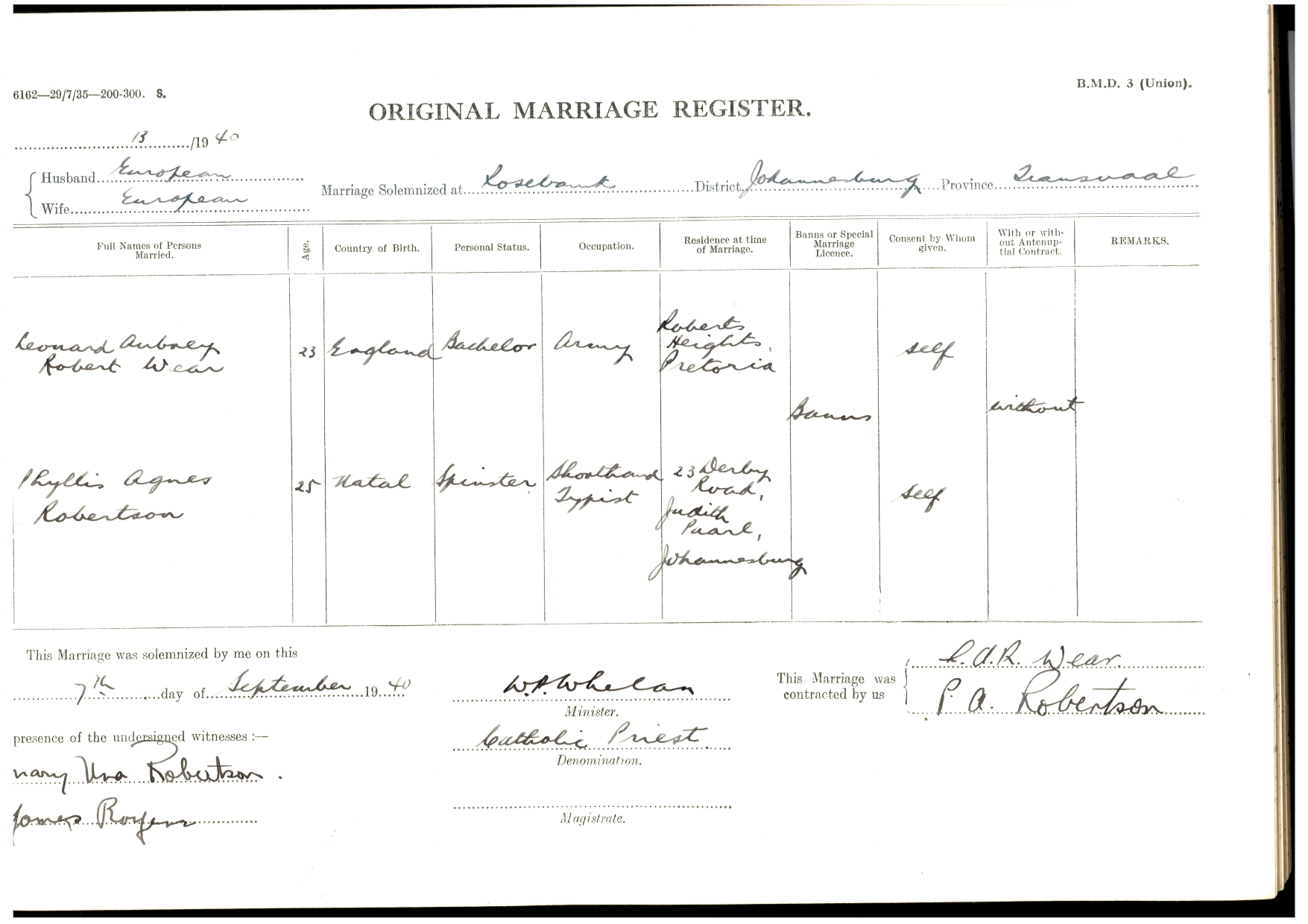
Duplicate Original Marriage Register, no. 13 of 1940 — Rosebank, Johannesburg
| Column | Leonard | Phyllis |
|---|---|---|
| (2) Full names | Leonard Aubrey Robert Wear | Phyllis Agnes Robertson |
| (3) Age | 23 | 25 |
| (4) Country of birth | England | Natal |
| (5) Personal status | Bachelor | Spinster |
| (6) Occupation | ARMY | Shorthand Typist |
| (7) Residence | ROBERTS HEIGHTS, PRETORIA | 23 Derby Rd, Judith Paarl, Johannesburg |
| (8) Banns or licence | Banns | |
| (10) Antenuptial contract | without | |
7 September 1940, solemnised by W. P. Whelan, who filled in the Denomination line in his own hand: “Catholic Priest”. Witnesses Mary Una Robertson and James Rogers.
Roberts Heights was the Union Defence Force’s principal base — the headquarters camp outside Pretoria, officially renamed Voortrekkerhoogte in 1939 though everyone went on calling it Roberts Heights, and Thaba Tshwane today. South Africa entered the war on 6 September 1939. One year and one day later an English-born man of twenty-three gives his occupation as Army and his address as that base.
So: Leonard was a serving soldier in September 1940. It is the first occupation recorded for him anywhere, it comes eleven years before the engineer of 1951, and it is the first thing that explains what he was doing in South Africa at all.
What not to read into it Method
Army is what the clerk wrote. Not a force, not a unit, not a number. He could in principle have been a British soldier posted to the Union. This archive’s own finding that the whole Wear household had left England before 29 September 1939 makes the Union Defence Force much the likelier of the two — he was already in the country, and enlisted there. But the register does not say so, and neither will this page.
Two routes — one closed, one open Leads
1. The SANDF Documentation Centre, Pretoria. South African service records of the Second World War survive there, and an attestation form gives full name, date and place of birth, next of kin, and in most cases the names of the parents. That is the exact gap. This archive’s whole chain rests on Leonard being a son of Henry Robert Wear and Martha Maud Castle, and the only source that says so is a seven-person family tree built by his daughter. An attestation form would make it a government record.
2. The Catholic parish register at Rosebank. Closed 22 September 2026 The reasoning was that civil registers have no parents’ columns and Catholic sacramental registers do. The reasoning was sound and the premise was wrong for this parish. The Church of the Immaculate Conception answered in a week: the 1940 marriage register survives, it contains this entry, and — in the parish office’s own words — “Unfortunately not”, it does not name the parents. There is also no second book to ask for: “There are no separate records for the banns of Marriage — the Catholic Church keeps one Marriage Register, the banns are included in the attached.” The page reproduced above IS the parish register. They confirmed Fr Whelan was parish priest at Rosebank from 1935, so it is the right church, and the books are at the parish rather than the Archdiocese. This route is closed by the only person who could close it, and route 1 is now the whole of it.
The two weddings, side by side
| 1940 | 1951 | |
|---|---|---|
| Status | Bachelor | Divorcee |
| Occupation | Army | Engineer |
| Lives at | Roberts Heights, Pretoria | Polana Ct, Abel Rd, Berea |
| Married by | banns, by a Catholic priest | special licence, at the magistrate’s office |
| Contract | without | with |
| Witnesses | the bride’s own people | two names with no evident tie |
Eleven years, and the second wedding is the quiet one. That is a shape, not a fact, and it is set down here as a shape.
Leonard, in his own handwriting 15 September, night
Everything above names Leonard from the outside — a birth index, a census line at the age of four, a sister's marriage, a daughter's tree, and a shape in the DNA. Until tonight this archive had not one document in which Leonard himself appears as an adult. It has one now.
Chasing his death year instead turned up the register of his second marriage —
which the archive knew of only as an index line. South Africa, Civil Marriage Records,
1801–1974, entry 1:1:6ZHR-R9ZG, image 3:1:3Q9M-CSX6-H9FS-M,
digital film 008019258, frame 2700. The image is 5,111 × 3,803
and was rebuilt from its 300 deep-zoom tiles to read the sideways column.
Duplicate Original Marriage Register, Johannesburg, no. 1397 of 1951
| Column | Leonard | Marjorie |
|---|---|---|
| (2) Full names | Leonard Aubrey Robert Wear | Marjorie Eileen Dunlop (born Walker) |
| (3) Age | 34 | 34 |
| (4) Country of birth | England | England |
| (5) Personal status | Divorcee | Divorcee |
| (6) Occupation | ENGINEER | School Mistress |
| (7) Residence | Polana Ct., Abel Rd., Berea, Johannesburg — written once, across both rows | |
| (8) Licence | Special Licence no. 205044 | |
| (10) Antenuptial contract | with | |
| (11) Remarks | “Order filed” | “Order filed” |
Solemnised 30 October 1951 at the Magistrate’s office, Johannesburg. Witnesses J. D. Malzer and L. H. Beck. Signed L.A.R. Wear and M.E. Dunlop.
He was an engineer. That is the first occupation ever recorded for him anywhere.
And he was living in Berea. Polana Court, Abel Road, Berea, Johannesburg. Ivone’s address on the Germiston register of February 1948 was 42 Joel Road, Berea. Abel Road and Joel Road are a few streets apart.
How much weight that carries Say the weakness with the fact
Not much, on its own. Berea was a dense inner suburb of tens of thousands of people. The two addresses are three and a half years apart. Nothing here places the two of them in a room together, and a shared suburb is not a document.
What it is: the first geographic overlap this archive has found between Ivone and the man the DNA points to. Every previous link ran through segments and indexes. This one is two street names. It belongs on the record, and it belongs on the record with this paragraph attached to it.
A third ante-nuptial contract New lead
Column 10 reads with. So a notarial contract was executed for Wear–Dunlop, Johannesburg, October 1951 and registered in the Deeds Office, alongside the two already sought for Kurt (June 1948, February 1956). An ANC recites the parties’ full particulars and is not confined to an eleven-column form. It is now the best available document naming Leonard in his own right, and it goes on the list for the Pretoria researcher.
One smaller thing falls out. FamilySearch’s index gives Marjorie’s birth year as 1927. The register says she was 34 in October 1951, which is 1917 — the same year as Leonard. The index is wrong and the register is the document.
And then the family turned up in the cemetery 15 September, late
The Letchworth household was supposed to be the English end of this story. It is not. Johannesburg’s burial records hold the parents.
| Henry Robert Wear, aged 80 | died 11 September 1969, buried West Park Cemetery, Johannesburg, 13 September |
| Martha Maud Wear, born 1896 | died 16 March 1986, aged 90, buried Johannesburg |
| Bruce Wallace Wear, born 1936 | married Jillian Anne Thorp at Kuruman, Cape Province, 21 November 1959 — so the “Bruce W” of the Hitchin index is Bruce Wallace, and he crossed too |
The whole household moved. Leonard was there by 1940, Cynthia married there in 1952, Bruce married in the Cape in 1959, and the parents died there in 1969 and 1986. The DNA put Derrick inside a family in a Hertfordshire market town; that family turns out to have picked itself up and moved to the city he was born in.
Six children, and only two of them sons 15 September, late
The GRO birth index carries the mother's maiden name from September 1911, which means a couple's whole family can be listed directly rather than guessed at from census nights ten years apart. Searched: surname WEAR, mother's maiden name CASTLE, all of England and Wales, all years.
| Registered | District | |
|---|---|---|
| Leonard A R Wear — Q1 1917 | Hitchin | Son |
| Janette E M Wear — Q4 1919 | Hitchin | Daughter |
| Kathleen E Wear — Q1 1921 | Hitchin | Daughter |
| Cynthia Y E Wear — Q2 1931 | Hitchin | Daughter — married at Johannesburg, 1952 |
| Linda A Wear — Q2 1933 | Hitchin | Daughter |
| Bruce W Wear — Q3 1936 | Hitchin | Son — eleven in June 1948 |
Which closes it Inferred, but no longer circumstantially
Six children. Two sons. In June 1948 one of them was thirty-one, and the other was eleven.
The DNA says Derrick’s biological father was a son of Henry Robert Wear and Martha Maud Castle. The index says there were exactly two — Leonard, born 1917, and Bruce, born 1936 — and in June 1948 Bruce was eleven. The naming of Leonard Aubrey Robert Wear no longer rests on him being the only son anybody happened to have found.
Two of these six may be living, and are named anyway, at the direction of the family this archive belongs to. They appear here exactly as they appear in the General Register Office index and nowhere else — a name, a quarter, a district — and nothing further about either of them is published. See the method page.
Limits, because they are real. The index covers England and Wales only — a child born abroad would not appear, though the births run continuously at Hitchin from 1917 to 1936, so the family was there throughout. The index does not give sex; if the 1936 child is not a son, the conclusion is only stronger. And it clears up a loose end: Eileen Mary Wear b.1914 and Laurence Anthony Wear b.1915, both registered at Hitchin, are not in this list — their mother was not a Castle. A different Wear family in the same district.
Two documents would still be better than an inference: WLD 2026/1951, the divorce, and WLD 790/1957, an opposed application brought against his first wife six years later — applications of that kind are usually about children. Both are in the National Archives at Pretoria and can be ordered by number.
And the Y cannot help yet Checked, negative, and the negative means little
If this is right, Derrick's Y chromosome is a Wear Y, from Henry Robert Wear of Bermondsey. So the surname projects were checked. Of the 7,748 public members of the R-U106 project, only 34 sit under R-S11477, and the surname projects with members there are Ballew (16), Stafford (8), Blakely (8), Byrd (5) and York (4). No Wear, Weir or Ware.
That is not evidence against anything. The branch is barely tested, and its common ancestor lived around 200 BCE — ninety generations before any surname existed. The test that would actually settle it is a living male-line Wear descendant taking a Y test, whose result should be Derrick's. That is cheaper and sharper than Big Y-700, though Big Y would at least put Derrick on a branch young enough for a surname to mean something.
A correction owed to the person it was sent to Retracted
This morning’s message to the 292.7 cM match told her that her tree was wrong and Caroline was born a Walls, not a Wallis. Her tree is right. It has Joseph Wallis, 1827–1912, which matches the 84-year-old widower in the 1911 house exactly. The spelling came from a FindMyPast transcription of somebody’s handwriting, and a transcription is not a document. What the census actually adds is that Caroline’s father was living with them — not a new surname.
Somebody else had already joined him to a Castle 15 September, night
This archive reached Leonard Aubrey Robert Wear from the English end: a birth registered at Hitchin in 1917, the 1921 census at Letchworth, and a search of the birth index on the mother’s maiden name. No record anywhere gave him parents — FamilySearch’s own tree profile for him has none to this day. The link was ours, and it was an inference.
Then the family found this Independent
A small MyHeritage tree — seven people, last touched in May 2018, kept by a South African family who know nothing of Baldock, Letchworth or this research:
| Leonard Wear | b. 1917, United Kingdom · d. 1973 |
| Parents | <Private> Wear · “Muad” Wear, born CASTLE |
| Wife | Phyllis Wear, born Robertson, 1915–2002 |
| Child | <Private> Nel, born Wear — living |
“Muad” is Maud. Martha Maud Castle, of Baldock, Hertfordshire — the woman this archive named from a birth index three days ago, sitting in a stranger’s tree as Leonard’s mother, and put there in 2018.
Two lines of work that never touched each other arrive at the same woman. This is the strongest corroboration the Wear reading has had, and it did not come from the DNA at all.
Held at its proper weight. A user-submitted tree is not a document — it can be wrong, and this one disagrees with FamilySearch about when Phyllis died (1973 here, 20 July 2004 at Key West, Florida there). What it cannot plausibly be is a coincidence: there is no reason for an unrelated South African family to give a Leonard Wear born in England in 1917 a mother called Maud Castle unless she was.
And it names the half-sister If the reading holds
Leonard had a daughter, and the tree says who she is without meaning to. Its profile page labels him “Father (of site manager)” — so the <Private> daughter is the person who built the tree, and opening it with her as the main person shows the name unmasked: Gillian Nel. Which is, exactly, Gillian Agnes Louisa Nel, born Wear, 1941–2024, married Willem Adrian Nel in 1969 — born a year after Leonard married Phyllis Agnes Robertson, and carrying her mother’s name.
On the reading this archive is testing, she was Derrick’s half-sister. She died in 2024, so the one test that would have ended this in a single reading — half-siblings share about 1,750 cM and nothing else looks like it — is no longer possible.
The whole tree is seven people: Gillian, her parents, and her four grandparents — and it stops there. It records no children for her, which is not evidence she had none: a tree built to record where you came from does not contain your descendants. Her 2024 estate file names her heirs, and that is the document to get.
Two more things fall out of opening it. Her Robertson grandparents are entered as Edgar and Sabine Robertson, which independently corroborates FamilySearch’s Anatole Edgar Robertson and Sabine Marguerite Momple. And Leonard’s own father is blank in it — she knew her grandmother was a Castle and did not know, or did not write down, that her grandfather was Henry Robert Wear of Bermondsey, who is buried at West Park in the same city. That much this archive can give her family back.
Does he have brothers or sisters? Asked 15 September
On the line of record: none — with one exception that is not on that line at all
Kurt Israel Luwinski married three times — Frances Hostowsky, Ivone in 1948, and Pauline Rappoport in 1956 — and one child is recorded across all three. On the paternity of record, Derrick has no brother or sister.
The exception comes through his mother, and so it survives whichever way the father question falls: Henrique Figueiredo Pinto da Rocha, 11 March 1941 – 27 October 2022, Ivone’s son by her first marriage. He is Derrick’s half-brother on either reading, because the dispute has only ever been about the father. His estate, 12294/2023, is the file this archive first wrote away for.
On the DNA line: unknown, and one name that is only a candidate Open
Leonard was married from 1940 to 1951 and again from 1951 to 1962. WLD 790/1957 — an opposed application he brought against his first wife six years after she divorced him — is the kind of case that is usually about children. But no child of his has been documented.
There is exactly one name in the Johannesburg records that fits the shape, and it is offered as nothing more than that: Edwina Ann Wear, born 1945, died 30 June 2014, cremated at Braamfontein. The right surname, the right city, born inside his first marriage. Her parents are not recorded in anything found so far, and until they are she is a coincidence with good timing.
Everything findable about her has now been searched, and it runs out. The gazette gives her birth date — 28 May 1945 — her identity number 4505280044086, an address at 17 Pollie Street, Homestead, Germiston, and no surviving spouse, which on that form means there was none. She was cremated, not buried: certificate 65676, ashes released on 9 July 2014 to the undertaker rather than to any relative, so there is no grave and no stone to read. There is no marriage, no married surname, no obituary, no memorial. Google returns nothing for her name at all.
One document names her parents and it is offline: the death notice inside estate 33157/2014 at the Master of the High Court, Johannesburg. Until it is read the honest answer to does Derrick have siblings on this side is: yes — but she is the daughter in the Nel tree, not necessarily this woman.
Working the sons, and one that has to be left alone 15 September, evening
Ernest is out, on a document rather than an argument
The 1939 Register has him at 29 Norton Crescent, Baldock: Ernest Castle, born 28 November 1904 — “Butcher (Incapacitated)”, married, with Mabel (b. 1908) and children in the house. Incapacitated answers to the invalid of the 1911 census, thirty-eight years apart. A married, settled, disabled butcher in a Hertfordshire market town in September 1939 is not the man in Johannesburg in June 1948.
Frederick, and a caution this archive is publishing rather than papering over Unproven
A Frederick Castle married Ella Newman at Hitchin in the third quarter of 1922, and the 1939 Register puts them at 17 Orchard Road, Baldock — he a vertical driller on aircraft work, she at home, and with them one officially closed record: a child born after 1912. A son there would be exactly what the further reading needs.
And it may well be the wrong Frederick. The 1939 Register gives his birth as 10 April 1887. The 1901 household gives Frederick as eleven — born about 1890 — sitting beside a sister Ada aged fourteen. Two siblings born three months apart is not possible. And the Hitchin birth index contains no Frederick Castle born between 1889 and 1892 at all; what it contains is Frederick James Castle, born 1887.
So either a census age is wrong, or there are two Castle families in Baldock and this is the other one. The archive does not know which, and is not going to decide it by preference. It is written down here so that the next person does not inherit it as a fact.
An objection worth taking seriously
“Kurt was twelve before his parents married. What if Jacob wasn't his father — could Kurt still be Derrick's?” Asked 15 September 2026
It is the best objection anyone has put to this page, because it attacks the right joint. Almost everything here assumes Kurt was Jacob's son. He was born on 11 May 1912 to an unmarried Auguste Luwinski, carried her surname, and his parents did not marry until 5 January 1924 — twelve years later. Jacob's paternity of Kurt was never documented at the birth. So: if Jacob were not Kurt's biological father, Kurt would carry no Ashkenazi ancestry, his Y-chromosome would be some other man's, and both of this page's main arguments would collapse.
It fails, and it fails on Auguste rather than on Jacob. Whoever fathered Kurt, Auguste was still his mother — that is the one thing the 1912 entry does record, and it is why he bore her name. So if Kurt were Derrick's father, Auguste would be Derrick's grandmother, and roughly a quarter of Derrick would be her: East Prussian, from Sauerbaum and Allenstein.
| Derrick's estimate, as reported | |
|---|---|
| Portuguese | 60.6% |
| English | 18.5% |
| French · Danish · Breton | 5.8% · 5.4% · 5.3% |
| Dutch · Scottish and Welsh | 1.5% · 1.5% |
| Germanic | 1.4% |
| Ashkenazi Jewish | 0.0% |
There is no room for a German grandmother. Every non-Portuguese percentage points at the Atlantic and the North Sea — English, French, Danish, Breton, Dutch — some 38% of him, against 1.4% Germanic. MyHeritage even names his additional genetic groups as “Southeastern and Eastern England” and “England”.
So the objection does not rescue Kurt. It would have had to survive two independent tests and it only addresses one: rewriting Kurt's father leaves Kurt's mother exactly where she was, and Auguste is not in Derrick's DNA either.
But the question underneath it is a real one, and it is already in the post Open
Was Jacob Leibholz actually Kurt's biological father? That is a separate question from Derrick's paternity, and this archive cannot answer it from DNA — there is no sample from Kurt and none from any Leibholz. But the paper is thinner than the family tree suggests, and one detail is genuinely odd.
Under German law a child born to an unmarried mother took her surname, and Legitimation durch nachfolgende Ehe — legitimation by the parents' subsequent marriage — would ordinarily have made him a Leibholz in 1924. He stayed a Luwinski, to his death in 1968, and registered his own son under that name. Meanwhile his brother Siegfried, born in August 1925 after the marriage, was a Leibholz from the start.
That asymmetry has an innocent explanation — a family that simply never bothered to change a grown boy's name — and a less innocent one. The archive does not know which, and the 1912 birth entry is the document that decides it: a marginal note of Vaterschaftsanerkennung or legitimation, or the absence of one.
It was asked for on 15 September, as the third question in the letter to the Landesarchiv Berlin — before this objection was raised, and for the same reason. If the margin is blank, then Kurt's descent from Jacob rests on nothing but family memory, and this archive will say so.
The replies were already in the inbox Found by accident, 15 September 2026
Every one of them had been written to in June 2025, and three answered
Opening MyHeritage's message window to send a carefully drafted first approach revealed that the matches had all been contacted fifteen months earlier, with one template — and that three of them had replied with names. Nothing in this archive had used any of it. It was found by accident, and it is the worst process failure of the project.
Two things follow at once. The non-paternity was already disclosed to these people in 2025, so the delicacy being written into fresh drafts was, to that extent, beside the point. And the original template asked the wrong question — it asked each of them to work out how they were related and to share a tree, which is labour, rather than telling them something they could react to.
What the three said
The second cousin at 333.9 cM, 18 June 2025 — and he offered everything. “You are very welcome to all the information I have — do you have access to Ancestry? Or I could draw it out. It seems likely Derek and I are related through Great Grandparents … My Paternal Great Grandparents are Harrison / Randall and Crisp and Bray.” He was never answered. It also explains why his MyHeritage tree holds three people: his real tree is on Ancestry. And because his paternal great-grandparents are Harrison, Randall, Crisp and Bray, the Brown in his surname list must be maternal — which is exactly what the Brown–Castle reading requires.
And one remark that does not fit. He checked Salkow, de Witt, Luwinski and Rocha against his own matches, and reported that “Rocha was the only name which appeared.” Rocha is Ivone's side — the maternal, Portuguese one. Either he has an unrelated Portuguese connection, or the tidy split of this archive's two clusters is wrong somewhere. It is the one loose thread in the whole DNA picture, and it should be put to him directly. Open
The closest match of all, 17 June 2025 — and she named four grandparents. Her maternal grandparents were John and Elsie Parr; her paternal grandparents Mervin and Cynthia Halsey, Cynthia born Weir, her mother possibly Mord. Since her common ancestors with Derrick are his own grandparents, one of those couples ought to be the join — most plausibly the Halseys. Four new surnames to work: Halsey, Parr, Weir, Mord.
And the sentence worth staring at, from the match at 165.9 cM, also 17 June 2025: his great-grandfather was “Walley Brown, who was married twice (possibly at the same time)” — and this was on his mother's side. A Brown great-grandfather, maternal, married twice and perhaps bigamously, is precisely the shape of thing that leaves a branch nobody has traced. And Walley may well be Walter — the big tree's grandfather is Walter George Brown, 1889–1971. He added that his sister keeps the family tree and he would pass the message on. Nobody followed up with her either.
What it changes Method
- No cold letters. Everyone in the British cluster already has an open thread. The follow-up sent today went into the existing one, because the drafted version opened “I hope you don't mind a message out of the blue” — which would have been false.
- Answer the man who offered his tree, first. Fifteen months late is better than never, and the offer may still stand.
- Ask for the sister who keeps the other family's tree.
- Put the Rocha question directly. It is the only fact on the table that the two-cluster model cannot absorb.
- The drafted letter to the closest match is obsolete — she has already answered the question it asks.
Read the inbox before writing to it. A day went into composing careful first approaches to people who had already been approached, three of whom had already replied with names.
What would settle it
Y-DNA. The paternal line, tested directly.Done, 14 September 2026: R-S11477. See below.The British cluster.Done — see above. It gave the surnames and the city. What remains is a message to the closest match, which this archive will not send on anyone's behalf.Shared-match triangulation.Done — see above. One family, and the nearest surname on it is Halsey.- A search of all 5,464 for Leibholz, Luwinski, Thimm and Fricke. Absence across the whole list, and not merely the top of it, would be conclusive.
The Y-DNA came back: R-S11477
Consent was given on Derrick's own kit on 14 September 2026 and the result appeared the same day. This is the test the archive had nominated as the one that would break the finding or confirm it. Documented
R-S11477 — R1b, and specifically the North Sea branch
MyHeritage's own page puts it plainly: “R-S11477 is a human paternal lineage nested within the broader R-Z381 haplogroup. Every man who carries it descends from a single ancestor who lived around 200 BCE.” The haplogroup-family badge on the same page reads R1b / Z381, and the node above it on the time tree is R-FGC13328, about 600 BCE.
The chain is R1b → M269 → P311 → U106 → Z381 → FGC13328 → S11477, and the branch that matters is U106. U106 is the North Sea, Germanic branch of R1b: it peaks in the Netherlands at about 37%, and runs at roughly 21% in Germany and Austria and 18% in England and Denmark.
Ashkenazi paternal lines do not look like this. Haplogroup J alone accounts for about 38% of the Ashkenazi paternal gene pool; the characteristic lineages are J1, J2, E1b1b, R1a and G. R1b does occur among Ashkenazi men — but the literature describes R1b-M269 there as repeated punctuated introgression of European Y chromosomes, and the two Ashkenazi R1b clusters that are identifiably Near Eastern belong to R1b-Z2103. A different branch of R1b entirely. Not U106.
Where the branch lives
Self-reported earliest known paternal origin, from the 74 R-S11477 testers MyHeritage can see.
| Country | R-S11477 testers | Total testers |
|---|---|---|
| United States | 29 | 30,253 |
| England | 19 | 27,563 |
| Germany | 7 | 17,457 |
| Scotland | 3 | 14,026 |
| United Kingdom | 3 | 9,712 |
| Northern Ireland | 2 | 2,869 |
| Russian Federation | 2 | 7,172 |
| Netherlands | 2 | 2,289 |
| Finland · France · Norway · Sweden · Ireland · Poland · Estonia | 1 each | — |
British Isles 28. United States 29. Germany 7. No Israel, and none of the countries that dominate Ashkenazi paternal testing. And note where the two independent systems meet: the autosomal cluster is British with a Johannesburg branch, and the Y-haplogroup's largest European population is England.
What it proves — and what it does not Read this before quoting it
This is not a comparison with Jacob Leibholz's Y-chromosome. The archive does not have Jacob's, and it almost certainly never will, because his male line is exhausted:
| Jacob's male line | Where it ends |
|---|---|
| Kurt → Derrick | Kurt's only son of record is the man whose paternity is the question |
| Siegfried → Michael Kurt Leibholz | b. 15 November 1951, d. 3 November 2005, no children recorded |
| Samuel | Murdered at Auschwitz, 1943. No sons recorded |
| Oskar | Died at Theresienstadt, 1944. No sons recorded |
| Georg → Werner, b. 1913 | And this archive already argues Georg was not Jacob's brother — so Werner's Y would not be Jacob's either |
So the Y-DNA works by character, not by comparison. It says that Derrick's unbroken father-to-father line belongs to the branch of R1b that peaks in the Netherlands and England, and not to any lineage characteristic of Ashkenazi Jewish paternal descent.
On its own that would not be decisive. A Jewish family can carry a European Y-chromosome — that is exactly what “European introgression” means, and it is why nobody should argue from a haplogroup alone.
But it is not on its own. It is the second independent system to return the same answer. The autosomal estimate says 0.0% Ashkenazi where a quarter is required. The Y-chromosome says the paternal line is North Sea R1b. Different molecules, different inheritance, no contradiction between them, and no evidence anywhere pointing the other way.
The sweep of all 5,464, finally done
This was the archive's oldest outstanding item, and every earlier attempt was beaten by the filter interface. The tool was there all along: with the right kit selected, the DNA Matches page has a search box labelled “Name or ancestral surname”, which searches each match's own name and the ancestral surnames declared in their tree, across the whole list.
Leibholz: nothing. Luwinski: nothing. Exhaustive
| Searched across all 5,464 matches | Result |
|---|---|
| Leibholz | No DNA Matches found |
| Luwinski | No DNA Matches found |
Not one of the 5,464 people who share measurable DNA with Derrick carries either name or lists it among their ancestors. This page has said from the beginning that there is no German or Jewish cluster near the top of the list. That was a statement about six matches opened in full. It is now a completed search.
The Portuguese half of that sweep was overstated, and is withdrawn Self-corrected
For about an hour this page said the same search had found Ivone's family — 27 matches for Figueiredo, 13 for Mota — and called it the best lead on her parentage the archive had ever had. That was written before a single one of those matches was opened. Opening them undoes it.
“Shared ancestral surname” is a string match. On the top Figueiredo match — 29.0 cM, fifth or fourth cousin — the two people MyHeritage is pairing are Ivone Mota Figueiredo, born 1922 at Lourenço Marques, and Águeda Maria de Figueiredo, the match's direct ancestor six generations back, born before 12 April 1713. Two centuries and an ocean apart, joined on a string, in a country where Figueiredo is one of the commonest names there is. The shared place is no better: it resolves to “Portugal”, and beside the match's own parish the panel reads “No ancestors in derrick's tree.”
And the Mota matches share no surname with him at all. MyHeritage says so on the 50.1 cM match in plain words. The reason is in Derrick's own indexed surname list — Figueiredo, Leibholz, Luwinski, Schmul, Thimm — which does not contain Mota, because the source tree carries it as a middle name. The thirteen hits were other families' Motas.
The archive already held much better Portuguese matches, worked weeks ago and still on Ivone's page: 108.7 cM at second cousin's son, and 133.2 cM. A 29 cM surname coincidence was never going to beat them. The lesson is cheap and worth keeping: open the match before believing the label.
What the sweep did establish Documented
The two zeroes stand, and they are stronger than they looked. MyHeritage indexes Leibholz and Luwinski as two of Derrick's own five ancestral surnames. So the search was not firing blanks at terms the system had never heard of — it had real, indexed names to match, and across 5,464 people it returned nothing for either.
And there is no computed path to anybody. Filtering his matches for Has Theory of Family Relativity returns “There are no DNA Matches that fit your criteria.” MyHeritage has built no relationship path to a single one of the 5,464. Whatever is found here will be found by hand. Negative, and clean
One loose thread, recorded as loose. The two Portuguese matches that were opened both trace to the Viseu district — Treixedo in Santa Comba Dão, and Tondela and Castro Daire. The three are not one place: Treixedo and Tondela are nine kilometres apart, Castro Daire is forty-five kilometres from Tondela, and fifty-four separate the two furthest. Worth noting; not worth believing. Both are distant, one has no documented link to Ivone at all, and the closest Portuguese match by a wide margin records no place more specific than “Portugal”. If Viseu were the family's district, the strongest match ought to show it. Open
A document has since walked into the same concelho from the other direction. Ivone’s own birth registration, supplied by the family in September 2026, gives her father’s parish as VIMIEIRO and her mother’s as NEGOZELA. Both are freguesias of Santa Comba Dão — and Nagozela and Treixedo were merged into a single parish in 2013, which is to say they adjoin. Her mother came from the parish this match’s parish was merged with.
Every caution above survives intact: the matches are distant, one has no documented link to Ivone, and the closest Portuguese match still says only “Portugal”. What changed is the size of the coincidence, not its status. It was a district — Viseu has twenty-four municipalities and half a million people. It is now one concelho of eleven thousand and two adjoining parishes inside it, arrived at from a register that knows nothing about DNA. That is worth more than a match list agreeing with itself, and it is still not a relative. Recorded as what it is: a coincidence that got smaller.
Can the Y line be named from the men who share it?
Yes — but not from this result, and the reason is arithmetic Tested
FamilyTreeDNA's Discover pages are public, and they list the projects whose members carry R-S11477: Ballew (16 members), Stafford (8), Blakely (8), Byrd (5), York (4), plus a Norman England group and a German-language group. Real surnames, English and Anglo-American, on Derrick's own paternal branch.
They cannot name his father, because surnames are about 800 years old and this branch is about 2,200. R-S11477's common ancestor lived around 200 BCE. Every Ballew and Stafford on it is a cousin at roughly ninety generations, descended from a man who lived before any of those names existed.
That is the theory. It was then tested against Derrick's own match list:
| Y-branch surname | Matches in Derrick's 5,464 | Closest |
|---|---|---|
| Ballew | 2 | 5th cousin, 0.3% (23.4 cM) |
| Stafford | 13 | 5th cousin, 0.3% (22.1 cM) |
| Blakely | 6 | 5th cousin, 0.4% (28.4 cM) |
| Byrd | 15 | 5th cousin, 0.3% (21.5 cM) |
| Yorke | 2 | 4th cousin's son, 0.2% (17.0 cM) |
Every one lands between 10 and 28 cM, at the noise floor, and not one is near the close British cluster at 297–334 cM. The prediction was that these surnames would be genealogically meaningless. The match list agrees.
The arithmetic, done properly at last New, 11 October 2026
Those counts had been copied from Discover for three weeks and nobody had put a base rate under them. The base rate is the master gateway project: 21 of the 23,730 public members of “R1b ALL Subclades” sit on R-S11477 — 0.0885 per cent. That is what “a project contains this branch” looks like when nothing is going on.
| Project | Kind | On the branch | Project total | Share | vs base |
|---|---|---|---|---|---|
| R1b-P89.2 | haplogroup | 33 | 63 | 52.4% | 592× |
| Ballew Family DNA | surname | 16 | 62 | 25.8% | 292× |
| Blakely | surname | 8 | 68 | 11.8% | 133× |
| Stafford | surname | 8 | 96 | 8.3% | 94× |
| Byrd | surname | 5 | 102 | 4.9% | 55× |
| York, Yorke | surname | 4 | 85 | 4.7% | 53× |
| R U106 | haplogroup | 34 | 7,785 | 0.437% | 4.9× |
| England GB Groups EIJ (Norman) | geographic | 5 | 5,088 | 0.098% | 1.1× |
| R1b ALL Subclades | haplogroup | 21 | 23,730 | 0.0885% | 1.0× |
| Germany-YDNA | geographic | 4 | 5,420 | 0.074% | 0.8× |
| R1b1a2 Iberian | haplogroup | 1 | 2,117 | 0.047% | 0.5× |
The two geographic projects carry no signal at all. The branch sits in a large English project and a large German project at chance. A note here had told the next session to go and read their member lists; that instruction is withdrawn, because it would cost an afternoon and return nine men whose presence means nothing. R1b-P89.2’s 592× is circular — it is a project defined by a SNP on this very branch.
And the five surname projects, ranked below them, are enriched fifty-three to two hundred and ninety-two times. Which corrects a sentence this archive has printed: “no surname has surfaced and none is predicted to” is true in its meaning — nothing in the public Y record names Derrick’s biological father’s line, and that is not weakened — and misleading in its words, because five surnames do sit on this branch far above chance. The honest form: five surnames sit on this branch at fifty-three to two hundred and ninety-two times chance, and not one of them is Wear, Weir or Ware.
It does not make him a Ballew. A surname project’s enrichment says that one documented paternal line of that name carries this branch; it says nothing about which of the branch’s other members descend from it. What it does is name the places a paper trail would have to come from if one ever comes — Ballew, Blakely, Stafford, Byrd, York, in that order of strength, and nowhere else in the thirteen.
The countries flatten the same way. Raw counts read Anglo-German — United States 30, England 18, Germany 7 — but against each country’s own pool in the same database the United States is 2.3× base, England 1.5× and Germany 0.95×, which is exactly chance. Estonia reads 7.5× and is one man; it is written down only so nobody later reads it off a chart. And 167 of 242 branch members state no origin at all, so every rate above is computed on under a third of the branch. The denominator is a sample of men who joined a project, not a population, and that is the honest limit of the whole table.
What would work: a Big Y-700, which would place Derrick on one of the 42 branches below R-S11477 — terminal branches in a well-tested lineage are often only three to six centuries old, and at that depth a shared branch usually does mean a shared surname. It would also open FamilyTreeDNA's Y-DNA match list, which is the literal answer to the question and which MyHeritage does not provide at all: a list of men sharing the paternal line, each with their earliest known ancestor's name, year and birthplace.
But the Y is not the best tool available here, and it is worth saying so. The Halsey match is Derrick's first cousin's daughter at 297.5 cM — which means their common ancestors are Derrick's biological grandparents. The surname being looked for is that grandfather's, and it is in her family tree, not in anybody's chromosome. The Harrison match is a second cousin at 333.9 cM, in the United Kingdom. Two messages could produce a name; a Big Y produces a branch number and a probability. Both are worth doing, in that order.
The label does not change, and that is the point Inferred
The method page has said since this archive was built that the paternity finding stays Inferred until a Y-DNA result moves it. The result has been run. It did not overturn the finding — it corroborated it from an independent direction — and there is no further test available, because Jacob's male line has ended.
So the tag stays Inferred. There is still no document and still no direct comparison, and a finding does not become Documented because it survived a test. What has changed is that the test nominated to break it was run, and it held. The archive can now say so without hedging.
Two things would sharpen it further. Big Y-700 — MyHeritage calls its own result a low-resolution estimate; a full sequence would pinpoint the terminal branch and place Derrick in a surname project, and the nearest surname in the British cluster is Halsey. And one message: if any of the Halsey, Harrison or Browne matches is a man descending father-to-father from that family, his Y is directly comparable to Derrick's, and that costs nothing at all.