Lynn Derrick Luwinski
Living. Named, and nothing more.
This archive is organised around him and tells almost nothing about him. That is deliberate.
What is published here
- Name
- Lynn Derrick Luwinski
- Father
- Kurt Israel Luwinski — of record, and the man who raised him. Not his biological father: the DNA excludes him, and who the biological father was is still open.
- Mother
- Ivone de Figueiredo
Nothing further. No address, no occupation, no photograph, no descendants.
The join
Two lines meet here and go no further. Nothing below him is drawn — not because nothing is known, but because he is living and this archive publishes a living person's name and their relationship to the dead, and nothing else. Kurt Israel Luwinski is drawn here as his father of record and of upbringing, which is what he was. He is not his biological father and that is not in dispute — the DNA excludes him twice over, 0.0% Ashkenazi where a quarter would be required and a Y haplogroup that is North Sea rather than Ashkenazi. What is open is who the biological father was, not whether it was Kurt. And the family has since said what no document here could: Kurt raised him. The tree draws both lines.
Why a living man is the centre of an archive that will not describe him
Because he is the join. Every line this archive follows runs through him and stops there. His father's line goes back to a Berlin tenement and a transport to Auschwitz. His mother's goes back to a Portuguese colonial town on the Indian Ocean. Neither of those families knew the other existed until 1948, and they were finished with each other by 1951.
The policy of the sibling archives is that living people are omitted from the build entirely — not hidden, not gated, not present in the output. Here that rule is bent exactly once and no further: Derrick is named, because an archive about his ancestry that refused to say whose ancestry it was would be absurd. Everything else about him is left out.
What is known and not published
A good deal. The source tree records more, and the research file holds more still — including the DNA that prompted the central finding of this archive. It stays in the private notes. If Derrick wishes any of it published, or wishes his name removed as well, either is done on asking, without argument and without requiring a reason.
His own paternal line, read at last
R-S11477 14 September 2026
Everything else in this archive is about people who left documents. This is the one fact that came from Derrick himself, and it is the oldest thing in the collection: an unbroken line of fathers reaching back to a single man who lived around 200 BCE.
The haplogroup is R-S11477 — R1b, branch U106/Z381, the North Sea lineage that peaks in the Netherlands and runs at about a fifth of the men of England and Germany. It is not a lineage characteristic of Ashkenazi Jewish paternal descent, and it is therefore not the line of Jacob Leibholz, who was deported from Berlin to Auschwitz on 26 February 1943.
The archive had named this test, in writing, as the one that would break its central finding or confirm it. It confirmed it. The autosomal estimate said 0.0% Ashkenazi where a quarter was required; the Y-chromosome now says the paternal line runs to the North Sea. Two independent systems, no contradiction, and they agree on where as well as on what: his closest matches are an English family with a branch in Johannesburg, and his haplogroup's largest European population is England.
What it does not do is name anyone. It cannot be compared with Jacob's own Y-chromosome, because Jacob's male line has ended — Siegfried's only son died in 2005, Samuel and Oskar were murdered without sons, and Kurt's only son of record is Derrick. The finding rests on the character of the lineage, not on a match. The full reasoning, and its limits →
So the Berlin family is his by name, by law and by upbringing, and by the paperwork of a marriage in 1948 — and the line of fathers written into his chromosome goes somewhere else entirely. The archive holds both, and does not pretend either one cancels the other.
He was searching for the surname twenty-five years before this archive existed 27 September 2026
Among his mother’s papers, faxed from Portugal in the week she died, is a page that has nothing to do with her. It is a Lycos Genealogy search for LUWINSKI in the German telephone directories, run on 10 June 2001, printed at the time and kept. It travelled to Portugal in 2010 with her birth and death certificates.
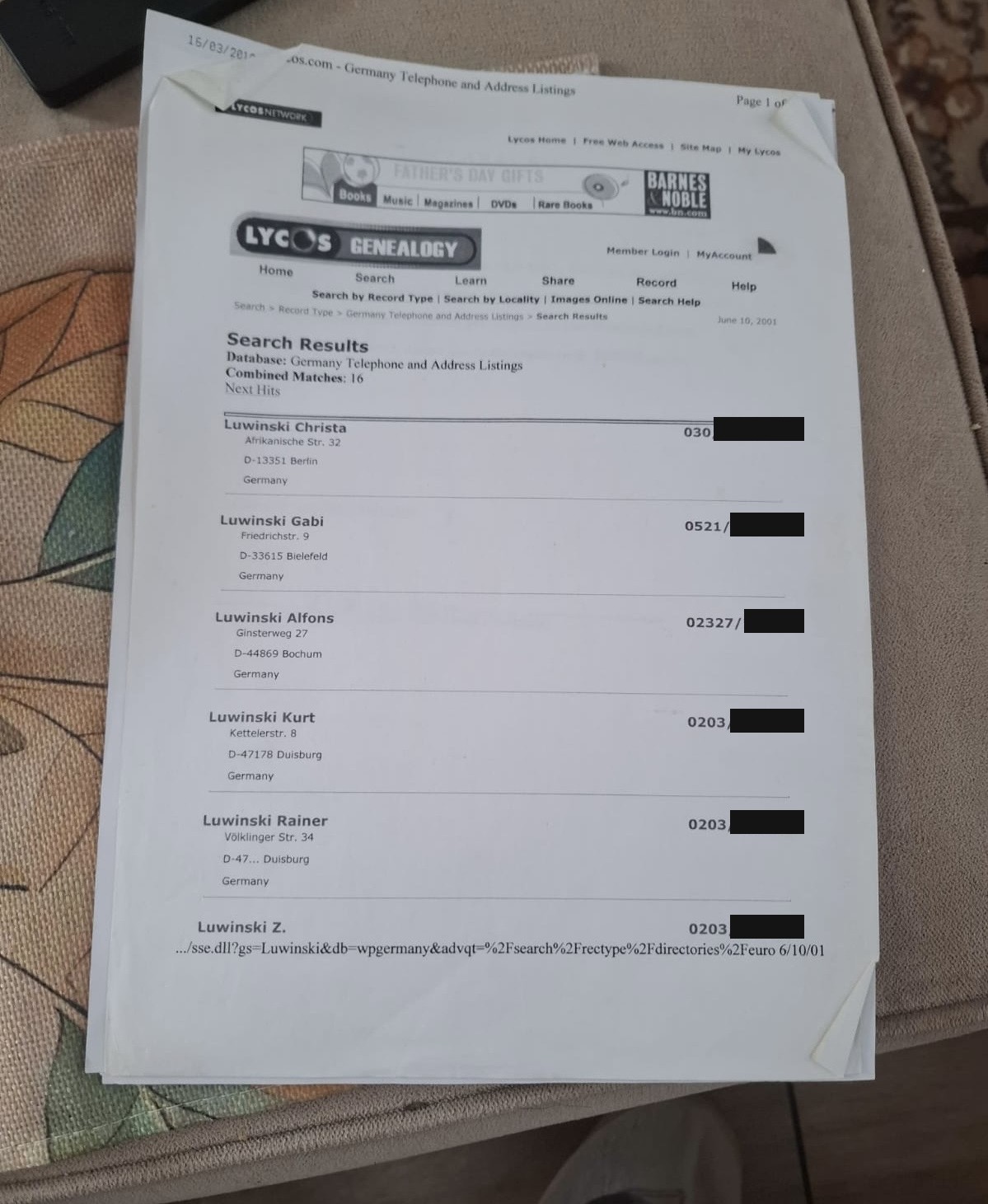
Three of the six are in Duisburg and all three are on the 0203 code — Kurt, Rainer and Z. — with Alfons at Bochum forty kilometres away, so four of six sit in the Ruhr. A rare surname clustering in one steel city is the shape of a family that moved together, and Duisburg took large numbers of East Prussian and Silesian expellees after 1945. The Berlin one is Christa, at Afrikanische Straße 32. One of the Duisburg six is called Kurt — a different man entirely, and no connection is claimed; it is recorded because the coincidence will occur to the next reader as it occurred to this one.
It is here because it is this archive’s own prehistory. The question being worked on these pages is one he asked first, on a dial-up portal, and then kept the answer to for a quarter of a century.
The two families that meet in him
There are three, and the distinction matters more here than anywhere else in this archive. His mother is not in dispute on any reading. His father is two people: the man the DNA points to, and the man whose name he carries.
Kurt Israel Luwinski is excluded as his biological father — 0.0% Ashkenazi where a quarter would be required, and a Y haplogroup that is North Sea rather than Ashkenazi. That is this archive’s central finding. It does not make Kurt’s family less his. Derrick carries their name, this archive is named for it, and the dead it has read most closely are theirs — Jacob Leibholz, his grandfather of record, deported from Berlin to Auschwitz in February 1943, and his brothers Samuel and Oskar after him.
Kurt’s own name is part of that story. He carried his mother’s surname, Luwinski, and not his father’s, Leibholz; his brother Siegfried kept Leibholz. A Catholic East Prussian name on a half-Jewish child in Nazi Berlin is not a clerical accident. The name Derrick carries was already a shelter before it was an inheritance.
And the family has answered the part the papers could not. “Kurt raised Derrick.” — David Defranceski, his son-in-law, 28 September 2026. So the man the DNA rules out is the man who brought him up, and this archive now says both instead of neither.
The court file made that look unlikely and does not actually contradict it. Kurt sued Ivone in 1948 and the child was born after he had filed — but the action was for restitution of conjugal rights and was granted only in 1951, which in South African practice was the first step of a divorce rather than the end of a marriage. The marriage ran on paper for about three years and the child was born inside it. A filing date is not a departure date. The tree sets the two lines out side by side, graded on the same ladder, because descent is not the only thing a family is.
Kurt Israel Luwinski, born Berlin 1912, in Johannesburg by 1939, died there in 1968.
Ivone de Figueiredo, born Lourenço Marques 4 March 1922, died Vila Nova de Gaia 14 March 2010. Her birth entry names her parents and all four of her grandparents.