Kurt Israel Luwinski
Berlin, 11 May 1912 — Johannesburg, 15 December 1968
He was born with his mother's name because his parents would not marry for another twelve years. He left Germany at twenty-one and never lived there again. His father, his uncles and his cousins were killed while he was cutting dresses eight thousand kilometres away.
| When | What | Status | |
|---|---|---|---|
| 11 May 1912 | Born at Berlin | To Auguste Luwinski, nineteen and unmarried. He took her surname and kept it for life. | Documented |
| 5 Jan 1924 | His parents marry | Auguste Luwinski and Jacob Leibholz, at Berlin-Schöneberg — twelve years after his birth. | Documented |
| 5 Aug 1925 | A brother | Siegfried Leibholz, born at Martin-Luther-Straße 60, Berlin-Schöneberg. Same parents; the other surname. | Documented |
| 1933? | Emigrates to Johannesburg | The year comes from the family tree and nothing else. A Berlin driving licence of 30 January 1934 now sits against it — see His own papers. | Documented |
| 30 Jan 1934 | A driving licence, in Berlin | Class 3, issued by the Polizeipräsident, to Kurt Luwinski of Meraner Straße 2, Berlin-Schöneberg. Four Reichsmarks in Prussian fee stamps. He was in Berlin. | Documented |
| 1934 | An international driving permit | Berlin, the 26th of a month the stamp no longer gives. A document for driving outside Germany, issued against the licence above. | Documented |
| from 1933 | South Africa | Occupation recorded as dress designer — his mother was a Schneiderin und Modistin. | Documented |
| 21 Mar 1940 | His parents divorce | Landgericht Berlin 251. R. 80. 40, noted in the margin of their own 1924 marriage entry on 4 April. Kurt had been seven years in Johannesburg; his brother Siegfried was fourteen. The date was unknown to this archive until the Landesarchiv sent the entry on 29 September 2026, and his father had two years and eleven months left. | Documented |
| 26 Jul 1939 | A German passport, in Johannesburg | Issued by the Deutsches Konsulat, valid one year. Occupation HUTMACHER. Wife and children columns struck through. He signs it ISRAEL KURT LUWINSKI — the 1938 decree reaching him six thousand miles from Berlin. | Documented |
| 26 Feb 1943 | His father deported | Jacob Leibholz, from Berlin to Auschwitz. Kurt had been ten years gone. | Documented |
| 19 Jun 1948 | Marries Ivone | Johannesburg, certificate 858, by special licence. He is 36, a BACHELOR, born Berlin, occupation shop keeper. She is 24, born Portuguese East Africa, and DIVORCED. Married WITH antenuptial contract, on special licence 164531 taken out ten days before, by J.J. Greyling, Magistrate. Both at 108 Dunottar Street, Sydenham. | Documented |
| 1 Nov 1941 | Buys the Piccadilly Hat Company | Hannah Court, 81 Eloff Street, Johannesburg, with Walter Oppenheimer, from Ivy Fuchs. Sole owner from 31 October 1942; still trading there in 1952. | Documented |
| after Jun 1948 | Files for divorce | Within weeks of the wedding, and before his son was born. | Documented |
| 1951 | Divorce | Illiquid case, restitution of conjugal rights: Kurt Luwinski versus Ivone, formerly de Witt, born Figueiredo. | Documented |
| 29 Feb 1956 | Marries Frances Hostowsky | Registered in the Hanover, Orange Free State records. | Documented |
| 1956 | Sues Frances for restitution of conjugal rights — in the year he married her | WLD 1878/1956. Kurt Luwinski versus Frances, formerly Sefton, formerly Berner, born Hostowsky. This archive dated it 1957 until 11 October 2026; correction 9500919. | Documented |
| 1957 | And the bank sues him | Standard Bank of South Africa Ltd versus K Luwinski — Witwatersrand Local Division, 2542/1957. Two actions in one year. | Documented |
| 15 Dec 1968 | Dies at Johannesburg | Aged 56. Buried the next day: Westpark, block L, grave 211. Estate file 7584/1969 follows in the new year. | Documented |
| 16 Dec 1968 | Buried Westpark, Johannesburg | By the Chevrah Kadisha. Yahrzeit 24 Kislev 5729. He was buried as a Jew. | Documented |
His family
Three marriages, one son, one brother, and a father whose death this archive cannot date — Jacob Leibholz's record ends with a deportation and not with a date, which is why the node beside his name carries only a birth. The prose below says what the chart cannot.
1933 — and now a question mark over it
Read this section knowing what the bottom of the page shows. The year below comes from the family tree and from nothing else, and a Berlin driving licence of 30 January 1934, from Kurt’s own papers, sits squarely against it. Either the tree’s year is wrong or he left and came back. The rest of this section is left as it was written.
The tree records his emigration in a single word and a year: Johannesburg, Süd Afrika, 1933. He was twenty-one. His father was a Kaufmann in Schöneberg; his mother a dressmaker from an East Prussian farming family. He arrived in a city with an established German-Jewish trade and took up a needle trade of his own.
Ten years later, on 26 February 1943, his father was put on a train from Berlin to Auschwitz — the day before the Fabrikaktion, the round-up of the last Jewish forced labourers in the city. Within six weeks his uncle Samuel was dead at Auschwitz too. Nothing in the record says what Kurt knew, or when.
The stone
Westpark Cemetery, block L, grave 211. Photographed by the burial society, and it carries more than his dates.
אִישׁ יָקָר וְחָבִיב
ר׳ לייב קלמן בר דוד
נפטר כ״ד כסלו תשכ״ט
תנצב״ה
IN CHERISHED MEMORY OF MY DEAR HUSBAND
(LU) KURT LUWINSKI
WHO PASSED AWAY 15TH DECEMBER 1968, AGE 56
ALWAYS REMEMBERED BY HIS LOVING WIFE PAULA, SON, MOTHER AND FRIENDS
“A dear and beloved man, R' Leib Kalman bar David, died 24 Kislev 5729.” Pauline — Paula — put it up. His mother was alive and is named on it; Auguste outlived him by seven years. “Son” is singular.
And his father's name is not Jacob Documented reading
A matzevah names the father. Jacob Leibholz would ordinarily be יעקב — Yaakov. The stone says בר דוד: bar David, son of David.
Three explanations fit, and one photograph will not choose between them:
- Jacob's Hebrew name was David. German Jews often carried a civil name and a Hebrew name that were not translations of each other. Ordinary, though not the default.
- Kurt's father was a man called David — and Jacob, who married Auguste twelve years after Kurt was born and is named as his father only in the family record, was not.
- Paula supplied the name, in Johannesburg in 1968, for a father-in-law she never met who had been dead a quarter of a century in a country she had probably never seen.
The second would be a second paternity break, one generation above the one this archive already found. The third is the dullest and, on this evidence, no less likely. Open
A further oddity
His mother was a Catholic East Prussian, so by halakha Kurt was not Jewish — and he was nonetheless buried by the Chevrah Kadisha, under Reb, with a Hebrew name in the standard ben form. A convert is normally written ben Avraham; he is not. Either the community did not apply the test, or something about his mother is not what the family record says.
The name
Where does “Israel” come from? Open
From 1 January 1939 the Nazi state compelled German Jewish men whose first names were not on an approved list to insert Israel, and women Sara. It is why the tree also carries a “Samuel Israel Leibholz”.
For his uncle, the document has been found. Yad Vashem's List of Jews murdered in Auschwitz records him as “Samuel Israel Leibholz”, born Schubin — the camp registers used the names the German state had forced on people. The Bundesarchiv, working from civil sources, has him as plain “Samuel”. Both are right; they copy different documents.
Kurt is the one that still doesn't fit — or rather, half of what did not fit has now been settled, and the half that remains is a different question. He had been in South Africa for six years by 1939, and as the son of a Jewish father and a Catholic East Prussian mother he would ordinarily have been Mischling ersten Grades, to whom the name decree did not apply.
The decree itself, and it reaches across an ocean 17 September 2026
The law has been read rather than paraphrased. It is the Zweite Verordnung zur Durchführung des Gesetzes über die Änderung von Familiennamen und Vornamen, of 17 August 1938, promulgated the following day — Deutsches Reichsgesetzblatt 1938, Teil I, Nr. 130, Seite 1044, signed by Stuckart for the Interior Ministry and by Gürtner for Justice. The page is below. It is a published German law and therefore in the public domain.
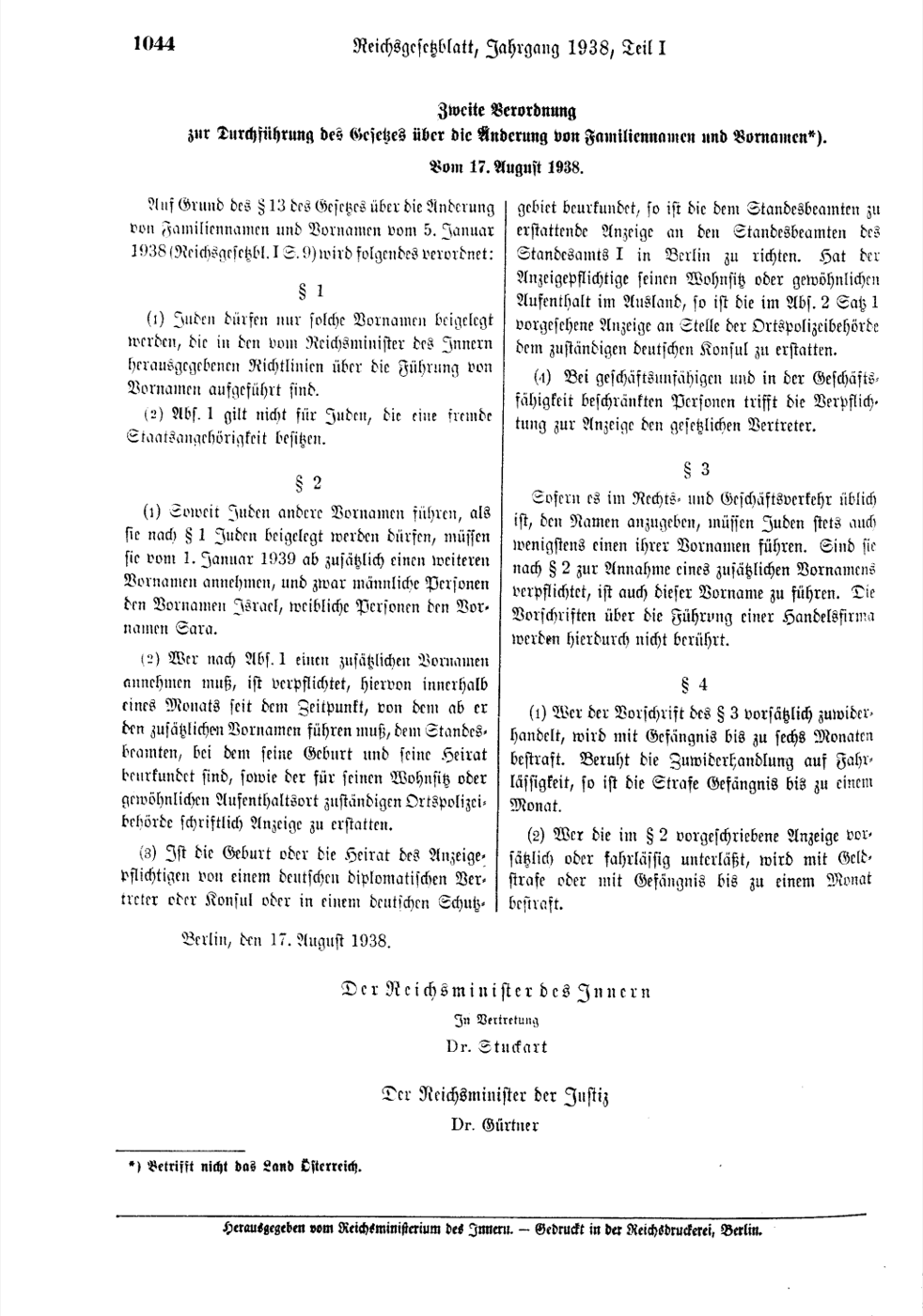
§ 2 (1) is the clause everybody knows.
„Soweit Juden andere Vornamen führen, als sie nach § 1 Juden beigelegt werden dürfen, müssen sie vom 1. Januar 1939 ab zusätzlich einen weiteren Vornamen annehmen, und zwar männliche Personen den Vornamen Israel, weibliche Personen den Vornamen Sara.“
Where Jews bear forenames other than those which may be given to Jews under § 1, they must from 1 January 1939 additionally adopt a further forename — male persons the forename Israel, female persons the forename Sara.
§ 2 (3) is the clause that answers Kurt, and this archive did not know it was there.
„Hat der Anzeigepflichtige seinen Wohnsitz oder gewöhnlichen Aufenthalt im Ausland, so ist die im Abs. 2 Satz 1 vorgesehene Anzeige an Stelle der Ortspolizeibehörde dem zuständigen deutschen Konsul zu erstatten.“
Where the person obliged to notify has his domicile or habitual residence abroad, the notification required by paragraph 2, sentence 1 is to be made to the competent German consul in place of the local police authority.
So “he had already left” was never an objection. The decree was written with emigrants in mind and says so in its own text: it names the consulate as the office you report to, and it routes births and marriages registered abroad to Standesamt I in Berlin. A man in Johannesburg in 1939 was inside its reach, and the machinery for reaching him was specified.
And § 1 (2) closes the other door. The decree does not apply to „Juden, die eine fremde Staatsangehörigkeit besitzen“ — Jews holding foreign citizenship. Kurt held none. This archive established separately, and for other reasons, that he never naturalised: he arrived in 1933, was an alien for thirty-five years and died one in 1968. The exemption that would have released him is the exact thing he did not have.
What this does and does not prove. It removes the geography as an objection and it removes the citizenship exemption. It does not establish that Kurt was classed as a Jude rather than a Mischling — that is the question below, and the decree is silent on it because it simply says Juden and leaves the definition to the Reich Citizenship Law. Nor is there a document here showing that Kurt personally notified a consul. What there is: a law that reached South Africa, a man it was not exempt from, and the name on his records.
And he is in the Arolsen Archives, which nobody expected Open
The Arolsen Archives — the international centre on Nazi persecution — were searched for the first time on 17 September 2026. Among nine Luwinski entries is one that stops you:
LUWINSKI, Kurt — 11.05.1912
DocID 11214358 · 1 Incarceration Documents / 1.2 Miscellaneous / 1.2.1 Deportations and Transports / Part 24: Folder “MFN01335” · reference 10000375 24 · five hundred documents
That is his date of birth to the day. And Kurt was not deported — he left Germany in 1933, ten years before his father’s transport, and died in Johannesburg in 1968 in a bed. So what is he doing in a folder of deportations and transports?
That guess was written this morning and it was only a guess: that he must be named inside a document about somebody else. By the afternoon it had evidence.
LEIBHOLZ, Jacob — b. 08.08.1884 — DocID 11214358
LEIBHOLZ, Auguste, née LUWWINSKY — b. 28.08.1893 — DocID 11214358
LUWINSKI, Kurt — b. 11.05.1912 — DocID 11214358
It is one document. The father who was deported, the mother who was not, and the son who had been gone ten years — all three named on a single sheet, in a folder of deportations and transports.
Neither Kurt nor his mother was deported. He was in Johannesburg from 1933 and died there in 1968; Auguste survived the war in Berlin and lived until 1975. A deportation form that records a man’s household and his next of kin is exactly the kind of paper that carries a wife and an absent son. The somebody else is his father.
What is still inference, and it has to stay labelled. The shared DocID is a hard fact from the index. What kind of document it is is not. It could be a transport list, a property declaration, a Gestapo household record, or something assembled after the war. Nobody here has read it. Three times in the last fortnight this archive has taken a good fit for a finding and had to withdraw it in public, so the distinction is being kept even where the reading now looks obvious.
The document was not opened, and the reason is a rule and not an obstacle. Arolsen requires a declaration of consent to the use of sensitive personal data before a document can be read. That is a statement a named person makes about their own conduct, and I do not make it on David’s behalf. The index needs no consent, and everything above came from it. If one file in this whole archive is ever opened, it should be this one — it is the only wartime German record known to carry Kurt’s name, and it carries his father’s and his mother’s on the same page.
And the citizenship question has the same shape Inferred
The obvious move is to search the Ausbürgerungslisten — the denaturalisations published by name in the Reichsanzeiger. It is the wrong door. Those were individual cases, about 39,000 of them across 359 lists, and they were aimed at politicians, writers and public figures. A twenty-one-year-old dress designer who left quietly in 1933 would never have appeared on one, so his absence from them means nothing.
If Kurt lost his German citizenship, he lost it on 25 November 1941, under the 11th Decree to the Reich Citizenship Law, which stripped it automatically and collectively from every German Jew living outside the Reich — between 250,000 and 280,000 people — and confiscated their property at the same stroke. No proceedings. No names published anywhere.
But the 11th Decree applied to Juden, and so did the name. A Mischling enrolled in the Jewish religious community was reclassified a Geltungsjude — counted as a Jew — and then all of it applies at once: the Israel, the 1941 statelessness, and a Jewish burial in Johannesburg thirty years later with a Hebrew name in the ordinary form.
That is the reading which makes four separate facts agree, instead of leaving three of them as anomalies. The Berlin Gemeinde membership registers would settle it, and so would the 1939 census supplementary card for Meraner Straße — which asked this family, in writing, how many Jewish grandparents each of them had.
His own papers, out of a drawer 1 October 2026
Everything above was built from register numbers, gazette notices and other people’s archives. Derrick has had Kurt’s own documents the whole time, and on 1 October 2026 he photographed them: a Berlin driving licence of 1934 with its international permit, and a German passport issued in Johannesburg in 1939. They answer one open question on this page outright and put a date on this page in doubt.
Reproduced in full below, each with a line-by-line transcription of the German and an English translation beside it.
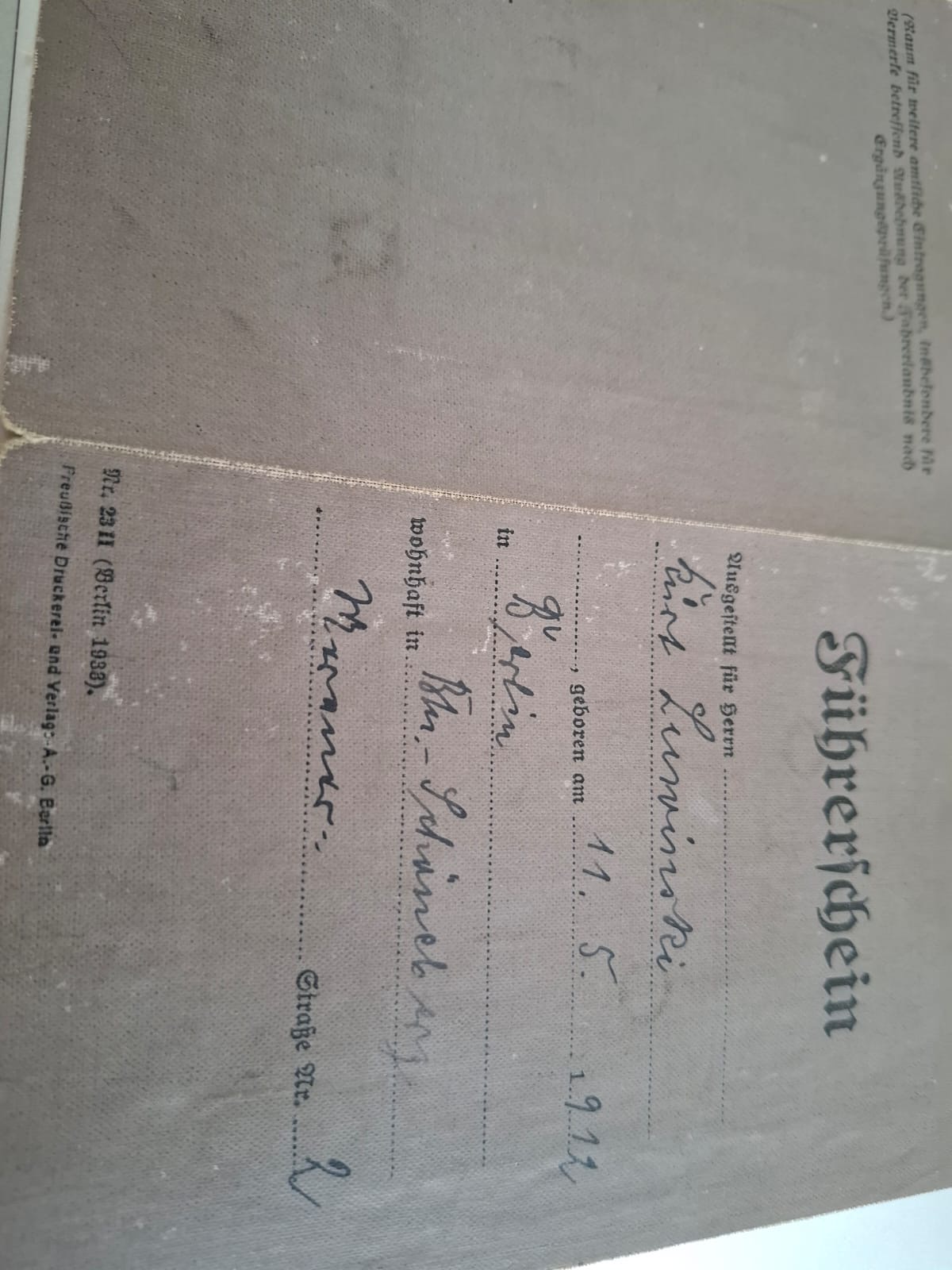
Was der Schein sagt
Ausgestellt für Herrn Kurt Luwinski
geboren am 11. 5. 1912 zu Berlin
wohnhaft in Bln.-Schöneberg, Meraner- Straße Nr. 2
Herr Luwinski ist ermächtigt, ein Kraftfahrzeug mit Antrieb durch Verbrennungsmaschinen [Elektromotoren und Dampfmaschinen gestrichen] der Klasse — 3 — zu führen.
Berlin, den 30. Januar 1934. Der Polizeipräsident [Unterschrift]
In English
Issued to Mr Kurt Luwinski
born on 11 May 1912 at Berlin
resident at Berlin-Schöneberg, Meraner Straße no. 2
Mr Luwinski is authorised to drive a motor vehicle powered by internal combustion engines [electric motors and steam engines struck out], of class — 3 —.
Berlin, 30 January 1934. The Police President [signature]
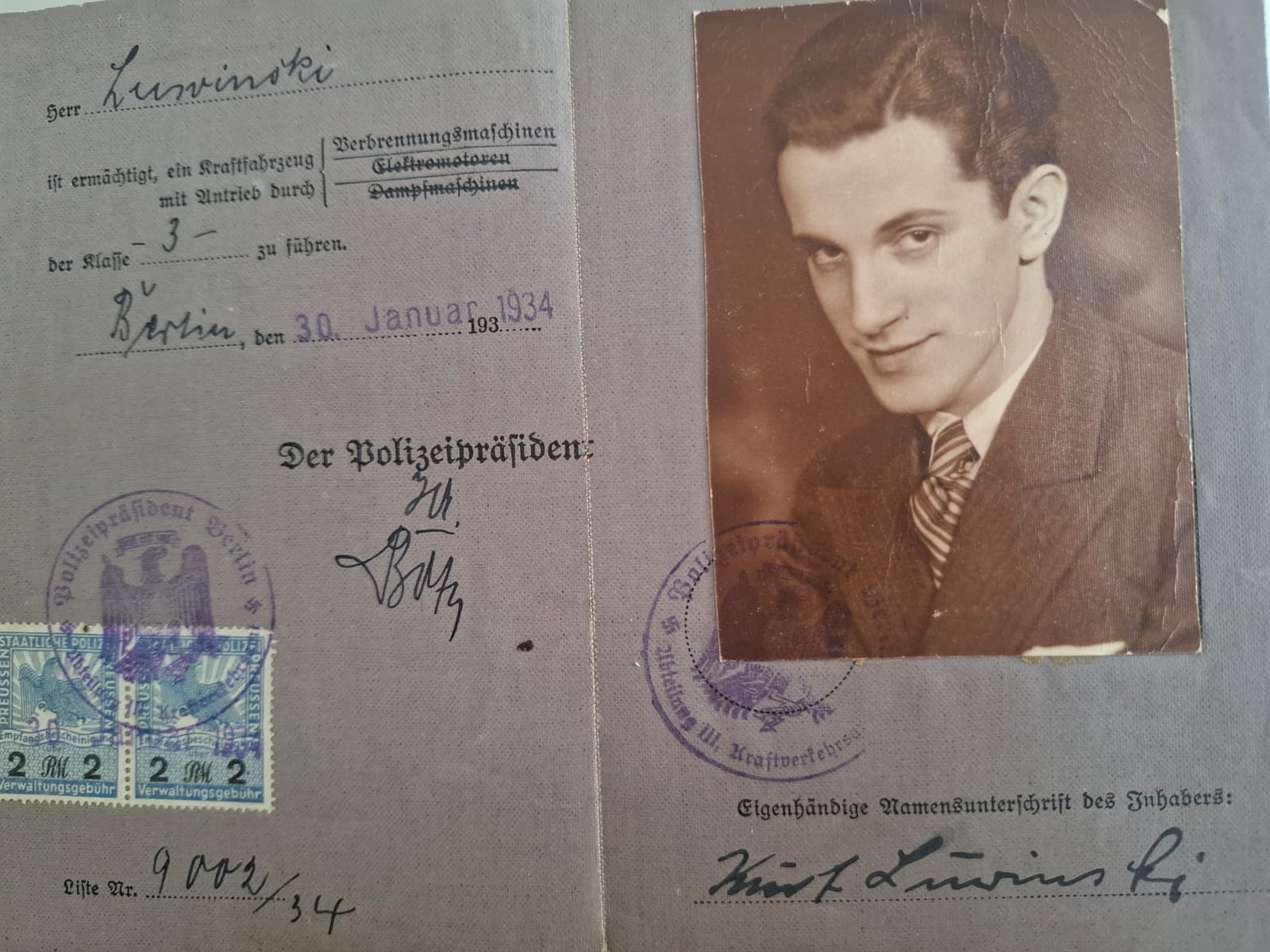
Which puts the year at the top of this page in doubt Corrected
This page is headed 1933, and says so because the tree records his emigration in a single word and a year. On 30 January 1934 he was in Berlin, living at Meraner Straße 2, applying to the Berlin police for a driving licence and paying four Reichsmarks of Prussian fee stamps for it.
Either the year in the tree is wrong, or he left and came back. The document cannot tell which, and this archive is not choosing. What it can say is that a man who had emigrated in 1933 did not take out a Berlin driving licence from a Schöneberg address in January 1934 — so the bare year is no longer safe, and every page that carried it now says so.
30 January 1934 is the first anniversary of Hitler’s appointment as Chancellor. That is recorded because it is a fact about the date. It means nothing about the man and is not offered as though it did.
And it moves the family into Meraner Straße five years early New
The census of 17 May 1939 puts Jacob, Auguste and Siegfried at Meraner Straße 2, and the 1939 Adressbuch has “Leibholz, J., Kfm.” in that house. Until today that was the earliest the archive could place them there.
The licence puts Kurt at the same address in January 1934 — so the family’s tenancy of that flat begins at least five years earlier than any document had shown, and the son was living in it at twenty-one.
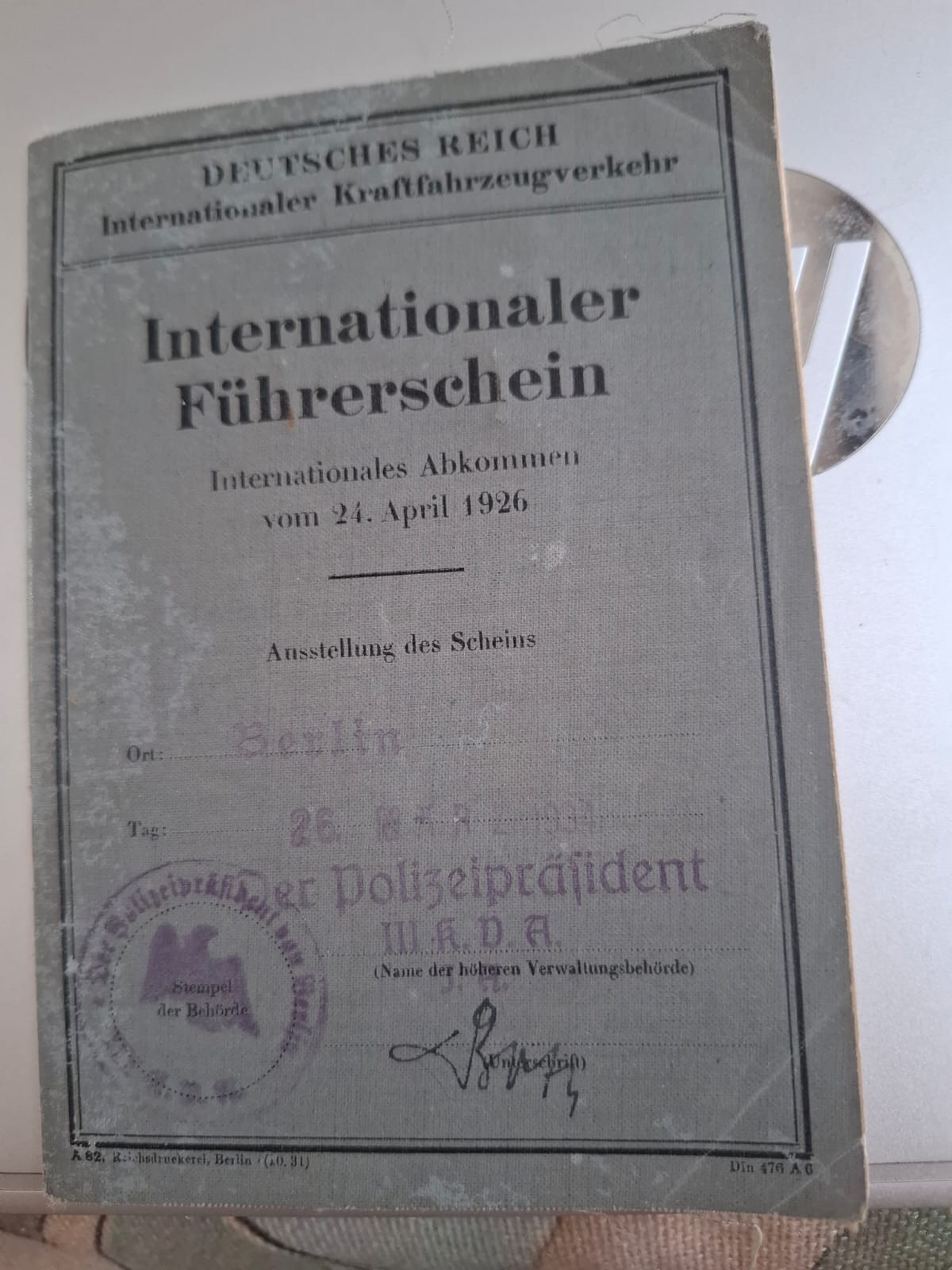
A permit for driving abroad Read with care
An Internationaler Führerschein is a document for driving outside Germany, and under the 1926 Convention it is issued against an existing domestic licence. So this one is on or after 30 January 1934. Taken with the licence weeks earlier, the pair reads as preparation.
That is a reading, not a finding. He may simply have wanted to drive on holiday. The archive writes down the sequence and does not pretend the paper states a motive.
Its identity page — Angaben über den Führer — carries his photograph and the Berlin police stamp, and all five particulars are blank, struck through with one looping stroke. The booklet was issued, stamped, photographed and left unfinished.
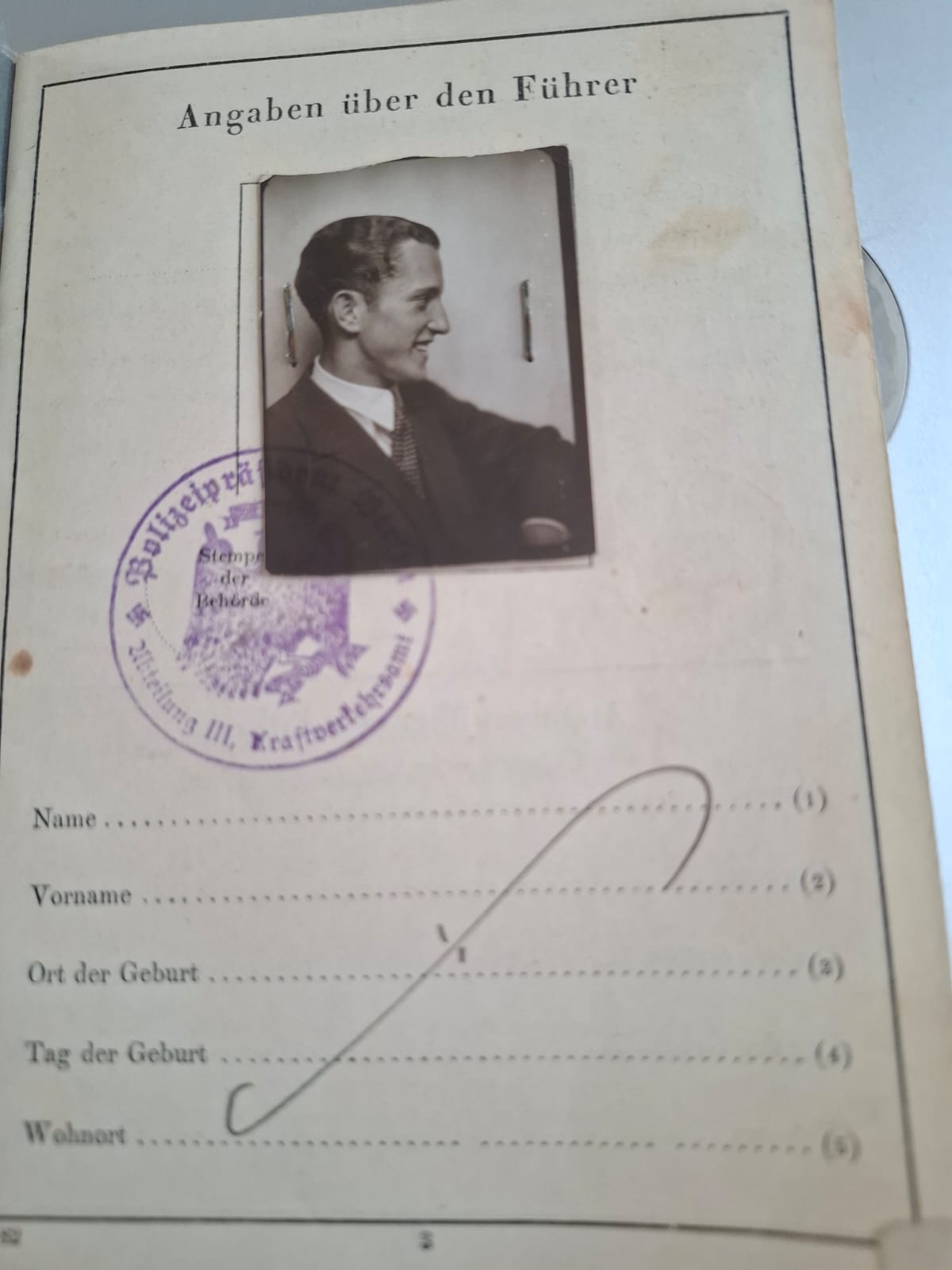
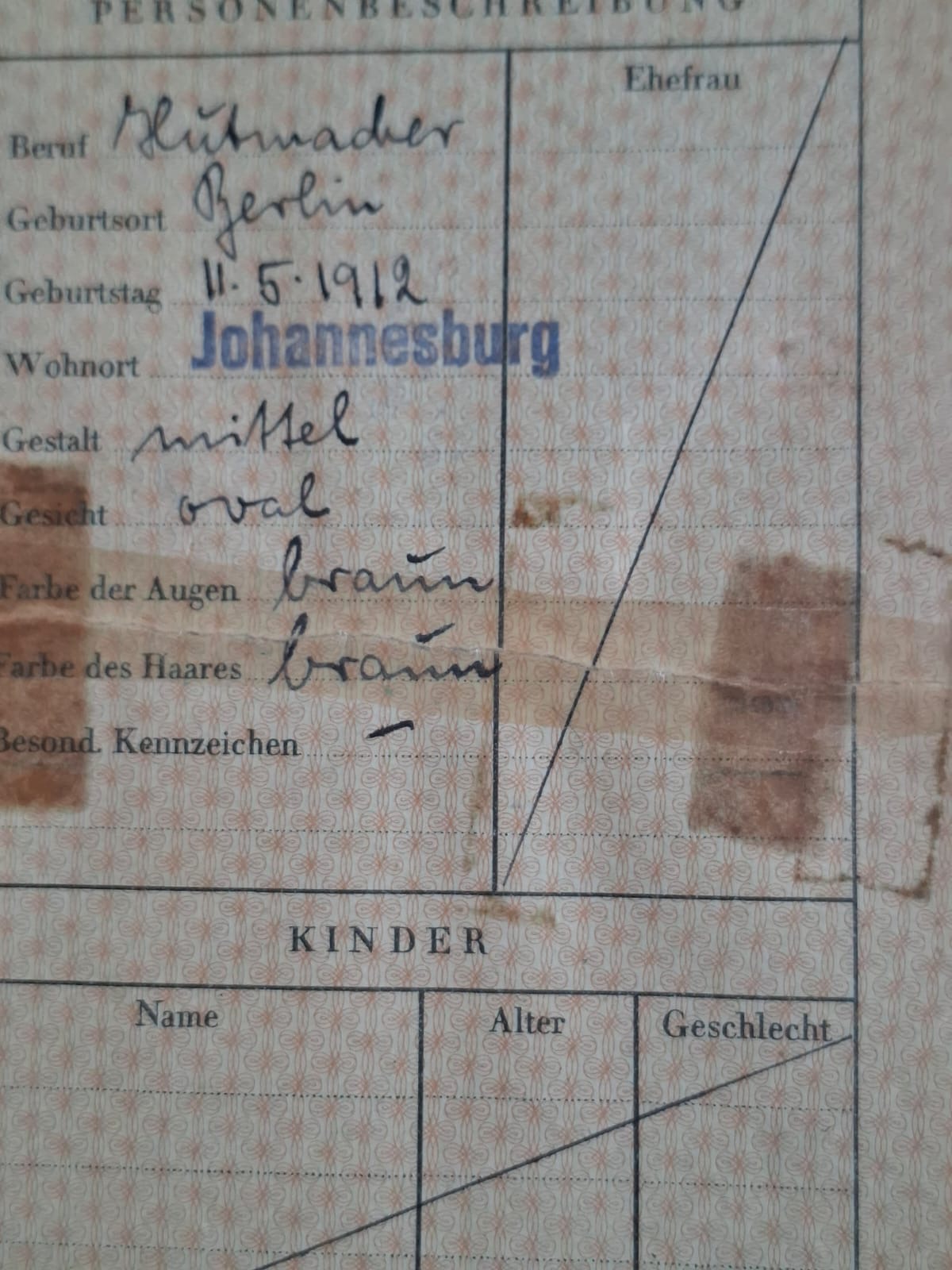
Personenbeschreibung
Beruf: Hutmacher
Geburtsort: Berlin · Geburtstag: 11.5.1912
Wohnort: Johannesburg [Stempel]
Gestalt: mittel · Gesicht: oval
Farbe der Augen: braun · Farbe des Haares: braun
Besondere Kennzeichen: —
Ehefrau: [durchgestrichen] · Kinder: [durchgestrichen]
Personal description
Occupation: hatmaker
Place of birth: Berlin · Date of birth: 11 May 1912
Place of residence: Johannesburg [rubber stamp]
Build: medium · Face: oval
Colour of eyes: brown · Colour of hair: brown
Distinguishing marks: none
Wife: [struck out] · Children: [struck out]
Hutmacher — and the hole in the trade closes New
This archive has had the shape of it for weeks and could not close it. His mother was a Schneiderin und Modistin — a dressmaker and milliner. His uncle Samuel Leibholz sold “Hüte en gros” — wholesale hats — at Kommandantenstraße 29. And Kurt bought the Piccadilly Hat Company in November 1941. But his own stated trade was “dress designer” in 1933 and again in 1956, so the hats looked like something he picked up in Johannesburg.
Here is his own word for it in 1939, two years before he bought the shop: Hutmacher. He was a hatter before he owned a hat shop.
And the struck-out columns are evidence too: no wife, no children in July 1939. The 1948 Johannesburg marriage register calls him a bachelor at thirty-six, and this agrees with it nine years earlier.
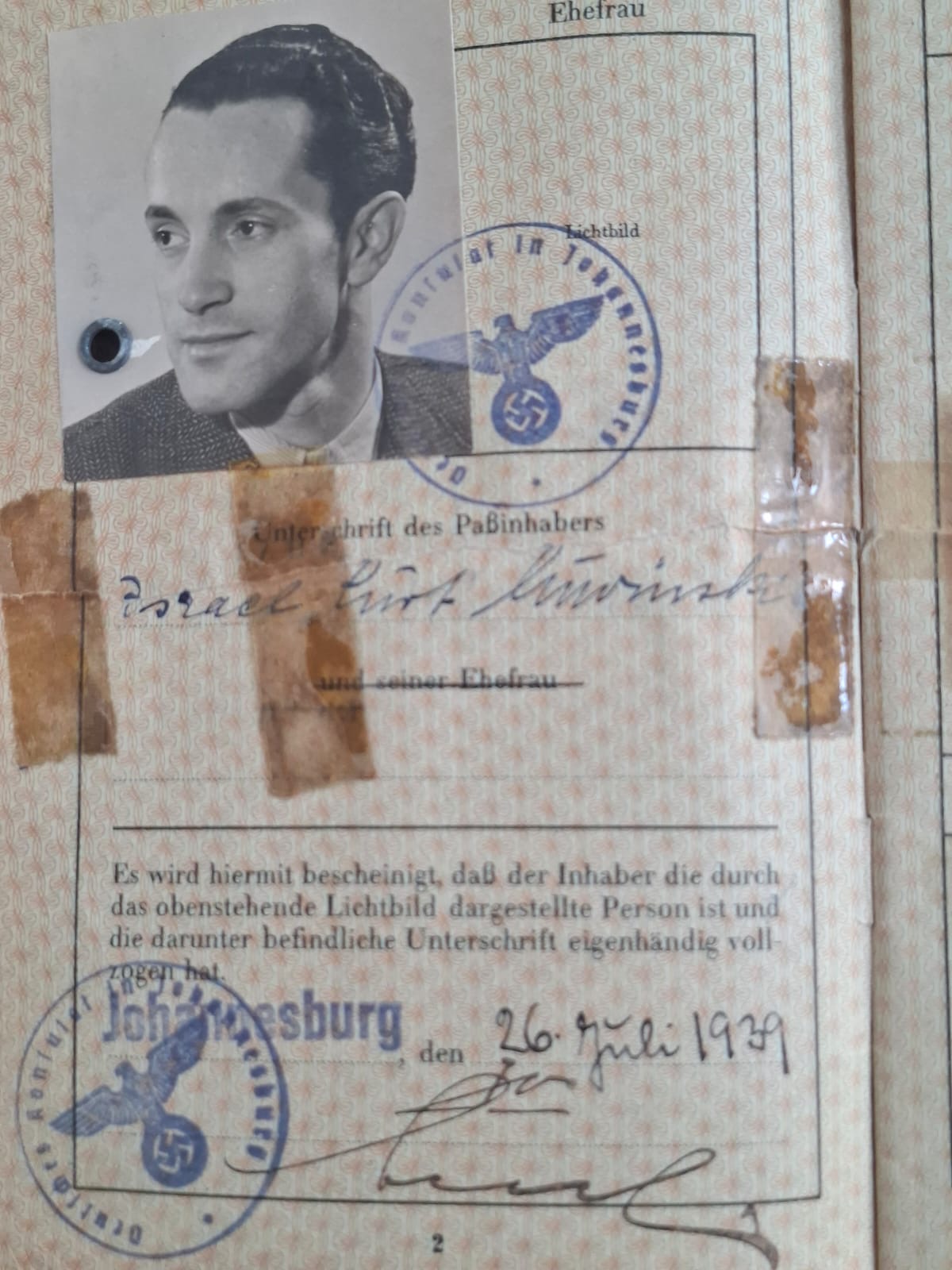
Die Unterschriftsseite
Unterschrift des Paßinhabers: Israel Kurt Luwinski
[und seiner Ehefrau — gestrichen]
„Es wird hiermit bescheinigt, daß der Inhaber die durch das obenstehende Lichtbild dargestellte Person ist und die darunter befindliche Unterschrift eigenhändig vollzogen hat.“
Johannesburg, den 26. Juli 1939
Geltungsbereich des Passes: In- und Ausland. „Der Paß wird ungültig am 25. Juli 1940, wenn er nicht verlängert wird.“ Ausstellende Behörde: Deutsches Konsulat Johannesburg.
In English
Signature of the passport holder: Israel Kurt Luwinski
[and of his wife — struck out]
“It is hereby certified that the holder is the person represented by the photograph above and has executed the signature below it in his own hand.”
Johannesburg, 26 July 1939
Scope of validity: at home and abroad. “The passport becomes invalid on 25 July 1940 if it is not extended.” Issuing authority: German Consulate Johannesburg.
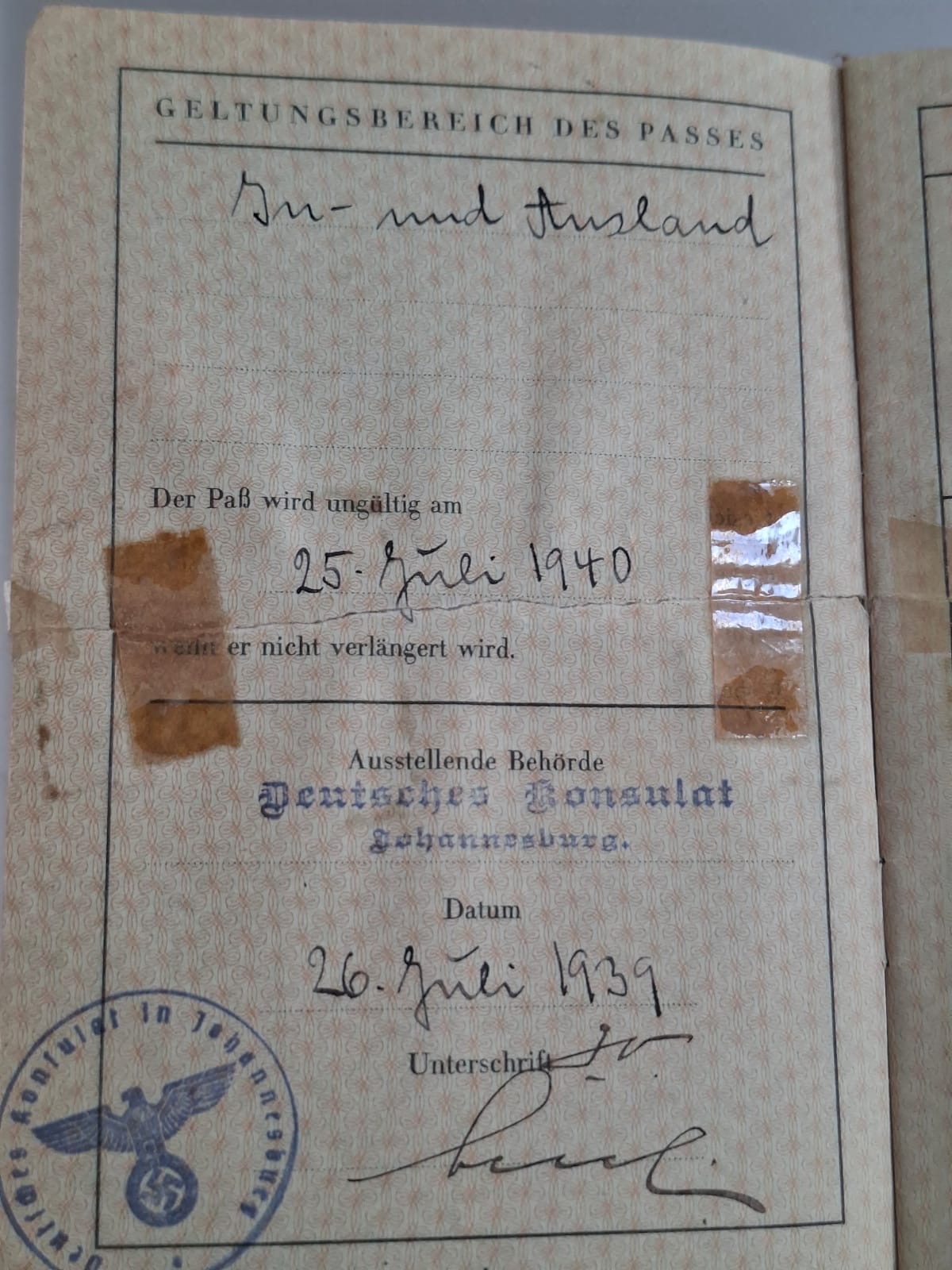
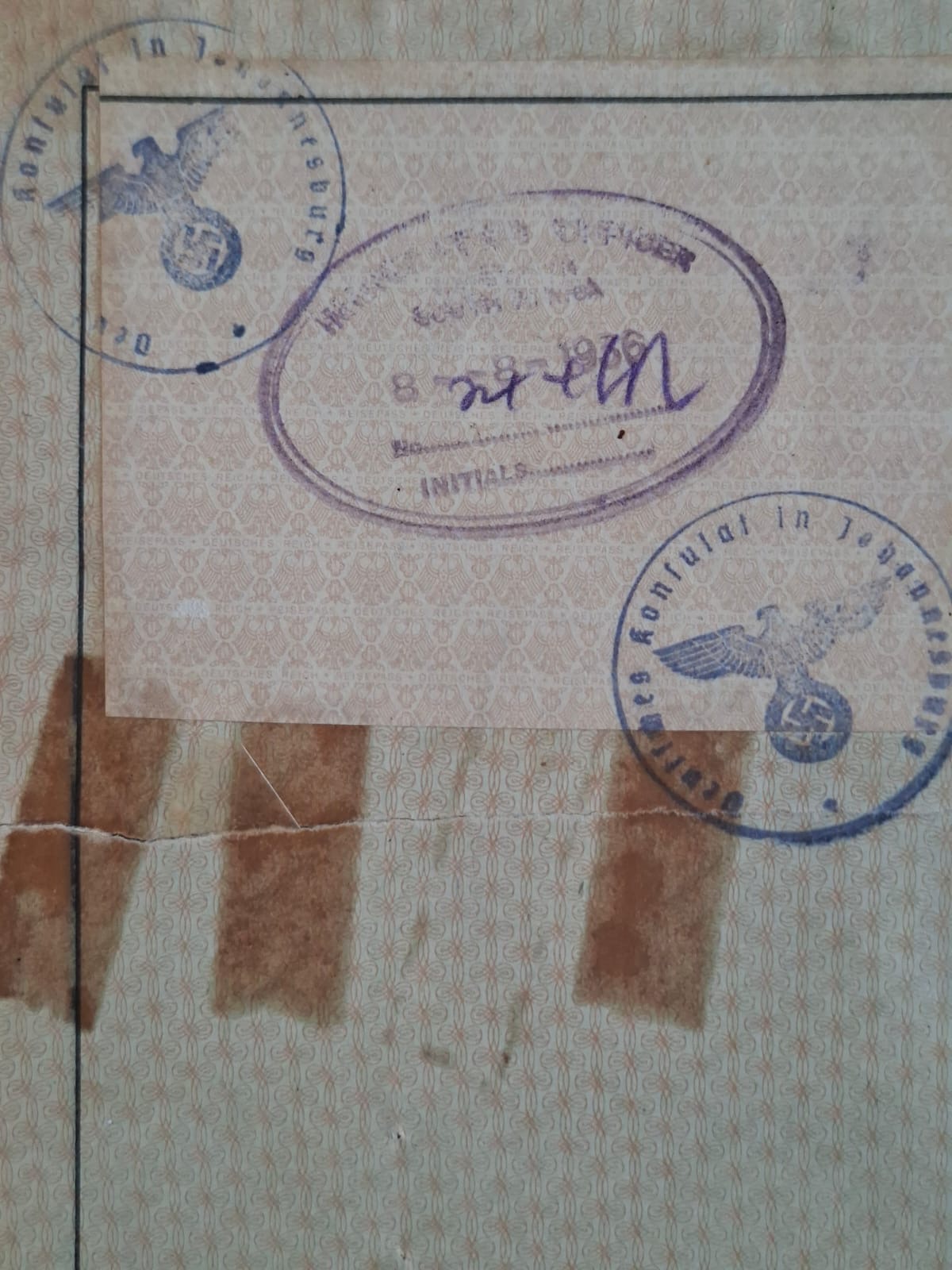
And one stamp on it has not been read Open
The page above carries a South African immigration officer’s stamp, and this archive has never written a word about it. The day and month read 8 –8–; the year is not legible in the photograph and is not guessed here.
What the document settles by itself: the book did not exist before 26 July 1939, so whatever is stamped in it is on or after that date — which makes the eighth of August 1939 the earliest reading the paper allows, thirteen days after the consulate issued it. That is arithmetic about the book, not a reading of the stamp, and the two should not be confused.
Why it matters enough to say out loud: this archive’s position is that the earliest document it holds placing Kurt in South Africa is this passport. An immigration stamp is exactly the kind of mark that could sharpen or complicate that, and it has been sitting on an unpublished page. The original is in Derrick’s keeping and a square photograph of this one page would likely settle the year.
“Israel” — he signed it himself, six thousand miles away Answered
The panel above has asked for weeks where Israel comes from, and noted that as the son of a Jewish father and a Catholic mother he would ordinarily have been Mischling ersten Grades, to whom the decree of 17 August 1938 did not apply.
A German consulate applied it to him anyway, and he signed it in his own hand. Not a family-tree embellishment; not a name he carried out of Germany, because the decree is five years later than his departure. Johannesburg, 26 July 1939.
What it does not answer is why. The document records the classification and gives no reason for it. The question is not closed — it is sharper, because it is now a question about an act by a named office on a known day, rather than about a word on a family tree.
The passport ran one year, to 25 July 1940. The war began five weeks into it. An oval Immigration Officer · South Africa stamp dated 8 [month] 1939 shows him presenting it to South African immigration within about six weeks; the month is overwritten by the officer’s initials and is not read here.
And the thing that is not a fact at all
Three photographs of Kurt. A young man of twenty-one in profile, smiling, in the international permit; the same man three-quarter face in sepia, in the licence; and a man of twenty-seven at a consular counter in 1939, the year his father had four left.
This archive has written about him for weeks out of register numbers, gazette notices and deportation lists. Derrick has had his face all along.
The Piccadilly Hat Company, 81 Eloff Street New, 14 September 2026
This archive had Kurt landing in Johannesburg in 1933 and then nothing at all until his marriage in June 1948. Fifteen years, blank. A page of the Government Gazette of the Union of South Africa closed most of them, and the source it came from closed the rest.
What the gazettes say
| Date | Gazette | Entry |
|---|---|---|
| 8 Nov 1940 | 2825, p.67 | “Notice of sale of business. The business of Piccadilly Hat …” — an earlier sale of the same shop |
| 7, 14, 21 Nov 1941 | 2960 · 2961 · 2963 | “The Piccadilly Hat Company carried on by Ivy Fuchs, at Hannah Court, 81 Eloff Street … transferred as from 1st November 1941 to Walter Oppenheimer and Kurt Luwinski” |
| 16, 23, 30 Oct 1942 | 3104 · 3106 · 3110 | “The partnership hitherto existing between Walter Oppenheimer and Kurt Luwinski, trading as Piccadilly Hat Company, at 81 Eloff Street, Johannesburg, will be dissolved as from the 31st October, 1942, and the business will be taken over with all assets and liabilities and continued under the same style and at the same address by Kurt Luwinski.” Attorney K. Steinberg, Howard House |
| 28 Apr 1939 | 2630, p.67 | Estate 1107/39, “Joseph Fuchs and surviving spouse, Ivy Fuchs” — she is executrix, of 64 Twist Street. The woman who sold them the shop was a widow, two years bereaved, and she sold it to two refugees |
| 16 May 1952 | 4846, p.93 | “Piccadilly Hat Co. … 81 Eloff Street, Johannesburg” — still trading, eleven years on |
| 10 Nov 1972 | 3701, p.126 | Sequestration, estate T1301/72: Phillip Crystal, a commercial traveller, Mark Hotel, O’Reilly Road, Berea — order 17/10/72, Witwatersrand Local — upon the application of Paula Luwinski Corrected |
| 25 Jul 1975 | 4801, p.95 | Paula Luwinski · Pallou's Dress Centre, 18 Wanderers Street, Johannesburg |
Every gazette reference above is a link to the page itself. Each was checked on 15 September 2026 and each resolves; the page number is in the anchor, so the link lands on the notice rather than on the front of a three-hundred-page issue.
So he bought a hat shop on Johannesburg's main shopping street on 1 November 1941, ran it in partnership for exactly one year to the day, took it over alone, and was still there in 1952. And it explains “Shop Keeper” — the occupation on the 1948 marriage register that sat so oddly beside dress designer in 1933 and again in 1956. It is the same man in the same trade throughout; in 1948 he simply owned the shop.
What a search snippet does to a four-column table Corrected 15 September
A snippet returns the 1972 gazette line as one string — “Paula Luwinski, a commercial traveller, Mark Hotel” — and read that way it says the opposite of what the page says. The gazette prints four columns, and the snippet flattens them: No. of estate/company · Name and description of estate/company · Date upon which and division of court by which order made · Upon the application of. The names either side of a comma belong to different columns and to different people.
So Phillip Crystal is the commercial traveller at the Mark Hotel, and he is the man being sequestrated. Paula Luwinski is the creditor who brought it. Reading the page also yields what the snippet never had: the estate number T1301/72 and the date of the order, 17 October 1972, Witwatersrand Local Division — which matches the court file this archive already held, WLD 2451/1972, Paula Luwinski v. Phillip Crystal.
The archive had these two people the right way round on one page and the wrong way round on another, because one entry was read from a document and the other from a snippet. It is the Caroline Walls mistake in a different costume.
One trade, five people, three countries Now documented at every point
| Auguste, his mother | dressmaker and milliner, East Prussia |
| Kurt | dress designer 1933 · hats, 81 Eloff Street, 1941–52 · shop keeper 1948 · dress designer 1956 |
| Ivone, second wife | dressmaker, firm — February 1948 |
| Frances, third wife | buyer, firm — 1956 |
| Pauline, his widow | sequestrating creditor 1972 · Pallou's Dress Centre, 18 Wanderers Street, 1975 |
Two occupations on a certificate would only ever have been a plausible account of how Kurt and Ivone met. This is better than plausible: a dressmaker and the man whose hat shop stood at 81 Eloff Street, in the same trade, in the same city, in the same year. He owned the shop.
His partner naturalised. He did not. Open
The Union gazette published applications for naturalisation under the Aliens Act of 1926, and Walter Oppenheimer made one in February 1942 — notice 1462, gazette 3007 of 20 February 1942, page 115. Eight months later the partnership dissolved.
Kurt appears in none of them. Searching all 54,313 South African issues returns exactly eight Luwinski documents, and not one is a naturalisation notice — under either spelling, and the optical character recognition demonstrably does find him, mangled, elsewhere.
That is a negative and it is stated as one: a name can be lost in a dense printed list, and the corpus may not hold every issue. But a naturalisation notice gives date and place of birth over an official signature, which is exactly what question 4 — where the compulsory Israel came from — has always lacked. If he never naturalised, that is itself worth knowing about a man who arrived in 1933 and died there in 1968.
And the date is hard to read without flinching
The partnership dissolved on 31 October 1942. His uncle Julius Leibke had died in the Jewish Hospital on Iranische Straße in Berlin on 12 October 1942, nineteen days earlier. His father Jacob Leibholz was deported to Auschwitz on 26 February 1943, four months later.
Kurt was taking sole ownership of a hat shop on Eloff Street in the same season his family was being destroyed in Berlin. Both facts are documented, and the archive sets them beside each other without adding anything to them.
Three wives, two divorces filed
Ivone in 1948, divorced 1951. Frances Hostowsky in 1956, action filed the same year. Pauline — recorded in the tree under the names Rappoport and Miller, born 29 September 1914, died of pancreatic cancer on 17 November 1985 — appears as his wife without a date, and outlived him by sixteen years. Both divorce actions are “illiquid case, restitution of conjugal rights”, which in South African practice of the period was the standard first step towards a decree, not a reconciliation.
The second wedding, read in full Documented
It was in the family tree the whole time, filed as a photograph and titled record-image_, attached not to Kurt but to Frances. The thumbnail is unreadable. The original scan is 3,918 × 5,245 pixels, and at that size every field on it can be read. Form B.M.D. 3 (a), entry No. 169 of 1956: the duplicate original register of Kurt's second marriage. That is the second time in this archive that a marriage register has been sitting in the tree disguised as a family snapshot.
| Register entry No. 169, 1956 | Husband | Wife |
|---|---|---|
| Names | LUWINSKI, Kurt | SEFTON; formerly Berner, born Hostovsky — Frances |
| Date and place | Twenty Ninth February 1956, Johannesburg, district Johannesburg, Transvaal | |
| Identity number | 331/398110 | — |
| Age and date of birth | 43 yrs (11:5:1912) | 41 yrs (19:1:1915) |
| Personal status | Divorcee | Widow |
| Occupation | Dress designer, private | Buyer, firm |
| Place of birth | Berlin, Germany | Vienna, Austria |
| Address at marriage | 1 Houghton Crest, Sharp Street, Bellevue, Johannesburg — both of them | |
| Licence | Special licence No. 265004, dated 29/2/56 — the day of the wedding | |
| Contract | With ante-nuptial contract | |
| Remarks | “Order filed. Affidavit filed. Birth certificates not available.” | |
| Signed by | K. Luwinski and Frances Sefton, before G. Rosenblatt and Walter Herz; marriage officer Alfred Reinach, Johannesburg | |
The word that matters is Divorcee. Until now the end of the marriage to Ivone rested on a single line in the national archives index — a 1951 illiquid case. Here a registrar records Kurt's status as divorced and notes an order filed: he had to put the decree on the table before he could be married again, and the registrar saw it. The divorce is confirmed from the other side.
And the parents' columns are ruled through. This form, unlike the 1948 one, does have a section C for the particulars of the parents of the husband and of the wife. The officer drew a diagonal line across it and left it empty. The reason is written four lines above: birth certificates not available. Neither a Berlin Jew who left in 1933 nor a Viennese woman born in 1915 could produce one, so he took an affidavit instead. The register that could have named Jacob Leibholz in Kurt's own lifetime has the column, and still says nothing. Closes a hope
Two by-products worth chasing. The identity number 331/398110 is a searchable key for estate, deeds and naturalisation files — the same Johannesburg 331 prefix carried by Nuno Lerena's number in the sibling archive. And an ante-nuptial contract executed on or just before 29 February 1956 is registered in the Johannesburg Deeds Office.
And he did it the first time too. Re-reading the June 1948 register at full resolution corrected column 10 from without to With A.N.C. Self-corrected So there are two ante-nuptial contracts in the Johannesburg Deeds Office — one from June 1948, one from February 1956. The 1948 one was drawn up in the month Derrick's parents married, the year before he was born, and unlike a marriage register it is not confined to an eleven-column form. It is the best remaining chance of a 1948 document that says something about who Ivone was.
The same action, twice Inferred
Married Ivone 19 June 1948, sued her for restitution of conjugal rights in 1951. Married Frances 29 February 1956, sued her for restitution of conjugal rights in 1956 — the same year. Frances remarried — Rolf Eisenhardt — on 23 May 1958. The same instrument, twice, against two wives, eight years apart.
Corrected 11 October 2026 (9500919). This page said 1957 in two places and the timeline said it too. The record is WLD 1878/1956, found on the NAAIRS successor: “ILLIQUID CASE. RESTITUTION OF CONJUGAL RIGHTS. KURT LUWINSKI VERSUS FRANCES (FORMERLY SEFTON, FORMERLY BERNER, BORN HOSTOWSKY).” The 1957 had nothing behind it — no file, no citation, nowhere in the data layer — and the likeliest origin is a conflation with WLD 2542/1957, Standard Bank of South Africa Ltd v K Luwinski, a different action by a different plaintiff that this archive has held since September. A year read off the nearest case in the list. The marriage lasted months, not a year and a half, and the reading that this action is the legal signature of a wife who has left is strengthened rather than weakened.
In South African practice of the period that action was the compulsory first step to a decree on the ground of desertion: you asked the court to order her to return, and when she did not, the order converted to a divorce. It is the legal signature of a wife who has left. Both of Kurt's marriages ended that way, and there was a small child in the first of them.
Frances carried five surnames in one life: Hostovsky by birth, then Berner, Sefton, Luwinski, Eisenhardt. The 1956 register gives her birthplace as Vienna; the family tree had only “Austria”. In 1956 she was a widow and a buyer for a firm — on that document she is the one of the two with an employer.
He died in 1968, not 1969 Corrected
The family tree gives 15 December 1969, and this archive repeated it. The Johannesburg Chevrah Kadisha burial register gives 15 December 1968 — and the Hebrew date settles it independently: 24 Kislev 5729 is 15 December 1968. Two datings of the same day, agreeing with each other and not with the tree.
Withdrawn 15 September 2026 And the estate notice has now been found. Government Gazette 2525 of 26 September 1969,
page 109, carries estate 7584/69, wound up from the Boedelafdeling at Sanlam Building
806, 63 Commissioner Street, Johannesburg — Sanlam Trust. It is not Kurt’s notice. The gazette was downloaded and read in full on
15 September. The word “Luwinski” does not appear in it once. What
is on that page, in a dense two-column list of estate notices, is this:
8923/69 — ROBBERTZE, Alida Christina, gebore Bezuidenhout … Die Trust Bank van Afrika Bpk., Trust- en Boedelafdeling, Sanlamgebou 806, Commissionerstraat 63, Johannesburg.
7584/69 — KOTZE, Pieter Johannes, gebore op 11 Januarie 1904, van Parklaan 8, Bethal-stasie, Bethal … Boedelafdeling, Pretoriusstraat 286, Pretoria.
Two adjacent notices, and this archive took the estate number from one and the address from the other. Neither belongs to Kurt. Sanlamgebou 806 appears exactly once in the whole issue, and it is Alida Robbertze’s.
So Kurt’s estate notice has not been found, and the archive is back where it was: the estate is known from the National Archives index, TAB MHG 7584/69, “Luwinski, Kurt”, and from nothing else. One loose end is left showing rather than tidied: the gazette prints 7584/69 against a Bethal man wound up from Pretoria, and a Transvaal estate number cannot belong to two people. Either the OCR has misread a digit on a small-print number, or one of the two references is wrong. Unresolved, and recorded as unresolved.
How it happened, because it is worth saying. The notice was matched on an estate number alone, across an OCR’d two-column page, without reading the name beside it. That is the same mistake as the Paula Luwinski line on this very page — a fragment taken for a document. Twice in one week, from the same cause: trusting a search hit instead of opening the page.
It also makes the estate file read naturally instead of oddly. MHG 7584/69 is an estate opened in 1969 on a death the previous December, which is ordinary; an estate opened in the same month would have been the strange thing.
So Kurt was 56 when he died, not 57. He lies at Westpark, block L, grave 211. Pauline was buried twenty-six years later in block V, grave 1470, still under his name. There is no family plot.
The national archives settle the end of it. His estate file — Transvaal, Master of the High Court, 7584/69, “Luwinski, Kurt” — carries the remark “surviving spouse Pauline Luwinski”. So Pauline was his widow, and the undated marriage in the family tree was his last. Documented The same index shows Frances remarrying in 1958, the year after he sued her: Rolf Eisenhardt and Frances Luwinski, formerly Sefton, formerly Berner, born Hostowski, in the Cape Town and Wynberg marriage register.
And that register was in the tree too Documented
Photo 9500005, 2,495 × 3,119, titled only image, never opened. Entry No. 183 of 1958, Wynberg, Cape: Rolf Eisenhardt and Frances Luwinski, formerly Sefton, formerly Berner, born Hostowski, married 23 May 1958. Her status: Divorcee. Column 14: “Decree of Divorce attached to D.O.M.R.”
Which closes the other end of Kurt's life the way the 1956 register closed the first. Both of his divorce actions were granted — Ivone's before February 1956, Frances's before May 1958 — and in each case the proof is a registrar on the far side of the case, looking at the decree and writing that he had seen it. The marriage to Frances lasted about two years.
It also gives Rolf Eisenhardt a life, where the family tree had only a name and no dates at all: born 11 December 1931 in Germany, a ladies' hairdresser, a bachelor of 26, living at 9 Trianon Court, Avenue Marseille, Sea Point. Frances was 43 and managing a restaurant. She had left Johannesburg for the Cape, and she married a man seventeen years younger than herself.
A Luwinski at number 32 and a Leibholz at number 31
This archive held one line about the year after Kurt was born: 1913, “LuwinSki, I., Invalide.” No street, no house, no district. It had never been opened at the page.
Chodowieckistraße, Berlin N 55 New, 20 September 2026
Berliner Adressbuch 1913, Teil III, page 139. At number 32, on the corner of Winsstraße, among a locksmith, a merchant, a butcher, a joiner, a teacher and a furrier: Luwinski, J., Invalide. And at number 31, the house next door: Leibholz, G., Kaufmann.
The initial is J, not I — the text layer read a Fraktur J as an I. In Prussian usage Invalide is a status, not a complaint: a man on a disability or veteran's pension, out of his trade. Joachim Luwinski, born at Allenstein on 21 October 1865, is recorded elsewhere as a Landwirt, and would have been forty-seven. A directory gives an initial, not a man, and nothing here proves it is him.
The volume was compiled in the autumn of 1912. Kurt was born on 11 May 1912. This is where a Luwinski household was in the year of his birth.
How the street was settled, rather than assumed Method
A running head names the first and last street on a page, not the street a given column belongs to. Reading a house number off one column and a street name off the header is precisely the two-adjacent-entries error this archive made with the 1969 estate notice, so the heading was hunted down instead: it is on the previous page — “NO. 55 · Chodowieckistr. · A.G. Berl. Mitte — L.G. I” — and the numbers run unbroken from 1 through 40 before the street ends at an arrow reading ← Greifswalder Str. → and a new heading begins, N.37 Choriner Str.
And the corner confirms it. Number 32 is marked s. a. Winsstr. 42 and number 33 s. a. Winsstr. 33 — consecutive numbers facing each other across a junction, which is what Berlin numbering does where one street meets another.
And the neighbour has a name New, 20 September 2026
The same volume's name section spells him out: “— Georg, Kaufm., NO 55, Chodowieckistr. 31 II.” A merchant, second floor, next door to the Luwinskis. This archive already holds a Georg Leibholz born at Hammerstein, who cannot be Jacob's brother and has a lane of his own. Whether he is this man is not established — though the 1913 volume lists exactly one Georg Leibholz in the whole of Berlin.
And four lines below him: “— Jaques, Kaufm., W 62, Lutherstr. 34 II.” The man Auguste married eleven years later, in the same column of the same page as the man living next door to her family — and twenty-five years earlier than any address this archive had for him. If Lutherstraße is the street later called Martin-Luther-Straße, where his son Siegfried was born in 1925, he lived on it for at least twelve years — and it is not. Checked within the hour: Martin-Luther-Straße has carried that name since 28 December 1899, and was Heinrich-Kiepert-Straße and Rostocker Straße before that. Berlin's only Lutherstraße today is in Steglitz. So in 1913 Jacob was not living in Schöneberg, and the family's arrival there is a move rather than a continuity.
And the first reason given here for that was wrong too. This page said W 62 was Berlin proper. It was not. The street section's own heading, printed page 534, reads “W. 62 Lutherstr. · A.G. Charlottb. — L.G. III. · (geh. z. Charlottenburg)” — it belonged to Charlottenburg, an independent city until 1920 just as Schöneberg was. Which is also why it is missing from the Berlin street index, whose L column runs Lustgarten, Lutherbrücke, Lütticher with nothing between: that index lists Berlin's own streets, and this was not one. The conclusion survives; the reasoning did not.
So Jacob's 1913 registry office was one of Standesamt Charlottenburg I, II or III — Charlottenburg IV does not begin until 1922, and the unnumbered office closes in 1897 — and this page said for weeks that narrowing the three needed a street directory that had never been found. It was the wrong page to look for, and the answer came on 8 October: Standesamt Charlottenburg I, Rankestraße 10. The chain is set out below. And the geography is worth stating beside Kurt's birth: Kurt was registered in May 1912 at Berlin VIII, which is Prenzlauer Berg, where the Luwinski household was. Jacob was at the far west end of the city. Two addresses about nine kilometres and two independent municipalities apart — which is not an argument against his paternity, and is not an argument for it.
And the directory prints its own eighth spelling of the surname: “Leipholz, s. a. Leibholz” — a form this archive had never searched anywhere. Run the same evening at Mapping the Lives, with LEIBHOLZ as the control on the same screen, it returns exactly one person: Elisabeth Weiler née Leipholz, born 1 January 1891 at Berlin. Not kin on any evidence held — but the generation is Jacob's, and she is in none of this archive's files under any spelling.
The eighth spelling has produced eight named people. Elisabeth Weiler got out, to Palestine. Friedrich Leipholz lived at Schwabstraße 4 in Reinickendorf from 1961 and left the telephone book after 1973–74; all twenty-one years of that borough’s death indexes, 1974 to 1994, have now been read and his death is not registered there. Marie Leipholz died in the same borough in 1988 — and the register marks her ev., Protestant, which points her toward the Masurian Leipholz family and away from this one. There are also Klara the milliner, Paul the Schlosser at the same Kreuzberg address thirty-three years earlier, and two different women called Erna. Not one is joined to Jacob by a document. The full account is on the Leibholz brothers.
And Yad Vashem settles the point outright. Its Shoah Names Database returns Willi Leipholz, born 1887 at Berlin, and Jenny Leipholz, born 1893 — both murdered, both with a Page of Testimony. The Bundesarchiv's fifty contain Leibholz, Wilhelm Willi, born 30.12.1887 in Berlin and Leibholz, Jenny, born 11.02.1893 in Loosen. The same couple, spelt with a B by a German federal archive and with a P by a Jerusalem memorial. The directory said the two names were one in 1913; this shows it on two named people, in two databases, compiled by different institutions from different sources.
Which office, settled — and it was never in a street directory 8 October 2026
The question had been stuck since 22 September because it was being asked of the wrong book. The Berlin directory gives a suburb street its COURT, not its registry office — printed page 534 reads “W. 62 Lutherstr. · A.G. Charlottb. — L.G. III. (geh. z. Charlottenburg)”, and the same page does the same thing to Präger Straße for Wilmersdorf. Charlottenburg defined its own offices by Stadtbezirk, not by street. A different page was needed, not a better search.
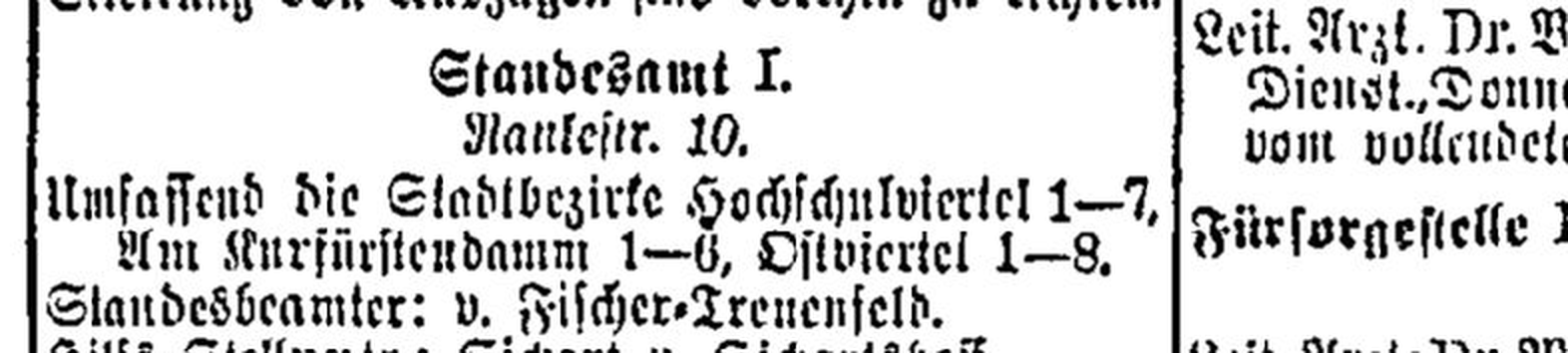

And the house cross-checks it, which is why this is two readings and not one. The street entry opens “34 s. a. Augsburger Str. 4” — number 34 is a corner building with a second address round the side, and Augsburger Str. 1–13 is also Ostviertel 2. Both faces of one building land in the same Bezirk and therefore the same office. A single street range could be a misread; two independent addresses agreeing is not.
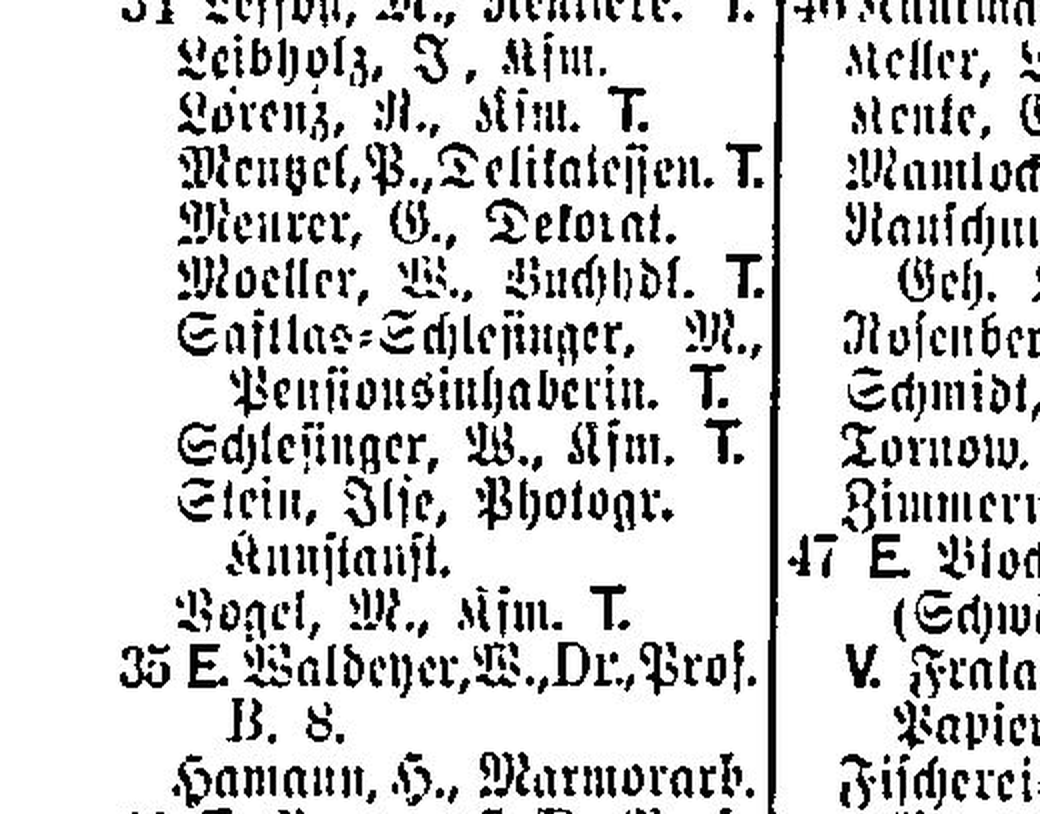
A trap this archive walked into and caught: the OCR word layer reads the house number as 31 and the Fraktur numeral on the image is unmistakably 34 — the open-topped Fraktur 4 read as a 1. Taken from the text layer it would have contradicted Teil I, which says “Leibholz, Jaques, Kaufm., W 62, Lutherstr. 34 II”, and put the whole identification in doubt.
What it buys: Charlottenburg I holds 35 free index volumes in the Landesarchiv’s online set — 15 birth, 10 marriage, 10 death — not the 114 of all three offices. Births stop at 1914 and marriages and deaths run to 1938, so a first marriage, a death in his household or an acknowledgement of paternity between 1898 and 1938 is reachable and free. Still open and not guessed at: what W 62’s Lutherstraße is called today.
Eleven years later Auguste Luwinski married Jacob Leibholz. Nothing here proves the two households are those families, and both surnames are borne by other Berliners. What it does is give that marriage a geography for the first time — and it gives Kurt's birth a district: Prenzlauer Berg, which is the thing the search below was missing.
Standesamt Berlin VIII, 1912, number 963
This morning Kurt's birth registration was a blank. By the evening it had a citation.

How the volume was chosen, which is most of the work New, 20 September 2026
The Landesarchiv's indexes are organised by registry office, and nobody knew Kurt's. That made twenty-one candidate volumes. Schöneberg was tried first, because the family is documented there from 1925, and the whole 1912 L section was read — four pages, entries 14 to 1119, Laband to Lüttke. No Luwinski.
Then the 1913 directory gave Chodowieckistraße 32. And the Berliner Adressbuch turns out to carry, in its second part, an alphabetical street index whose very first column is headed “Standesamt”. The Chodowieckistraße row: houses 1–10 → 8, 11–20 → 8, 21–22 → 10c, 23–32 → 8. Twenty-one volumes became one.
Why it is him Four things agree
The surname, which reaches only twenty-three pages in forty-four years of Berlin directories. The forename. The month — he was born on 11 May 1912. Those three agree outright. The district agrees only partly, and this page said so too confidently a few hours ago: the 1912 and 1914 volumes were opened afterwards, and Chodowieckistraße 32 turns out to be a Neubau with no tenants at all in 1912 and to have no Luwinski in 1914. The household was there for one year and moved into a brand-new building during 1912 itself, so the address shows where they were in the autumn, not in May. It does not touch the entry — the register index was opened and read — but it was the reason for opening that volume rather than a part of the proof.
And the arithmetic checks. Berlin VIII's 1912 register runs past number 2561 by the end of the year, so entry 963 is 37.6 per cent of the way through it. The eleventh of May is 36 per cent of the way through the year. An index gives a month, not a day; the proportion supplies the day's worth of confirmation the index withholds.
Every L page of the 1912 index was read, January to December. There is exactly one Luwinski in the entire year at that office. What is still not proved is that he is Kurt Israel Luwinski of Johannesburg — an index gives a surname, a forename, a month and a number. The certificate proves it, and the certificate is now orderable.
A second forename nobody has ever seen New
Kurt Myszislaus. Not the family tree, not the Arolsen index, not the Berlin registration card, not one South African document has ever carried a second forename for him. It is a German clerk's spelling of a Polish name — Mieczysław. Whether it came from a godparent, a grandfather or a saint's day is not something an index can say.
And what the certificate will contain Why it matters
The mother: Auguste Luwinski, nineteen and unmarried, with her age, her occupation and her address on 11 May 1912, which this archive has never had.
The father, or the silence where he should be. An illegitimate birth in Prussia in 1912 names the mother and leaves the father's column empty unless he acknowledged the child before the registrar. Either answer is worth having: a name would end the oldest question here, and a blank would establish that the paternity of record was attached later — and when.
The marginal notes. German birth entries accumulate Randvermerke over a lifetime: legitimation on a parent's marriage, changes of name, and after 1938 the compulsory addition of Israel. Auguste married Jacob Leibholz on 5 January 1924. If Kurt was legitimised then, the note is in that margin — and it would be the document that makes Jacob his father in law as well as in family memory.
And his mother's marriage: Schöneberg II, 1924, number 6

“Leibholz · mos. · verheiratet mit Luwinski · kath. · Nr. 6”, and on the line below the same entry under her name. The family tree gives the wedding as 5 January 1924; a register restarts at 1 each January, and the entries above this one are numbers 1, 2 and 4. The sixth marriage of the year is a marriage in the first week of it. The date and the number agree without either being derived from the other.
The clerk wrote down the Mischehe New, 20 September 2026
Beside each name he put the religion. Jacob: mos. — mosaisch, Jewish. Auguste: kath. — katholisch.
Her Catholicism had been inferred: from the Ermland, from Sauerbaum, from her mother's village, from a census card marked NNNN. Here a registrar writes it down at her own wedding, in the same line as her husband's Judaism — two words in January 1924, nine years before any of it mattered, and the whole shape of what happened to this family afterwards.
Found by elimination, and the elimination is itself a finding Method
A Berlin marriage is registered where one of the parties lives, and no address was known for either of them in January 1924. Berlin VIII was tried first, because that is where the Luwinskis were in 1913 — its whole January 1924 L block reads Lehmann 16, Liedtke 17, Langer 18, Levy 24, Lewandowski 29, Löffer 31, Langhans 33, Lange 39, Lauterbach 47, Lenz 62. Nothing. Schöneberg I next: Liefländer 4, Lehmann 11, Lucke 15, Leu 19. Nothing. Schöneberg II: number 6.
Which is a fact about the family and not just about the search. They were living in eastern Schöneberg by January 1924 — nineteen months before Siegfried was born at Martin-Luther-Straße 60, which was the earliest Schöneberg document there was.
And the certificate will name both sets of parents — Joachim Luwinski and Johanna née Thimm, Sally Leibholz and Friederike née Schmul, four names this archive believes it knows and has never seen on one document — with their ages and trades, the two witnesses, and the margin. If Kurt was legitimised by his mother's marriage at the age of twelve, the note is there, and a matching note is in the margin of his birth entry. Both are asked for in the same letter.
The rest of the indexes, and what is still unopened
The Landesarchiv Berlin publishes the Namensverzeichnisse — the alphabetical name indexes to the Berlin registry registers — as free PDFs, office by office and year by year. This archive had never opened them. Find the surname in the index, read off the entry number, and the certificate can be ordered by an exact citation instead of by a plea.
Schöneberg II, 1911 to 1913, thirty-three megabytes New, 20 September 2026
P Rep. 161 Nr. 713. Kurt was born on 11 May 1912, and this is the birth index for the district the family is documented in from 1925. Schöneberg I's birth indexes stop at 1910 and Schöneberg II begins at 1911, so inside Schöneberg there is no gap and no second candidate.
The 1912 L section of that volume has now been read, page by page, and there is no Luwinski in it. Entries 14 to 1119, four pages, every surname from Laband to Lüttke: Kurt was not registered at Schöneberg II. And the directory has since put a Luwinski household in Prenzlauer Berg, which is a different answer to the same question. But the alternative is finite: twenty more single-year 1912 birth indexes are online for the old Roman-numeral city offices, between 6 and 35 MB each. Twenty-one files, about 350 MB, all free, all listed. That is a bounded job, not a search.
And the same instrument holds the marriage. Jacob married Auguste on 5 January 1924, twelve years after Kurt was born and took his mother's name. A German marriage entry names the parents of both parties, and where a couple legitimise an existing child the entry carries a marginal note saying so. Two volumes cover the date: Schöneberg I, marriages 1922–1927, P Rep. 160 Nr. 1036; and Schöneberg II, marriages 1924–1928, P Rep. 161 Nr. 271.
And a false finding, caught before it was written down Method
This page was about to say that Schöneberg, this family's own district, has no online index at all. Three queries returned nothing and a sweep of all 142 registry offices put Schöneberg, Neukölln, Köpenick and Weißensee in the empty column.
Every office name with an umlaut returned zero, and every name without one returned
rows. Four failures, one shared property. The site's database stores the names
double-encoded — the stored string is literally Standesamt Köpenick — and the match
is on the whole string, so the correct spelling finds nothing and the mangled one finds
seventeen volumes. Schöneberg turns out to have more online than almost anywhere: births from
1874 to 1913, and deaths year by year to 1994.
What caught it was not cleverness. It was noticing that all four failures shared a character and none of the successes did. When a set of negatives has something in common, suspect the thing they have in common before believing the negatives.
The one file that would let him speak for himself
Everything on this page is someone else's paper about Kurt: a gazette notice, a burial register, a marriage entry, a court index. There is one kind of document in which he would be the one talking — a compensation file under the Bundesentschädigungsgesetz. An Entschädigungsakte holds the applicant's own sworn account of what he lost and when he left, his Berlin addresses, his trade, his schooling, what became of his parents, his foreign address at the time of filing, and usually affidavits from people who knew him. A man who left Germany in 1933 and lived thirty-six years abroad is exactly the profile of a claimant.
And they moved four and a half months ago New, 20 September 2026
This archive's own plan put these files at the Landesarchiv Berlin in B Rep. 025. They were not there. Until this year they belonged to the Entschädigungsbehörde, a department of LABO — a live administrative authority, not an archive. On 1 May 2026 the Landesarchiv Berlin took over the whole of it: about 280,000 proceedings, fifteen kilometres of paper, stem files and subsidiary files together. About 860 still-open cases stayed behind.
The stated minimum for an enquiry is a name and life dates. This archive has those for three of them — Kurt, 11 May 1912 to 15 December 1968; Auguste, 28 August 1893 to 22 June 1975; Siegfried, born 5 August 1925. The threshold is met without any further work. The letter is drafted, as a supplement to the thread already open with the Landesarchiv rather than as a second file.
Ten files a year, free — and a status this archive will not claim Stated, not assumed
The Landesarchiv's page says relatives of Nazi-persecuted people, or those they authorise, may have up to ten files a year digitised at no charge, and that the quota covers restitution and detention files too.
The letter mentions it and does not assert it. Derrick is Kurt's son on every document there is, and this archive has published at length the DNA result that puts that paternity in doubt. The German text says so plainly and leaves the decision to them. An archive that has questioned a relationship in public does not quietly rely on it in private.
And a national index that comes before Berlin New
Named on the Landesarchiv's own page: the Bundeszentralkartei, a central index of compensation claims for the whole Federal Republic, held by the Bezirksregierung Düsseldorf. It matters because § 185 BEG gave each western state its own authority, and this family scattered across three jurisdictions — Kurt to Johannesburg, his mother to Baden-Württemberg, his brother to Potsdam and the far side of the wall. A Berlin-only enquiry can come back empty while the file sits in Stuttgart. One letter to the BZK asks the prior question for all four of them: did they ever file, and where.
His brother, who stayed
Siegfried Leibholz was born at Martin-Luther-Straße 60 in Schöneberg on 5 August 1925 — the same parents, the father's surname. The residence record is the part that stops you: from January 1943 to 30 April 1945 he was at Sommerfeld in the Osthavelland, where his mother's people farmed. His father was deported from Berlin on 26 February 1943. The boy was moved out of the city in the weeks before it happened, and stayed out until the war ended.
He joined the Berlin Kreispolizei on 15 February 1947, married Edith Charlotte Zelenka, had a son Michael Kurt in 1951 — named, at least in part, for the brother in Johannesburg — and died at Potsdam on 1 February 2005. He is buried at the Südwestkirchhof, Stahnsdorf.