Ivone de Figueiredo
Lourenço Marques, 4 March 1922 — Vila Nova de Gaia, 14 March 2010
She was born in a Portuguese colonial town on the Indian Ocean, had a son at seventeen, married four men in Johannesburg between 1948 and 1953 — two of them Jewish, one of them an Afrikaner, the first a Portuguese she left behind — and was buried at the other end of the empire, in Porto.
She is filed under six spellings, and the indexes carry the worst of them 16 Sep 2026
IVONE, YVONNE, IVONNE. FIGUEIREDO, DE FIGUEIREDO, MOTA FIGUEIREDO, DE FIGUERIDO, DE FIGUEREDO, FIGARETTO. DE WITT, LUWINSKI, LUWINSKY, LUWENSKI, SALKOW. Fourteen forms of one woman’s name, each taken from a record that names her.
It is not a curiosity. The one file in which she is the plaintiff rather than the defendant — TAB WLD 2545/1950, in which she sued Kurt — is indexed as IVONE LUWENSKI, born FIGARETTO, and was invisible for months to every search run on her actual name. Neither word is a spelling anyone would choose.
Every form, with the record it comes from and whether it is a document variant or an index corruption, is set out on her names.
Her name is Mota Figueiredo — or Mata, and her own birth entry says Mata Disputed 27 September 2026
The family tree calls her Ivone / Mota “Yvonne” Figueiredo, and everyone — this archive included, until the South African national archives index was read properly — took Mota for a stray nickname sitting next to the anglicised Yvonne.
It is not a nickname. It is half her surname. The Transvaal Supreme Court, 1948:
Illiquid case divorce. Kurt Luwinsky versus Ivone (born Mota Figueiredo).
— National Archives of South Africa, Transvaal depot, Witwatersrand Local Division, WLD 1950/1948
She was born Ivone Mota Figueiredo, in all likelihood Ivone da Mota Figueiredo.
That was written before her birth registration was in the room, and it now has a rival that outranks the court index. The assento Derrick supplied on 27 September 2026 spells it MATA twice: her mother is Leonia dos Santos Mata, and averbamento 3 is a deliberate legal act rectifying her full name to Ivone Mata de Figueiredo. The 2010 death certificate spells it MOTA twice, typed, with the mother as Leónia dos Santos Mota.
Two Portuguese civil documents disagree, and this archive is not picking one quietly. What can be said: a rectification averbamento on the birth entry is the registrar of record correcting the register on purpose, and a death certificate typed sixty years later is derivative of whatever was in front of the typist. That favours Mata. It is not being adopted across the site on that reasoning alone, because the South African court index of 1948 independently reads Mota and three documents are not two. The name stays as published and is flagged as disputed until a third Portuguese record is read.
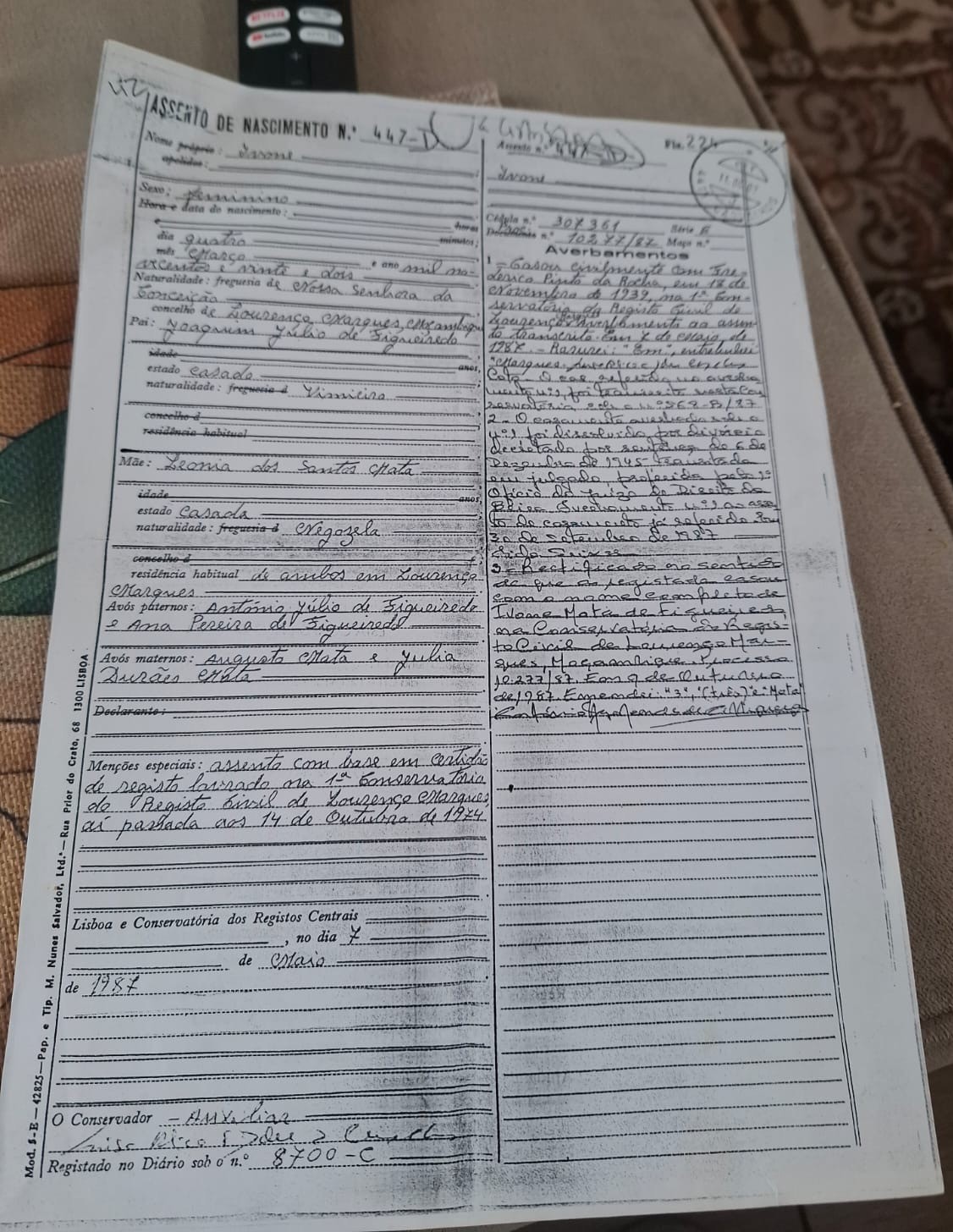
The right-hand column is where this document earns its place. Averbamento 1 records her marriage to Frederico Pinto da Rocha on 18 November 1939 at the 1.ª Conservatória of Lourenço Marques; averbamento 2 dissolves it by a divorce decreed at Beira on 6 December 1945; and averbamento 3 — the one the panel above turns on — is a rectification “no sentido de que a registada casou com o nome completo de Ivone Mata de Figueiredo”, processo 10.277/87, 9 October 1987.
What the entry says
Assento de nascimento n.º 447-D — Fls. 224
Nome próprio: Ivone
Sexo: feminino
Hora e data do nascimento: dia quatro, mês Março, ano mil novecentos e vinte e dois
Naturalidade: freguesia de Nossa Senhora da Conceição, concelho de Lourenço Marques, Moçambique
Pai: Joaquim Júlio de Figueiredo — estado: casado — naturalidade: freguesia de Vimieiro
Mãe: Leonia dos Santos Mata — estado: casada — naturalidade: freguesia de Negozela
Residência habitual de ambos em Lourenço Marques
Avós paternos: António Júlio de Figueiredo e Ana Pereira de Figueiredo
Avós maternos: Augusto Mata e Júlia Durães Mata
Menções especiais: assento com base em certidão de registo lavrado na 1.ª Conservatória do Registo Civil de Lourenço Marques, aí passada aos 14 de Outubro de 1974
Lisboa e Conservatória dos Registos Centrais, no dia 7 de Maio de 1987
Registado no Diário sob o n.º 8700-C · Cédula n.º 307361, série E · Processo n.º 10.277/87
In English
Birth entry no. 447-D — folio 224
Given name: Ivone
Sex: female
Date of birth: day four, month March, year one thousand nine hundred and twenty-two
Place of birth: parish of Nossa Senhora da Conceição, district of Lourenço Marques, Mozambique
Father: Joaquim Júlio de Figueiredo — status: married — born in the parish of Vimieiro
Mother: Leonia dos Santos Mata — status: married — born in the parish of Negozela
Both ordinarily resident at Lourenço Marques
Paternal grandparents: António Júlio de Figueiredo and Ana Pereira de Figueiredo
Maternal grandparents: Augusto Mata and Júlia Durães Mata
Special mentions: entry made from a certificate of the registration drawn up at the 1st Civil Registry Office of Lourenço Marques, issued there on 14 October 1974
Lisbon, Central Registry Office, on the 7th day of May 1987
Recorded in the Diário under no. 8700-C · Certificate no. 307361, series E · File no. 10,277/87
The three averbamentos, in the margin
1 — Casou civilmente com Frederico Pinto da Rocha, em 18 de Novembro de 1939, na 1.ª Conservatória do Registo Civil de Lourenço Marques. Averbamento ao assento transcrito em 7 de Maio de 1987. — Rasurei: “em”, entrelinhei “Marques”. […] O casamento referido no averbamento n.º 1 foi transcrito nesta Conservatória sob o n.º 268-B/87 [?]
2 — O casamento averbado sob o n.º 1 foi dissolvido por divórcio decretado por sentença de 6 de Dezembro de 1945, transitada em julgado, proferida pelo 1.º Ofício do Juízo de Direito da Beira. Averbamento n.º 2 ao assento do casamento já referido, em 30 de Setembro de 1987.
3 — Rectificação no sentido de que a registada casou com o nome completo de Ivone Mata de Figueiredo, na Conservatória do Registo Civil de Lourenço Marques, Moçambique. Processo 10.277/87. Em 9 de Outubro de 1987. Emendei: “3”, “(três)” e “Mata”.
In English
1 — Married civilly to Frederico Pinto da Rocha on 18 November 1939, at the 1st Civil Registry Office of Lourenço Marques. Endorsement to the entry transcribed on 7 May 1987. — I struck out “em” and interlined “Marques”. […] The marriage referred to in endorsement no. 1 was transcribed in this Registry under no. 268-B/87 [?]
2 — The marriage endorsed under no. 1 was dissolved by divorce, decreed by judgment of 6 December 1945, final and beyond appeal, handed down by the 1st Office of the Court of Law at Beira. Endorsement no. 2 to the marriage entry already mentioned, 30 September 1987.
3 — Rectification to the effect that the registered person married under the full name of Ivone Mata de Figueiredo, at the Civil Registry Office of Lourenço Marques, Mozambique. File 10,277/87. On 9 October 1987. I amended: “3”, “(três)” and “Mata”.
That last line is the whole Mata question in nine words. The registrar does not simply write the name — he records, over his own signature, that he amended it, and the word he lists as amended is Mata. A rectification averbamento is a registrar correcting his own register on purpose. It is the strongest thing either side of this dispute has.
Her family
Four husbands and two sons, and no parents drawn — and that is a limit of the register rather than an open question. Her parents are known: JOAQUIM JÚLIO DE FIGUEIREDO and LEÓNIA DOS SANTOS MOTA, named in her own 1922 birth registration, with all four of her grandparents besides. They cannot appear in this chart because the register is generated from the family’s own tree and has no mechanism for people found in documents afterwards. The section below has them. One son is living and appears as a name with no dates; the other died in 2022.
Which gives us her parents' surnames
Portuguese naming order puts the mother's surname before the father's. Her son's name already demonstrated the rule working in this family — Henrique Figueiredo Pinto da Rocha, his mother's name then his father's. Applied to her own:
| Surname | |
|---|---|
| Her father | a FIGUEIREDO — and the birth entry names him: Joaquim Júlio de Figueiredo |
| Her mother | a MOTA or a MATA — and the birth entry names her: Leonia dos Santos Mata |
That inference was the first thing this archive ever knew about Ivone’s parents, and it came out of an index entry eleven words long. It was right, and it has since been replaced by the document itself — her birth registration names both of them outright, and their parents after them. Now documented, 27 September 2026
The one thing the inference could not settle is the vowel. This archive reasoned to da Mota from a court index; her own birth entry says Mata and her death certificate says Mota, and the panel above sets out why neither is being adopted quietly.
The names
She appears in the record under five, which is itself the story. The constant is Figueiredo: the name she was born with, and the one the court reached for in 1951 when it had to say who she actually was.
| As written | Where |
|---|---|
| Ivone Mota Figueiredo | Her birth name in full — the Supreme Court of the Transvaal, 1948 |
| Ivone de Figueiredo | As the 1948 Johannesburg marriage register has it |
| Ivone / Mota “Yvonne” Figueiredo | As the family tree carries her — “Mota” unexplained, “Yvonne” the anglicisation Johannesburg gave her |
| Ivone de Witt | The name she married Kurt Luwinski under, in June 1948 |
| Ivone Luwinski | The name she married Morris Salkow under, in February 1953 |
| Ivone, formerly de Witt, born Figueiredo | The Supreme Court of the Transvaal, 1951 |
Her son's name gives up her father's Inferred
Her first son was Henrique Figueiredo Pinto da Rocha. Portuguese naming puts the mother's surname before the father's. So Figueiredo is hers, and Pinto da Rocha is the father's — the man the tree can only call “Unknown da Rocha”.
Which makes Pinto da Rocha, not da Rocha, the name to search on.
Lourenço Marques, 1922
Lourenço Marques — Maputo since 1976 — was the capital of Portuguese East Africa, a deep-water port built on the traffic of the Witwatersrand goldfields: the Rand's nearest sea, joined to Johannesburg by rail since 1895. A Portuguese family in Lourenço Marques in 1922 was living four hundred miles from Johannesburg on a line that ran straight there, which is the plainest available answer to how she came to be married in Germiston twenty-four years later.
Three court files, all now identified
Kurt sued her three times. The national archives index has all three, in the Transvaal depot, and they can be ordered.
| Case | Year | As the index has it |
|---|---|---|
| WLD 1950/1948 | 1948 | Divorce. Kurt Luwinsky v. Ivone (born Mota Figueiredo) |
| WLD 497/1951 | 1951 | Restitution of conjugal rights. Kurt Luwinski v. Ivone (formerly de Witt, born Figueiredo) |
| WLD 2368/1951 | 1951 | Divorce. Kurt Luwinski v. Ivone (formerly de Witt) (born Figueiredo) |
Watch what changes. In 1948 she is not “formerly de Witt” — only born Mota Figueiredo. By 1951 she is. Either the first clerk left it out, or the de Witt marriage was not being recognised in the earlier action. A divorce summons of this period normally recites both parties' full names, ages and domiciles and the date and place of the marriage, so these three files are worth ordering on their own account.
The 1951 divorce was granted Documented
The index lists the actions; it does not say how they ended. That is now settled from outside the court. When Kurt married again on 29 February 1956, the registrar entered his personal status as Divorcee and noted in the Remarks that an order had been filed — the decree he had to produce before a marriage officer would proceed. A registrar in Johannesburg saw the document that ended this marriage and wrote that he had seen it.
Which also dates the end of Ivone's second marriage to somewhere between 1951 and February 1956, and she had already remarried inside that window — Morris Isaac Salkow, 13 February 1953. See Kurt for the register entry in full.
Four marriages
| Date | Husband | Him | Where |
|---|---|---|---|
| 18 Nov 1939 | Frederico Pinto da Rocha | Lourenço Marques, 1.ª Conservatória — dissolved by divorce, sentence of 6 Dec 1945 | Son Henrique, born 11 March 1941, sixteen months after the wedding |
| 2 Feb 1948 | Johannes Antonie Oelofse de Witt | b. Dec 1923 Johannesburg; d. Sasolburg | Germiston |
| 19 Jun 1948 | Kurt Israel Luwinski | b. 1912 Berlin; d. 1968 Johannesburg | Johannesburg, cert. 858 |
| 13 Feb 1953 | Morris Isaac Salkow | b. 12 Oct 1921 Pretoria; d. 9 Nov 1991 Johannesburg, buried West Park | He sued her for divorce in the same year — WLD 2225/1953. The marriage lasted months. |
The Germiston register, read at last Documented
It was attached to the family tree as a photograph and never opened. Register no. 34 of 1948, Germiston, 2 February 1948:
| Johannes Antonie Oelofse de Witt | Yvonne Figueiredo | |
|---|---|---|
| Age | 25 | 22 |
| Born | Transvaal | Lourenço Marques |
| Personal status | Bachelor | SPINSTER |
| Occupation | Miner, underground | Dressmaker — firm |
| Residence | 77 Browning Street, Fairview | 42 Joel Road, Berea |
Married by special licence no. 156884, dated the same day, without antenuptial contract. Witnesses B. Green and E. E. Naude; marriage officer A. J. Rossouw, Magistrate's Office, Germiston. Both parties signed: J.A.O. de Witt and Y. Figueiredo — so the Y-spelling is not only what officials wrote about her, it is what she wrote herself.
Read again at full resolution. The first reading of this frame was made from the 1,195-pixel copy the website serves; the original is 4,931 × 3,929. Five cells came out differently and have been corrected here: the register number (34, not 54), the licence number, both witnesses, and the husband's address. Self-corrected The words read the same at either size — spinster, Lourenço Marques and the age of 22 all read the same at either size.
The da Rocha marriage, and what she declared at Germiston Documented
The family tree records “Marriage to: Unknown Da Rocha, before 1941”, and her own birth registration names him and dates it. Ivone married FREDERICO PINTO DA ROCHA on 18 November 1939 at the 1.ª Conservatória do Registo Civil de Lourenço Marques. The marriage was dissolved by divorce, by a sentence of 6 December 1945. Both facts are marginal notes on the assento, added in 1987.
So at Germiston in February 1948 she was not a spinster but a divorcée of two years — and the register there understates more than her status. It gives her age as 22; born on 4 March 1922 she was 25, a fortnight short of 26. A woman remarrying in another country, with a six-year-old son left behind in Mozambique, gave an office the version of herself she wanted on the page. The Portuguese state was not consulted and went on recording her as divorciado until she died.
Henrique was born on 11 March 1941, sixteen months after that wedding and four years before the divorce. He carries Pinto da Rocha because his parents were married to each other when he was born — which is a plainer reason than a father acknowledging him by surname. His father has a forename now, and it is not an inference: Frederico.
A husband at the date of birth is a legal presumption and not a certificate, and nothing here excludes another man. What it changes is the search. His birth registration at Lourenço Marques is no longer the only document likely to name his father, because the marriage entry of 18 November 1939 exists too.
And the gap is four months and seventeen days Unexplained
2 February 1948: spinster, marries de Witt.
19 June 1948: divorced, marries Kurt Luwinski.
Both are on official registers, both signed by her. A divorce granted inside four and a half months was not ordinary in South Africa in 1948, and this archive does not understand how it was done — annulment, a void marriage, or a court moving faster than courts moved. The Germiston divorce file is the next document. And the pattern then repeats at once: Kurt filed against her within weeks of their own wedding.
And what became of the first husband Documented
He has always ended mid-sentence on this page: a miner of 77 Browning Street, Fairview, who married her in February and is never heard of again. Two records found on 20 September 2026 finish him.
He remarried on 25 February 1950 — Johannes Antonie Oelofse Dewitt and Elsie Marie Geyer, in the national civil marriage index, he aged 27 and she born about 1930. And he died on 2 April 1963 at Sasolburg in the Orange Free State, aged 40, in the civil death register, which gives his birthplace as Pretoria.
That last date matters beyond him. The family tree holds this man twice — once as himself with no date of death, and once as his own son with the date — and neither record carries a citation. A government death register now says what the uncited duplicate said, which is what turns a tidy inference into a fact. The correction, and what it still does not settle →
One loose thread it pulls. Three officials wrote down his age — 25 in February 1948, 27 in February 1950, 40 in April 1963 — and the three ranges overlap at April 1922 to February 1923. The tree’s “December 1923, Johannesburg” is outside all three, and the death register says Pretoria. Declared ages are not proof of anything on their own. Three of them agreeing is worth writing down.
They were in the same trade Inferred
She was a dress maker. Kurt, on his 1933 emigration record, was a dress designer — his mother's trade — and by 1948 a shop keeper. Two people in the Johannesburg rag trade, four months apart on the same page of her life. It is the first plausible account of how they met, and it is pleasingly ordinary.
What the two registers showed about the dates Resolved
The archive previously called these dates a contradiction and guessed the February one was wrong. It was not. Both marriages are real, both registers have been read, and the four-and-a-half-month gap is exactly what it looks like. What was wrong was the assumption that no divorce could fit inside it.
And the register itself now answers it Documented
The 1948 entry has been read — it was attached to the family tree as a photograph, unopened. Column 5, Personal Status, gives Kurt as Bachelor and Ivone as DIVORCED.
She was not still married to de Witt in June 1948. That marriage had ended. So the February 1948 date is wrong, as suspected — the de Witt marriage was earlier, and she came to the second one a divorcée, under her first married name.
The Luwinski date is solid: it is on the certificate, number 858, with her age given as 24. The February date carries the same citation as the June one, which means it was never independently sourced. The likeliest reading is that the de Witt marriage was earlier and the February 1948 date belongs to something else — its dissolution, most obviously. But she was already Mrs de Witt when she married Kurt, so the de Witt marriage is real and came first. The Germiston register settles it.
The son she left, and the son she kept
Henrique was born on 11 March 1941, when she had just turned nineteen. He did not reach Johannesburg until November 1962 — twenty-one years later, and a grown man. In between, his mother had married three more times in another country and had a second son there. Henrique married Dawn Elizabeth Hendey on 18 May 1968, and died on 27 October 2022, outliving his wife by thirteen years.
Her cousins are alive, and there are dozens of them
Two of the Portuguese DNA matches were opened in full. Both resolve to common ancestors at great-grandparent depth — which is exactly where Ivone's own parents and grandparents sit. Match holders are living and are not named here; their families' surnames are, because those are the search terms.
| Match | Shared DNA | Best reading | Shared matches with Derrick |
|---|---|---|---|
| A match in Portugal, b. 1974 | 108.7 cM, 5 segments | 2nd cousin's son, 52.1% — common ancestors are great-grandparents | 36 |
| A match in Portugal, b. 1949 | 133.2 cM, 4 segments | 3rd cousin 41%; 2nd cousin 17% | 37 |
What the closer one implies Inferred
If the second-cousin's-son reading holds, then Derrick and that match's mother — born 1952, died 2018 — are second cousins, sharing one set of great-grandparents. Derrick's Portuguese great-grandparents are Ivone's grandparents. So Ivone's grandparents should sit among the forebears of that family, whose recorded surnames are Jorge, Silvestre and Conde.
The second match's line adds Gaspar and Matos, through a father born 1902 and dead in 1962.
Five surnames to take to the Portuguese registers, where before there were none.
And the clusters do not touch. Every one of the seventy-odd shared matches across both lists is Portuguese — Ferrão, Dias, Fernandes, Fogaça da Mata, Pereira, Da Costa Oliveira, Amorim Meirelles, Queirós, Dos Santos Pais, Machado, Vargas, Carneiro, Matos, Souza Pereira, Pires. Not one British name appears among them. Derrick's matches split cleanly into a maternal Portuguese side and a paternal British one, which is the paternity finding arriving from the other direction.
A small human detail, and a warning for searchers
The last marriage lasted months 16 September
This archive has carried Morris Isaac Salkow as the man in the house through Derrick’s childhood. A sweep of the National Archives index found the file that ends that reading:
TAB · WLD 2225/1953 — Illiquid case. Divorce. MORRIS ISAAC SALKOW versus IVONNE (born de Figueirido).
They married on 13 February 1953 and he sued her for divorce in the same year. The archive already knew the marriage ended — he married again in 1960 — but not that it ended almost at once. Johannesburg case numbers ran to five figures by the 1970s; 2225 of 1953 is not a December filing.
It explains the silence rather than deepening it. Nobody has been able to say where Ivone was between 1953 and her death at Porto, and that has been treated here as a failure of searching. It is more likely a fact about her life: the marriage that was supposed to settle her collapsed within the year, and after it she has no South African anchor at all. Next
In June 1948 she gave her age as 24; in February 1948 she had given it as 22. Four months apart, the two declarations differ by two years and neither is right: born on 4 March 1922 she was 25 in February and 26 in June. Her stated ages are not evidence of when she was born, only of what she was prepared to say. In February 1953 she gave it as 25. She was 28. She took three years off. Any search keyed to a 1927 or 1928 birth year is chasing her, not a different woman.
Her names accumulate rather than replace: by 1953 the register carries her as Ivone de Figueredo de Witt Luwinski, all three at once — which at least tells us the clerk had the earlier marriages in front of him.
And one name, from a passport register Candidate only
Her father must be a Figueiredo. Searched across every Portuguese archive indexed on Digitarq, exactly one Figueiredo took a passport for Lourenço Marques before she was born: Augusto Pereira de Figueiredo, 21, of Eixo in Aveiro, on 22 October 1904. It may well be nothing — Figueiredo is among the commonest names in Portugal and the index is a fraction of the whole. The case for and against him →
Where her family came from
The assento gives her father’s home parish as Vimieiro and her mother’s as Negozela. Both are freguesias of SANTA COMBA DÃO, in the district of Viseu — a town of three thousand between the rivers Dão and Mondego, halfway between Viseu and Coimbra. Vimieiro is three kilometres from it. Her parents came from one small concelho in the Beira Alta, and left it for Lourenço Marques before March 1922.
And the DNA page has been standing next to it for weeks Inferred
The DNA page records, as an explicitly loose thread, that the two Portuguese matches opened both trace to the Viseu district — “Treixedo in Santa Comba Dão, and Tondela and Castro Daire” — and judges it “worth noting; not worth believing”. Nagozela and Treixedo were merged into a single freguesia in 2013, which is to say they adjoin. Her mother came from the parish that match’s parish was merged with.
Every caution there survives: the matches are distant, one has no documented link to Ivone at all, and the closest Portuguese match still gives no place more specific than “Portugal”. What changed is the size of the coincidence, not its status. It was a district — Viseu has twenty-four municipalities and half a million people. It is now one concelho of eleven thousand and two adjoining parishes inside it, arrived at from a register that knows nothing about DNA. A coincidence that got smaller is not a relative.
Two of her people are already catalogued at the Torre do Tombo To order
Both appear in the same series: Direção-Geral da Administração Pública, Processos de Funcionários do Ultramar — personnel files of overseas civil servants.
| Who | Reference | Dates | Why it fits |
|---|---|---|---|
| Joaquim Julio de Figueiredo her father | PT/TT/DGAP-DIA/001/056204 cx 6377, proc 103541 | 1922–1954 | The file opens in the very year Ivone was born in the colony. |
| Frederico Pinto da Rocha her first husband | PT/TT/DGAP-DIA/001/059068 cx 6629, proc 106864 and PT/TT/DGAP-DIA/002/7338 | 1940–1983 1950–1984 | He married her at Lourenço Marques in November 1939 and a service file opens the following year. |
Such a file carries what the service required of a man: birth date and place, parents, marital status and dependants. Four answers in one document, and for the father it would confirm or destroy the Vimieiro reading in a line.
It also reframes her. A daughter born in the colony in 1922 to a man with an overseas service file from 1922, married at seventeen to another overseas functionary. This is a colonial civil service family — not settlers, not traders — and that is a different world from the one this archive had been imagining for her.
Neither is confirmed. Neither catalogue entry gives a parish, a birth date or a parent, and both names are ordinary Portuguese ones. The dates are the whole of the argument, and dates are the commonest coincidence there is. They are candidates to be ordered and read.
What can be reached, and what cannot Measured
The parish registers of Santa Comba Dão are not online. The Arquivo Distrital de Viseu’s holdings on Digitarq are judicial and civil-government series only; searches on Nagozela, Treixedo and Vimieiro return no parish-register fonds at all, while other districts’ come back readily. So her grandparents — António Júlio de Figueiredo and Ana Pereira de Figueiredo, Augusto Mata and Júlia Durães Mata — are out of reach from a desk. That is a finding, not a failure to look: the books exist, at Viseu and on FamilySearch microfilm.
What is online, free and indexed by individual name is the Governo Civil de Viseu’s passport applications — “Pedido de passaporte de…”, PT/ADVIS/AC/GCVIS/H-D/001 — digitised, with image counts against them. That is the emigration itself, the event that produced every Portuguese person in this archive. The Santa Comba Dão court records are there too, and a Portuguese inventário por óbito names the heirs.
And there are two Vimieiros. One in Santa Comba Dão and one in Arraiolos, district of Évora — and it is the Évora one whose parish registers are digitised, so a search on the name returns the wrong parish first every time. What settles it is the mother: Negozela exists in Santa Comba Dão and not in Évora, and couples emigrated from one concelho together. The father’s Vimieiro is a reasoned preference until his own record says so.
Porto
She died in the district of Porto — not Lourenço Marques, not Johannesburg, but the metropole, which she may never have lived in before. She died at home, at 04:30, at Rua Nova das Marinhas 82, Gulpilhares, Vila Nova de Gaia, on 14 March 2010, of cardio-respiratory failure, with dementia recorded as a contributing condition of more than a year’s standing. She was 88. The certificate gives her occupation as doméstica, and her marital status — sixty-five years after she left Mozambique — as divorciado.
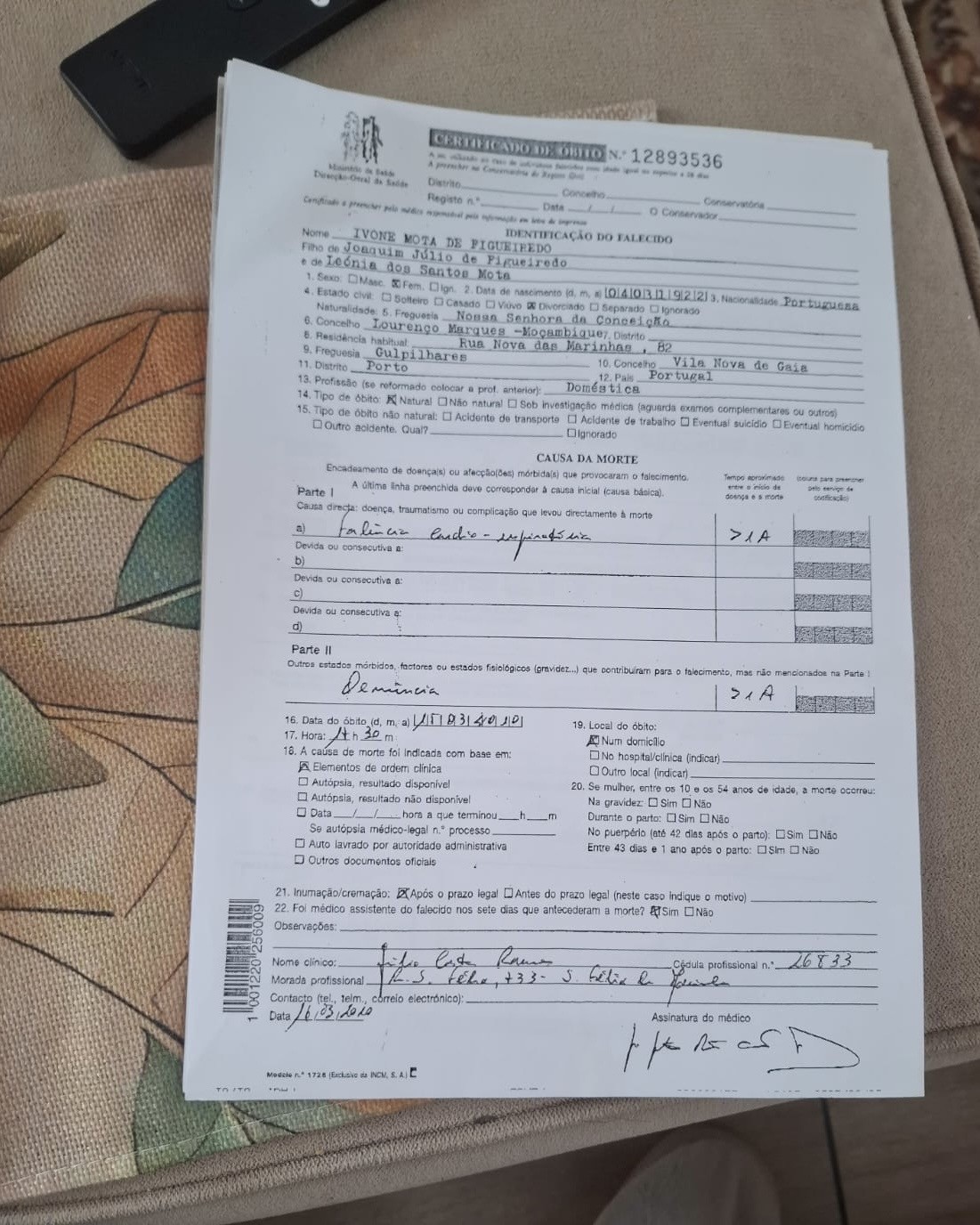
What the certificate says
Certificado de óbito n.º 12893536 — Ministério da Saúde, Direcção-Geral da Saúde
Nome: IVONE MOTA DE FIGUEIREDO
Filho de Joaquim Júlio de Figueiredo e de Leónia dos Santos Mota
Sexo: Fem. · Data de nascimento: 04|03|1922 · Nacionalidade: Portuguesa
Estado civil: Divorciado
Naturalidade: freguesia Nossa Senhora da Conceição, concelho Lourenço Marques — Moçambique
Residência habitual: Rua Nova das Marinhas, 82, freguesia Gulpilhares, concelho Vila Nova de Gaia, distrito Porto, país Portugal
Profissão: Doméstica · Tipo de óbito: Natural
Causa da morte, Parte I a): falência cardio-respiratória — tempo aproximado > 1 ano
Parte II: Demência — > 1 ano
16. Data do óbito: 14|03|2010 · 17. Hora: 4h 30m
18. A causa de morte foi indicada com base em: Elementos de ordem clínica
19. Local do óbito: Num domicílio
22. Foi médico assistente do falecido nos sete dias que antecederam a morte? Sim
Cédula profissional n.º 26833 · Data 16/03/2010 · Assinatura do médico
In English
Death certificate no. 12893536 — Ministry of Health, Directorate-General of Health
Name: IVONE MOTA DE FIGUEIREDO
Child of Joaquim Júlio de Figueiredo and Leónia dos Santos Mota
Sex: F. · Date of birth: 04|03|1922 · Nationality: Portuguese
Marital status: Divorced
Born in: parish of Nossa Senhora da Conceição, district of Lourenço Marques — Mozambique
Ordinary residence: Rua Nova das Marinhas, 82, parish of Gulpilhares, municipality of Vila Nova de Gaia, district of Porto, Portugal
Occupation: housewife · Type of death: natural
Cause of death, Part I a): cardio-respiratory failure — approximate duration > 1 year
Part II: Dementia — > 1 year
16. Date of death: 14|03|2010 · 17. Time: 4.30 a.m.
18. The cause of death was given on the basis of: clinical findings
19. Place of death: at a private residence
22. Was the certifying doctor the attending physician in the seven days before death? Yes
Medical licence no. 26833 · Dated 16/03/2010 · Doctor’s signature
And it names her parents, which was the whole object of the exercise: JOAQUIM JÚLIO DE FIGUEIREDO and LEÓNIA DOS SANTOS MOTA. Her birth registration, supplied with it, goes a generation further and names all four grandparents — António Júlio de Figueiredo and Ana Pereira de Figueiredo, Augusto Mata and Júlia Durães Mata — and gives her parents’ home parishes in mainland Portugal: Vimieiro and Negozela.
She was 88, and ten days past her birthday. The certifying physician signed two days later, on 16 March, and the papers were faxed that afternoon.
And she was not alone at the end. JACINTO DE ARAÚJO FERNANDES DE OLIVEIRA was her partner until her death — the man who, on the day the certificate was written, signed a declaration at Santa Marinha giving a travelling son lodging for his journey to Portugal.
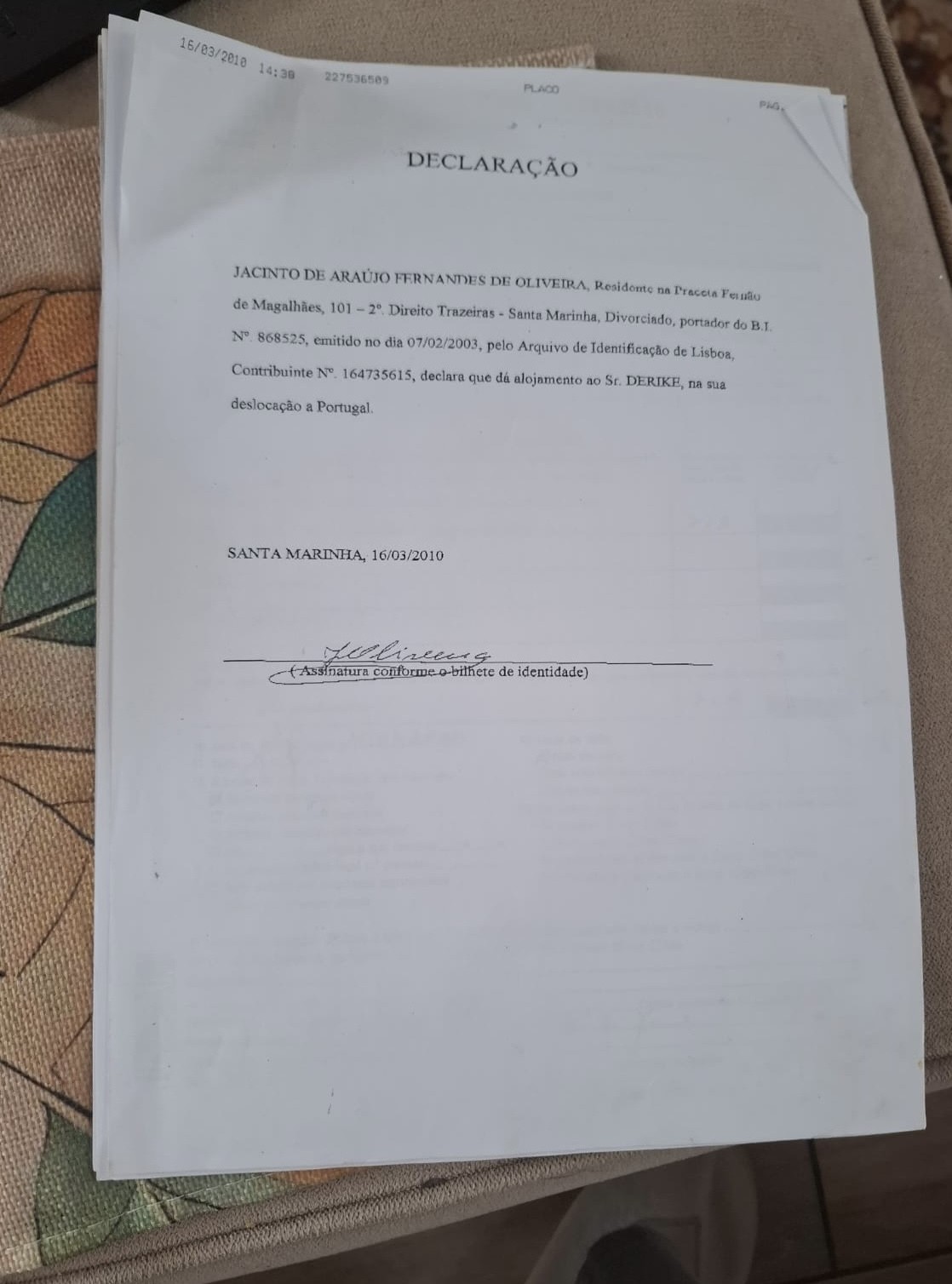
The declaration, in full
DECLARAÇÃO
JACINTO DE ARAÚJO FERNANDES DE OLIVEIRA, Residente na Praceta Fernão de Magalhães, 101 — 2.º Direito Trazeiras — Santa Marinha, Divorciado, portador do B.I. N.º 868525, emitido no dia 07/02/2003, pelo Arquivo de Identificação de Lisboa, Contribuinte N.º 164735615, declara que dá alojamento ao Sr. DERIKE, na sua deslocação a Portugal.
SANTA MARINHA, 16/03/2010
(Assinatura conforme o bilhete de identidade)
In English
DECLARATION
JACINTO DE ARAÚJO FERNANDES DE OLIVEIRA, resident at Praceta Fernão de Magalhães, 101 — second floor right, rear — Santa Marinha, divorced, holder of identity card no. 868525, issued on 07/02/2003 by the Identification Archive of Lisbon, taxpayer no. 164735615, declares that he is providing lodging to Mr DERIKE on his journey to Portugal.
SANTA MARINHA, 16/03/2010
(Signature as on the identity card)
The son was Derrick. The declaration names “o Sr. DERIKE”, which is how a Portuguese hand writes Derrick down from speech, and the family confirms he was there. He came for his mother and stayed with her partner, and it is through him that these papers survive.
This archive had nothing between South Africa in the 1950s and a grave at Porto. It now has a person. She married four times between 1939 and 1953 and the Portuguese state recorded her to the end as divorciado, so this last attachment was not a marriage; his own declaration gives his status as divorced too. He lived at Praceta Fernão de Magalhães 101, Santa Marinha — about three kilometres from the house at Gulpilhares where she died, both parishes of Vila Nova de Gaia. Whether they kept separate homes or the declaration simply cites his registered address is not something that document decides.
He is also dead, which is the loss in it. A partner is the person who would have known where she lived across the fifty-seven years this archive cannot account for, whether she ever saw Henrique again, and what became of her papers. Whether Jacinto had children or siblings is now a question worth asking, because they would have known her too.
Her line is the one part of this family the DNA confirms outright Documented
Three of Derrick's ten closest matches are in Portugal, sharing 133, 111 and 109 centimorgans, all three flagged by the testing service as having Portugal in common with him. Against 60.6% Portuguese in the ethnicity estimate. Whatever else is in doubt — and a great deal is — Ivone is not.
Why she is not simply looked up Tested
A search of MyHeritage's birth, marriage and death collections for Ivone Figueiredo returns nine results: eight Brazilian, one Floridian. Portuguese and Portuguese-colonial civil registration is not in these indexes at all. Her records exist — in Porto, in Maputo, in Lisbon — and none of them can be reached from a desk. This is not a search done badly; it is a search that cannot succeed, and knowing which is worth something.
A coincidence in the same index, logged and not believed
Two Johannesburg files: WLD 1467/1971, a divorce — Margaret Figueiredo (born Harrison) v. Estácio Figueiredo — and WLD 506/1970, an ex parte application by the same woman.
Derrick's single closest DNA match, at 333.9 cM, is a Harrison in the United Kingdom, on the paternal side.
Be careful with this. A woman marrying into a Figueiredo family is no blood relation of Ivone's, so this is not a link between the two surnames in any genetic sense. What it is: evidence that an English Harrison family was in Johannesburg in exactly these years, in the same Portuguese-Johannesburg world Ivone lived in — and Derrick's paternal cluster is English with a South African connection. Harrison is also a very common name. Speculation, recorded so it is not lost
Still to find
The Portuguese DNA matches from the surname sweep.Withdrawn the same evening. The 27 Figueiredo and 13 Mota hits are surname-string coincidences: MyHeritage was pairing Ivone with a woman born before 1713, and on the Mota side it states outright that no ancestral surname is shared. The real Portuguese matches are the ones already in the table above. Why it was withdrawn →Her death and burial record at Porto, which will name her parents outright.FOUND — supplied by the family, 27 September 2026. Certificado de óbito n.º 12893536: died at home at Gulpilhares, Vila Nova de Gaia, in March 2010, and it names both parents. The assento de óbito at Vila Nova de Gaia would still fix the exact day.The certificate images, because South African certificates name both parties' fathers.They do not. The 1948 register has now been read and the form has no parents column at all — eleven columns, none of them a father. Ivone's parents are in the Portuguese records or nowhere.The 43 Figueiredo documents in the South African national archives index— read, 14 September 2026, and they gave up her name. Of the rest, 31 are Transvaal court and estate files of other Johannesburg Portuguese families, and one Cape Town entry is early enough to be worth a look: KAB PIO 4752A, “Immigration papers. Mrs. L.A. Figueiredo”, 1950.- The three Luwinski divorce files in the Transvaal depot, listed above.
Her birth registration at Lourenço Marques.A transcription is in hand — assento n.º 447-D, Conservatória dos Registos Centrais, Lisboa, 7 May 1987, itself taken from a certidão issued at Lourenço Marques on 14 October 1974. It carries the parents, all four grandparents and the marriage and divorce. THE 1922 ORIGINAL IS STILL WORTH HAVING, because a transcription of a transcription is where Mata and Mota could have parted. The Arquivo Histórico de Moçambique holds the registers for 1865–1934 and issues certificates on request — the survey of where everything is kept →The Germiston marriage register, February 1948— found and read, and re-read at full resolution on 14 September 2026. It is the panel above.The original image of Johannesburg certificate 858— found and read. It was in the family tree, filed as a photograph. It has no parents column either.- The 1948 ante-nuptial contract, Johannesburg Deeds Office. New lead, 14 September 2026: re-reading the June 1948 register at full resolution corrected column 10 from without to With A.N.C. A contract was therefore executed in June 1948 and registered. It is not confined to the register's eleven columns, and it is the best remaining chance of a 1948 document that describes her.
The Pinto da Rocha family of Lourenço Marques — Henrique's father.NAMED: FREDERICO PINTO DA ROCHA, who married Ivone at the 1.ª Conservatória, Lourenço Marques, on 18 November 1939 and was divorced from her by a sentence of 6 December 1945 — so Henrique was born within the marriage. The marriage entry itself is now the document to order, and it will name Frederico's own parents. Henrique's own deceased estate was gazetted three times in 2023 — estate 12294/2023, “DA ROCHA, HENRIQUE FIGUEIREDO PINTO”, opened on his death of 27 October 2022. A South African estate file contains the Death Notice, form J294, which asks outright for the full names of the father and the maiden name of the mother. It has not been ordered yet. Located, not ordered- Her immigration to South Africa: when, and with whom.